
Boots Sale Australia: The Ultimate Shopper's Guide

The popular advice is simple: wait for the biggest discount and buy before the timer runs out. That's poor guidance for Australian boot shoppers. A dramatic markdown can still become an expensive mistake if the fit is wrong, return postage comes out of your refund, or the advertised RRP was inflated before the sale began.
A smarter approach treats every boots sale in Australia as a total-cost decision. Check the original price, the materials, the fit information, delivery and return conditions, and whether you'd still want the pair without the countdown clock. A smaller discount on a comfortable, versatile boot can beat a spectacular reduction on a pair that spends more time in the returns queue than on your feet.
Table of Contents
- Why Most Boots Sale Guides Get It Wrong
- The Australian Boot Market by the Numbers
- When to Shop for the Best Boot Deals
- Where to Find Genuine Boots Discounts Across Australia
- Tactics That Separate Smart Shoppers from Casual Browsers
- Sizing and Returns Risks That Can Kill Your Bargain
- Are Boot Discounts Actually Getting Better or Just Harder to Judge
- Your Action Plan for the Next Boots Sale
Why Most Boots Sale Guides Get It Wrong
Most sale roundups are retailer directories with percentage-off badges attached. They tell you where to click, but not whether the purchase makes financial sense. A discount percentage is only the opening question, not the answer.
Consider a heritage boot advertised at 60% off an RRP of $400. The calculation looks attractive, but the apparent saving doesn't account for return postage, an exchange caused by inconsistent sizing, or the possibility that the advertised RRP was raised before the markdown. If the boot arrives too small and your preferred replacement size sells out during the exchange, the bargain has also cost you time and flexibility.
A 30% reduction on an everyday pair may be better value if the shape suits your foot, the size chart is clear, and the retailer offers a straightforward return process. That's the difference between sticker-price thinking and total-cost thinking.
The price you should actually compare
Start with the current selling price, then ask:
- Price history: Has the product appeared at the stated RRP, or is the sale anchored to a price shoppers rarely paid?
- Wear potential: Will the boots work with the clothes you already own, across more than one season?
- Fit risk: Does the brand explain the last, width, shaft measurements, and whether the style runs large or small?
- Exit cost: Who pays for return postage, and are exchanges handled differently from refunds?
- Stock reality: Is the discount attached to a full size run, or only to difficult-to-sell sizes?
Retailers also use urgency language, limited-stock messaging, and event names to make separate promotions feel like one unmissable moment. That pressure can push shoppers into buying a colour or silhouette they wouldn't choose at full attention.
Practical rule: Judge the boot you'll own, not the percentage printed above it.
For a useful contrast between excitement-led shopping and considered additions, see shoes worth adding to your cart. The same principle applies to boots: a genuine bargain reduces the cost of a good purchase, rather than making a questionable purchase look irresistible.
The Australian Boot Market by the Numbers
Australia's boot market is large, competitive, and heavily shaped by stock turnover. It generated USD 1,087.1 million in 2022 and is forecast to reach USD 1,819.4 million by 2030, implying a 6.6% CAGR from 2023 to 2030, according to Grand View Research's Australian boot market outlook. Those figures describe market scale, not automatic value for shoppers. A large market gives retailers more stock to discount, but it also gives them room to frame ordinary pricing as a special event.
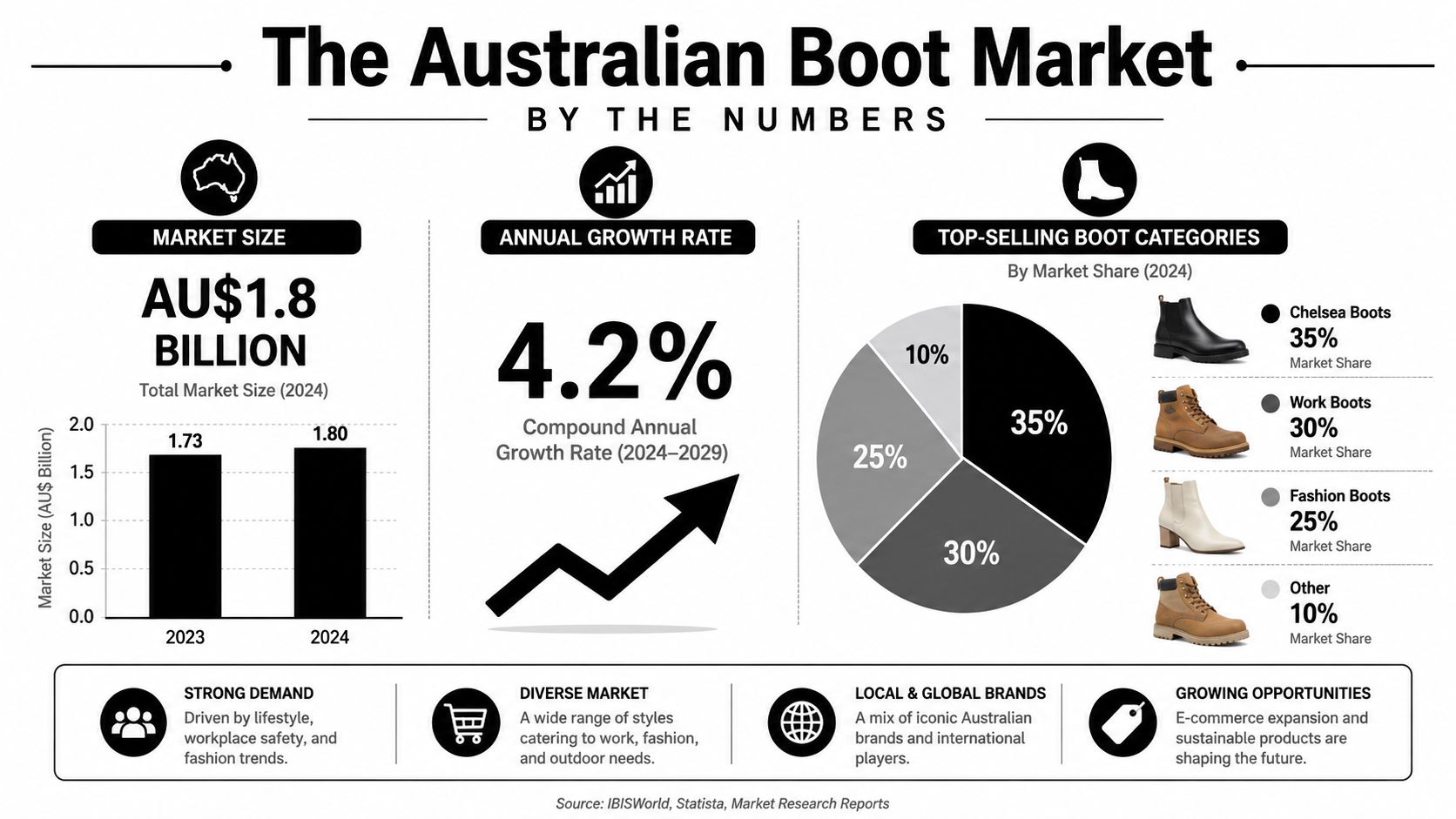
Regular boots were the largest type in 2022, accounting for 21.18% of revenue, while military boots were the fastest-growing segment. For sale shoppers, that mix matters because mainstream styles usually have more inventory. More inventory can mean better clearance access when colours, sizes, or seasonal demand shift. It does not prove that a percentage discount is genuine, so compare the selling price with the product's earlier pricing rather than trusting the RRP alone.
Australia represented 3.4% of the global boot market in 2022. Local shoppers can therefore access international styles, but they still carry the practical costs of Australian delivery, return postage, and retailer-specific stock. A niche boot may be difficult to replace after an exchange if the remaining sale stock is thin.
Broader footwear figures add context. Australian retail footwear volumes reached 126 million units in 2025, up 2% from 2024, while total value sales rose 3% to AUD 6.2 billion, as reported in Euromonitor's Australia footwear market data. Women's footwear was the largest overall category, so seasonal buying across women's, men's, and children's lines affects which boots reach clearance first.
Online comparison is now part of the same buying decision. Australian footwear e-commerce revenue was estimated at US$2,856 million in 2025, with online sales growing 5–10% year on year. That convenience can hide sizing friction and cart abandonment: shoppers hesitate when fit notes are weak, return postage is unclear, or the apparent saving depends on inflated pricing.
For outfit planning, the 132 Fashion Calista lightweight Stripe Knit (Sage/Latte) is a lightweight wool-blend knit with a relaxed fit, neutral sage and latte stripes, and a shape designed to work with denim, fitted pants, flats, or ankle boots.
When to Shop for the Best Boot Deals
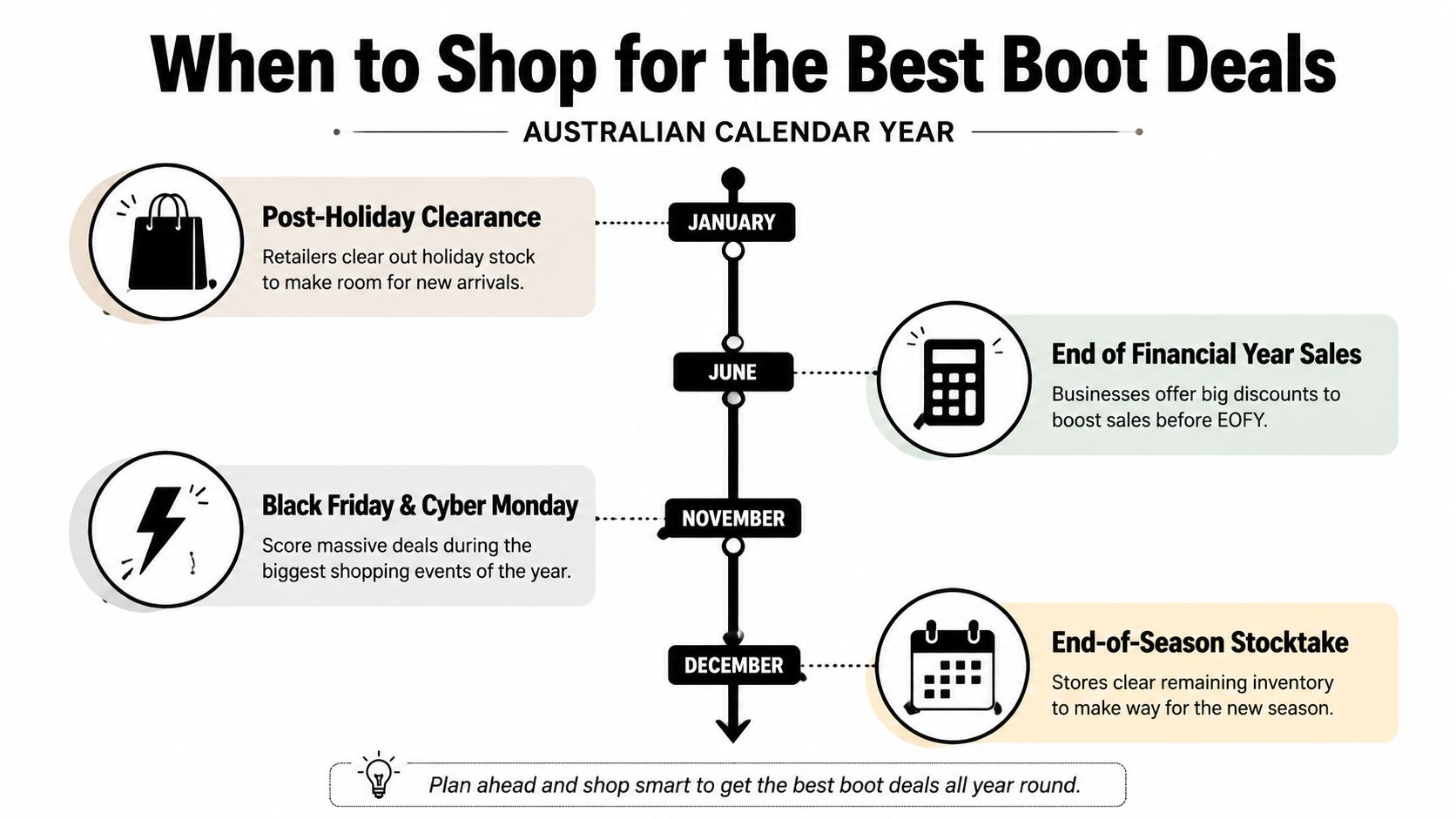
Australian boot sales follow a recognisable rhythm, but each shopping window rewards a different priority. The deepest markdowns usually come with narrower choice, while the widest selection often appears before retailers become desperate to clear remaining stock.
Match the sale window to your goal
January post-holiday clearance can suit shoppers who aren't fixed on a particular colour or size. Retailers are clearing seasonal stock, so inspect the size run and return policy before getting distracted by a large badge.
February end-of-season clearance is useful for warm-weather remnants and fashion styles that retailers want out before the next cycle. This is a strong period for price-focused shoppers, but not for anyone who needs a specific pair immediately.
June End of Financial Year sales often bring broad promotional activity. You'll see full-price and reduced stock together, so filter by size, category, and final price rather than assuming the sale page contains only clearance products.
August end-of-season sales can create opportunities in winter-oriented boots as retailers prepare for warmer-weather ranges. The trade-off is that popular sizes may already have disappeared.
November Black Friday and Cyber Monday promotions can combine brand events, outlet reductions, and sitewide codes. Compare the final checkout price, because a code may exclude sale items or apply only to selected styles. Sale guidance from HOKA's Black Friday information also reinforces the need to check event details rather than rely on the event name alone.
December stocktake and mid-season flash sales deserve attention because they're easy to miss. Retailers may announce them through email or short-lived digital campaigns, and the best approach is to monitor brands before you need the boots.
A practical sale-calendar habit
Keep a shortlist with the exact boot name, your size, acceptable colours, and maximum delivered price. Check the product page during major windows, but don't assume waiting always improves the deal. A later markdown can reduce the price while removing your size, preferred colour, or right to return.
For a seasonal promotion worth monitoring, see the Boxing Day sales guide. Treat every event as a comparison opportunity, not a reason to purchase on autopilot.
Where to Find Genuine Boots Discounts Across Australia
The best channel depends on whether you value selection, price, speed, or a forgiving returns process. No single source consistently wins on all four.
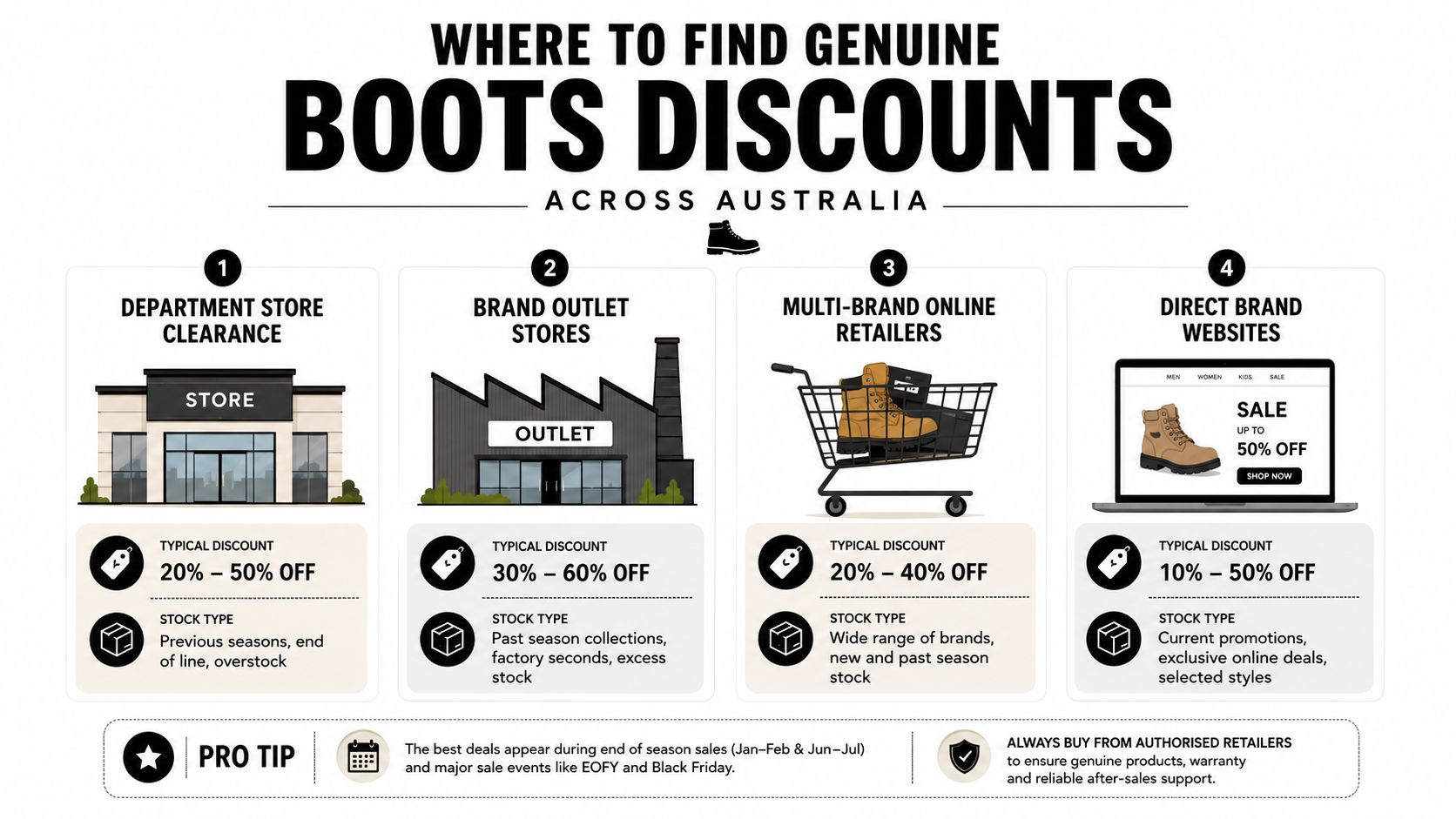
| Channel | What it's good for | What to check |
|---|---|---|
| Department store clearance | Broad brands and convenient comparison | Whether clearance items have different return conditions |
| Brand outlet stores | End-of-line colourways and direct brand stock | Size availability and whether outlet purchases are final sale |
| Multi-brand online retailers | Fast browsing across many labels | Who fulfils the order and how returns are processed |
| Direct brand websites | Product detail, fit notes, and brand-specific service | Whether the promotion applies to sale styles and delivery terms |
Department stores
Department store clearance pages make sense when you want to compare familiar brands in one place. Their weakness is presentation. Full-price new-season boots can sit beside heavily reduced styles, and a prominent “sale” filter may still leave you sorting through unrelated products.
Brand outlets
Brand-direct outlets can offer clear provenance and useful product detail. They're often strongest for shoppers who already know the brand's sizing and construction. The risk is that unusual colours, discontinued versions, or imperfectly matched size runs make returns more important than the headline reduction.
Multi-brand platforms
A multi-brand deal aggregator can save time by bringing promotions together instead of making you visit every retailer separately. Special8 aggregates fashion, footwear, accessories, jewellery, and lifestyle offers from 230+ stores nationwide, and its pages can be browsed by category, brand, or sale event. Use it as a discovery layer, then verify the final retailer's product, delivery, and returns terms before paying.
A curated EOS boots sale page is useful when you want to scan a specific promotion rather than search the entire web. Collection links also help shoppers move directly to a relevant category, but they should appear naturally in useful editorial context. Shopify's internal-linking guidance supports contextual links to collections and categories instead of stuffing links into navigation areas.
Direct brand websites
Direct sites are often the right choice when fit notes, construction details, and warranty information matter. They can also make the returns process easier to understand. Don't assume direct means cheapest, though. Compare the delivered total and the actual return conditions with the other channels.
Tactics That Separate Smart Shoppers from Casual Browsers
Serious sale shopping starts before the promotion appears. Casual browsers wait for a badge. Experienced shoppers create a reference point first.
Build a price and size watchlist
Save the exact boot, colour, and size you want. Record the normal selling price when you first find it, then monitor the same product during sale periods. This makes inflated-then-discounted pricing easier to spot without relying on memory.
Set a maximum delivered price, not just a maximum item price. Include shipping, possible return postage, and any cost attached to exchanging sizes. If the boot exceeds that ceiling, leave it alone.
Use alerts with restraint
Newsletter sign-ups can provide early notice of brand events and access to promotional codes. Create a separate shopping email folder so genuine sale notifications don't disappear among general marketing messages.
Special8's deal pages, ending-soon alerts, social updates, and email sign-ups can help shoppers monitor promotions across its retailer network. The footwear steals guide is another starting point for browsing offers, but you should still open the retailer's own terms before checkout.
Test the discount at checkout
A clearance markdown and coupon code may or may not stack. Add the product to the cart, apply the code, and check exclusions before treating the advertised saving as final. Some codes apply only to full-price merchandise, selected brands, or orders above a threshold.
Adding an item to a wishlist or cart can help you monitor movement, but don't assume every retailer sends an abandoned-cart offer. If an email arrives, inspect the sender address and destination before clicking. Sale urgency is useful for timing, not for bypassing basic security.
Sizing and Returns Risks That Can Kill Your Bargain
Fit is the hidden cost most boots sale Australia guides ignore. Boots aren't uniform across brands because heritage styles, fashion boots, riding silhouettes, and work boots use different lasts, materials, toe shapes, and shaft proportions. Your usual size is a starting point, not a guarantee.
Read the product page like a returns manager
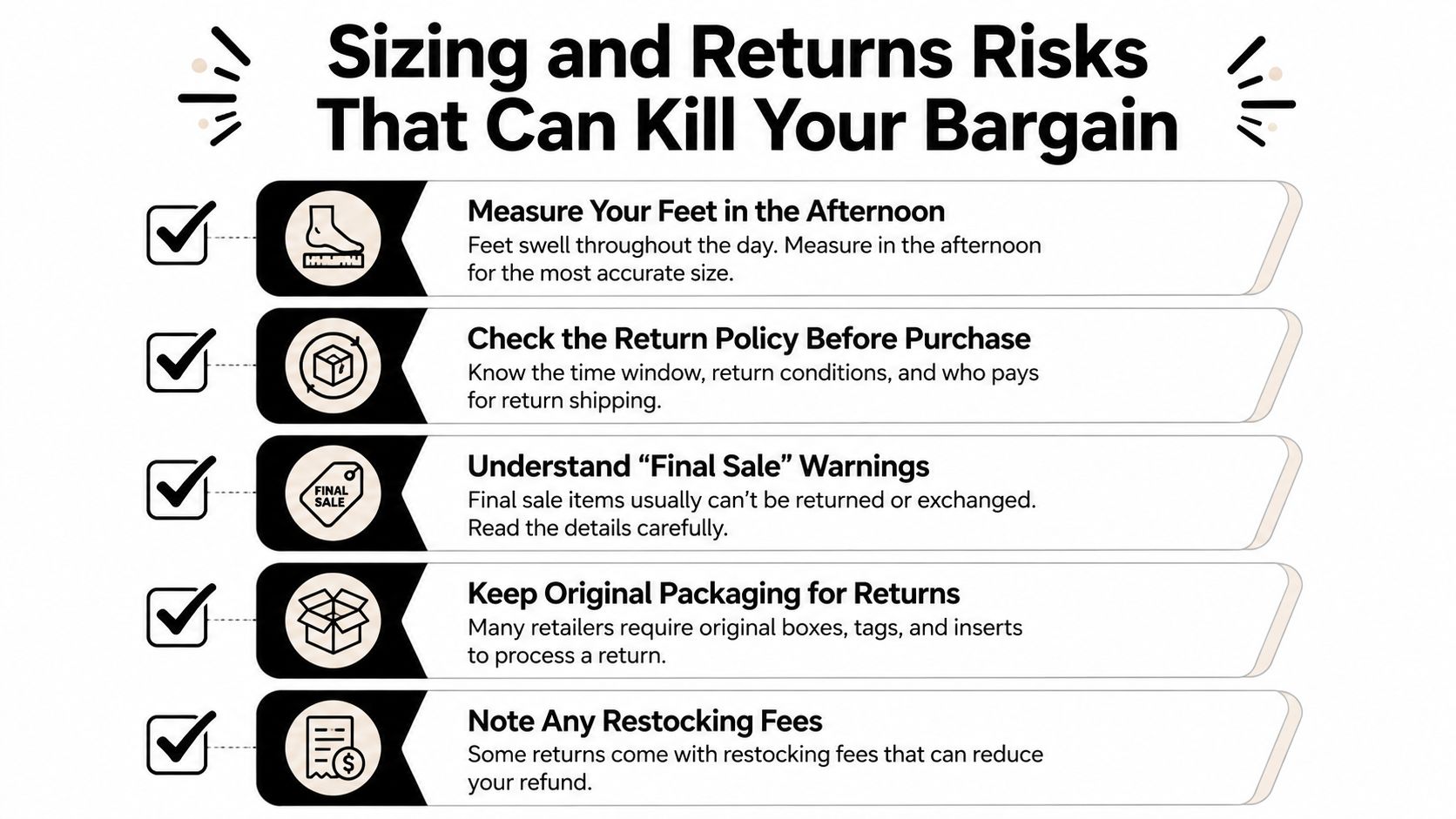
Check the brand's measurement guide, width information, shaft height, fastening, and customer fit notes where available. Compare those details with a pair you already own, especially if you're buying knee-high boots or a structured leather style.
Before paying, find the answers to these questions:
- Return postage: Is the first return free, charged, or deducted from the refund?
- Exchange process: Does the retailer reserve your replacement size, or must you place a new order?
- Final-sale status: Does the sale page exclude returns for change of mind?
- Condition requirements: Must the boots remain unworn, with the box, tissue, tags, and protective packaging?
- Processing time: Will an exchange take long enough for the replacement size to disappear?
Australian consumer guidance says goods must be fit for purpose, and consumer advice on footwear concerns shows why shoppers need plain-English information about sizing, exchanges, and retailer contact processes. Consumer rights don't remove the practical inconvenience of ordering the wrong size. They also don't automatically turn a change-of-mind return into a free return.
Before checkout: Treat the return policy as part of the product specification, alongside the heel height and material.
Measuring both feet later in the day can provide a more realistic reference, especially for fitted boots. Wear the socks you expect to use, and don't remove labels or discard packaging until you're confident about the fit.
If you're comparing silhouettes, women's leather knee-high boots are a good example of why shaft measurements and calf fit deserve as much attention as foot length. For expensive or difficult-to-return styles, buying two sizes can reduce fit uncertainty, but only if the retailer's policy makes the second return financially sensible.
During major sales, exchanges can also become awkward. A boot may be available when you order and sold out by the time the retailer receives your return. That's why a slightly less dramatic discount with reliable returns can be the safer bargain.
Are Boot Discounts Actually Getting Better or Just Harder to Judge
Boot sales look deeper online, but the bargains are harder to verify. The Australian footwear e-commerce market generated about US$2.856 billion in 2025. Add-to-cart rates sat at 10.5% to 11.0%, while cart abandonment reached 66.0% to 66.5%, according to ECDB's Australian footwear sample data. Those figures point to a market where shoppers browse seriously, then hesitate before payment.
The hesitation is rarely just the sticker price. Fit uncertainty, delivery charges, return postage, and restrictive exchange rules can turn a headline discount into an expensive mistake. A size that sells out during the return process adds another cost: time spent restarting the search. Retailers also spread promotions across codes, member offers, clearance pages, and short events, making the genuine price harder to establish.
Boots e-commerce was estimated at about US$336.2 million in 2025, representing 11.5% of footwear e-commerce, within the same market data. Boots are a meaningful online category, but narrower than footwear overall. Retailers have strong reasons to clear particular colours, sizes, and seasonal shapes instead of reducing every boot evenly.
Where price compression hides
The most convincing discounts usually sit where stock is difficult to place, such as premium niche designs, end-of-line colours, unusual sizes, or styles between seasons. A steep reduction on an awkward size is weaker value than a moderate reduction on a well-sized boot you will wear often.
My view: Australian boot discounts are more fragmented, not automatically better. Comparison skill now matters more than loyalty to any single sale event.
Check the same style across retailers, test whether the reference price looks credible, and calculate the delivered cost, including likely return postage. Watch the cart, not just the product page. If the discount disappears behind shipping, payment friction, or uncertain returns, it was never the bargain the badge suggested.
Your Action Plan for the Next Boots Sale
If you're hunting designer boots, shortlist the exact styles first, verify sizing through the brand, and set a delivered-price ceiling before the event begins. For an everyday replacement, prioritise comfort, return flexibility, and a colour you'll wear often, then act when the pair meets your limit. Gift buyers should choose a retailer with clear exchanges and avoid final-sale styles unless the recipient's size is certain.
Before checkout, confirm the product page, size chart, return terms, postage cost, and payment security. Use collection pages to narrow the search, but inspect the retailer's final terms and don't trust unexpected sale-alert emails without checking the sender and destination.
Special8 brings promotions from 230+ stores into one Australian shopping destination, including fashion and footwear offers that can be filtered by category, brand, or sale event. Visit Special8 to compare current deals, monitor limited-time promotions, and find boots without relying on the biggest percentage badge alone.


