
Briefs Plus Size: How to Find the Right Fit Every Time

You've bought the size you always wear, pulled your outfit on, and spent the day discreetly tugging at your waistband. The briefs roll beneath your stomach, ride up at the back, or leave angry marks around your thighs. That isn't a personal failure, and it doesn't mean your body is difficult to fit. It usually means the cut, grading, fabric, or size chart isn't doing its job.
Shopping for briefs plus size in Australia requires more than picking the biggest label available. Measure your waist and hips, compare the actual chart, choose a silhouette that matches your coverage needs, and check how the waistband and leg openings are built. This guide gives you the practical fit logic to find pairs that stay comfortable from the morning commute through the end of the day.
Table of Contents
- Why Plus Size Briefs Deserve a Smarter Buying Strategy
- The Australian Market Reality for Plus Size Briefs
- Understanding the Main Brief Styles for Larger Bodies
- Measuring Yourself and Reading AU Size Charts
- Fabric, Stretch and Seam Behaviour Explained
- Solving Common Fit Problems
- Smart Shopping Tactics for Better Deals
- Care, Longevity and a Quick Reference Checklist
Why Plus Size Briefs Deserve a Smarter Buying Strategy
Briefs that roll, ride up or dig in aren't merely irritating. They can create rubbing, pressure marks and constant readjustment, especially when you sit, walk or move through a long day. A stretched waistband can also lose its recovery, leaving the briefs comfortable for the first few wears but loose and unreliable later.
The answer isn't automatically a higher size. Start with your waist and hip measurements, then consider where you want the waistband to sit, how much coverage you prefer and whether your thighs need a softer leg finish. One brand's AU 18 may not fit like another brand's AU 18, so the label is only a starting point.
Practical rule: Judge a pair by how it feels after several hours, not how it looks while you're standing in front of the mirror.
Full briefs, high-waist styles and control briefs all behave differently. Full briefs can offer more coverage across the seat and hips. High-waist pairs may smooth the abdomen, but they can also press into a soft waist fold if the rise or elastic is wrong. Control styles add firmness, yet sizing down to force more compression commonly creates rolling and digging rather than a cleaner fit.
Before buying a multipack, test one pair in your usual measurement range. Check the fabric composition, seam placement, gusset and return terms, then wash and wear it through an ordinary day. If you're also comparing support garments, the guide to bras for a big chest is useful for applying the same fit-first approach elsewhere in your underwear drawer.
The Australian Market Reality for Plus Size Briefs
An AU 18 shopper can still spend longer hunting for a properly cut brief than a smaller-size shopper spends choosing between colours. Australian body-size data shows that larger underwear sizes serve a mainstream audience. Mys Tyler reports that the average Australian woman wears size 16, 67% wear size 14 and above, 52.1% wear size 16 and above, and 36.9% are classified as plus-size at size 18 or above. Ragtrader's Australian sizing coverage also reports that only 9.1% of Australian women sit in straight-size ranges 4 to 8, while 53.9% are mid-size 10 to 16.
Retail availability falls short. Independent coverage reported that only 6.3% of Australian clothing retailers sold plus sizes, defined as size 16 and above. That helps explain why shops carry plenty of smaller and mid-range underwear but offer few well-cut briefs in AU 18, 22, 26 or beyond. Refinery29's coverage of Australian plus-size availability shows how sharply retailer ranges can miss the customers they need to serve. Check Australian women's clothing sales for discounted stock, but confirm the available measurements before buying.
The broader plus-size clothing sector remains substantial. IBISWorld estimates Australia's Plus Size Clothing Retailing industry at about A$1.7 billion in 2026, with roughly 969 businesses operating in the segment. The industry recorded a slight 0.3% annualised CAGR decline from 2021 to 2026, and the sector remained sizeable after a 7.7% drop in 2025, according to the Australian lingerie market summary citing IBISWorld data.
Stock changes by retailer, colour and size. Local sellers usually make exchanges and delivery simpler, while overseas ranges may bring unfamiliar conversions and harder returns. Read each brand's chart on its own terms, compare waist and hip measurements, and never assume a familiar dress size transfers perfectly.
Understanding the Main Brief Styles for Larger Bodies
The most useful way to compare briefs is by the job you need them to do. A larger size alone won't fix a cut that sits in the wrong place or uses the wrong kind of stretch.
Full briefs for everyday coverage
Full briefs usually sit higher across the hips and offer more fabric over the seat. They're the safest starting point if you want dependable everyday coverage, less exposed skin under dresses and skirts, or more protection against thigh rubbing. Look for a back panel that reaches across the fullest part of the seat rather than stopping halfway down.
The leg opening matters just as much as the rise. A narrow elastic edge can cut into the upper thigh even when the waist fits, while a wider, softer finish distributes pressure more evenly. Full coverage should feel secure, not like a band around each leg.
High-waist briefs for a smoother line
High-waist briefs rise above the natural waist and can create a smoother transition under fitted tops, dresses or high-rise trousers. They suit shoppers who dislike a waistband ending directly across a soft fold, provided the top edge reaches a stable part of the torso.
Don't assume higher is always better. If the band presses into your stomach when seated, folds over as you bend, or leaves a deep horizontal mark, the rise is wrong or the garment is too small. Try your normal measurement-based size before considering anything firmer.
Control briefs for targeted smoothing
Control briefs use firmer fabric or panels around the tummy, hips or lower back. They're useful under close-fitting clothing when you want more structure, but they're not an ideal replacement for comfortable everyday underwear. A pair that feels fine standing up may become restrictive once you sit.
Briefs reduce visible lines, but they often depend heavily on stretch rather than supportive construction. Compare the side height, gusset width, leg opening and rear coverage before choosing one for long wear. The right pair should stay in position without pinching, bunching or creating a new pressure point.
Measuring Yourself and Reading AU Size Charts
A soft fabric tape measure gives you a better answer than guessing from a dress label. Measure in front of a mirror while wearing light underwear, keep your posture natural and avoid pulling the tape tight enough to compress your body.
Take the two measurements that matter
- Measure your waist. Place the tape around your natural waistline, across the belly button or the narrowest point above it. Bend gently to one side if you need to identify where your body naturally creases, then stand upright and keep the tape level.
- Measure your hips. Wrap the tape around the fullest part of your seat and hips. Bendon advises measuring the hips approximately 20 cm below the waist, while the precise fullest point matters more than forcing an exact distance. Bendon's underwear size chart also explains the natural-waist measurement method.
- Record both numbers. If your waist and hip measurements fall into different size bands, choose according to the larger area, especially for a close-fitting brief. A brief that fits the waist but strains across the seat will usually ride up or pull at the gusset.
- Compare the brand's chart. Bendon's chart links Australian dress sizes from AU 8 through AU 18 to underwear sizes from XS through 2XL, while its complete underwear guide shows the dress-size conversion. That conversion is useful, but the centimetre measurements should decide the final size.
Target-style Australian charts can extend from AU 16+ at about 115 cm bust, 103.5 cm waist and 121 cm hips to AU 28+ at about 149 cm bust, 141.5 cm waist and 163 cm hips, as shown in this Australian size guide. That represents roughly 42 cm across the hip circumference within the plus-size block, so fit tolerance and fabric recovery matter greatly.
| AU Size | Hip (cm) | Waist (cm) | Fit Note |
|---|---|---|---|
| AU 16 | Check the brand chart | Check the brand chart | Use measurements, not the label alone |
| AU 18 | Around 115 cm in the Nisa benchmark | Around 90 cm in the Nisa benchmark | Compare cut and rise carefully |
| AU 20 | Check the brand chart | Check the brand chart | Size by the larger body measurement |
| AU 22 | Around 130 cm in the Nisa benchmark | Around 105 cm in the Nisa benchmark | Allow room for a high-rise waistband |
| AU 24 | Check the brand chart | Check the brand chart | Look for extended sizing and clear returns |
Nisa's chart gives 2XL as AU/UK 18 with a 90 cm waist and 115 cm hips, and 4XL as AU/UK 22 with a 105 cm waist and 130 cm hips. You can use those figures as a benchmark, not a universal conversion. For a practical measuring refresher, see how to measure for clothes.
Fabric, Stretch and Seam Behaviour Explained
Fabric determines how briefs feel against your skin. Construction determines whether they still fit properly after sitting, walking and washing.
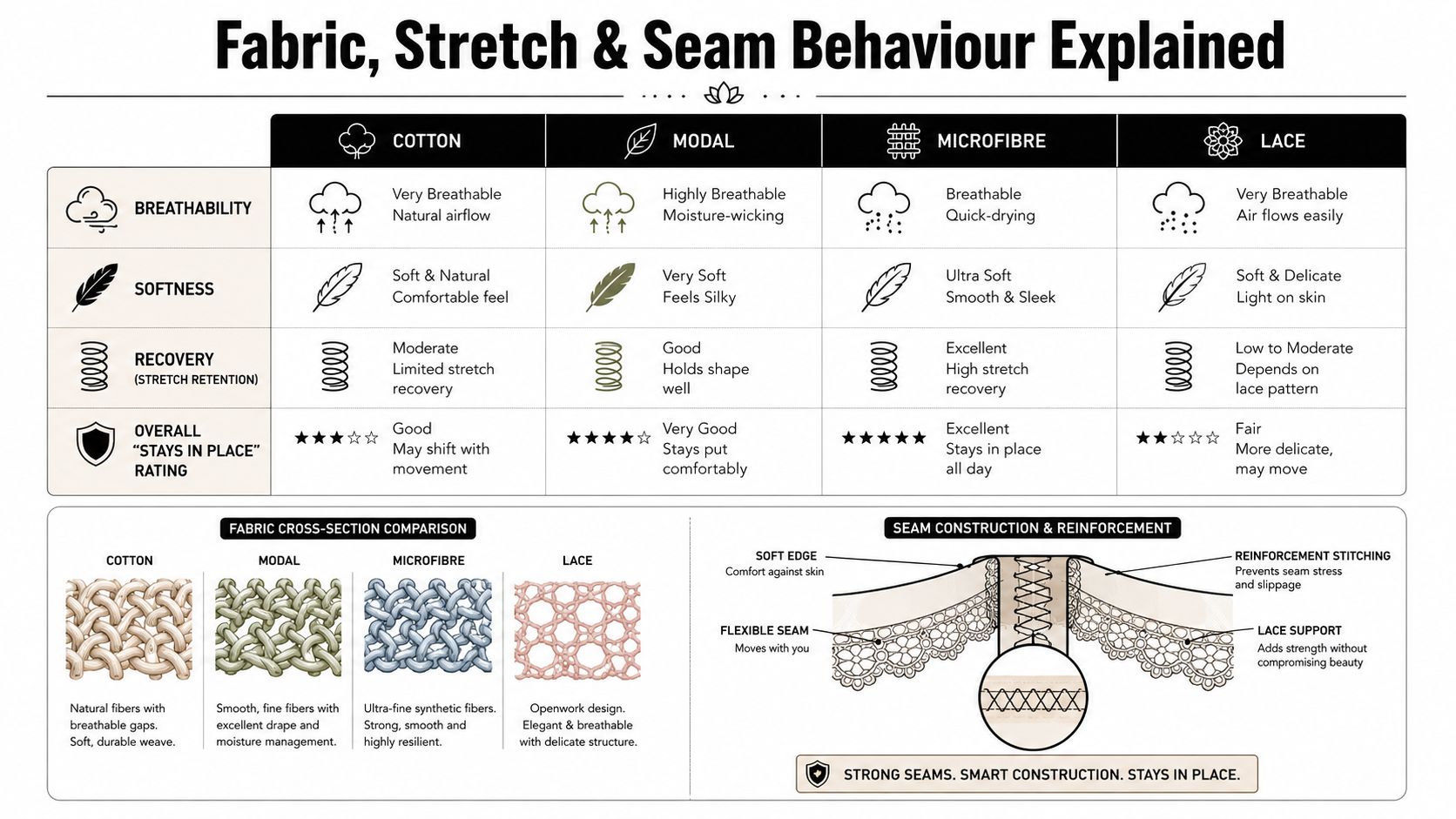
Cotton feels breathable and familiar, but pure cotton can lose shape more quickly than a cotton blend. Adding elastane improves recovery, and a cotton gusset remains a sensible choice for comfort. Modal feels soft and smooth, with a fluid hand feel that works well for everyday wear. Microfibre is lightweight and often gives a cleaner finish under clothing, while lace can be attractive and flexible, but only if the trim has enough stretch and doesn't act like a narrow cord around the thigh.
The elastane content gives you a useful starting point:
- Below 5% elastane: Suitable for lighter-support everyday wear, particularly where the fabric has enough room through the hips.
- Around 8% to 15%: A stronger range for fuller hips and thighs because it offers more hold and recovery without automatically turning the brief into shapewear.
- 20% or more: More appropriate for dedicated control garments, where firmer compression is intentional.
These ranges are buying guidelines, not guarantees. A well-designed lower-stretch brief can outperform a poorly graded high-stretch style.
Inspect the waistband and seams
A wide stitched waistband generally spreads pressure better than a thin elastic strip. Encased elastic can feel smoother against the skin, while a narrow exposed band is more likely to roll when it crosses a soft fold. Flatlock seams lie closer to the body and reduce raised pressure points. Bonded seams can also create a smooth finish, but the adhesive construction needs to flex with the garment.
Check the gusset before buying. A lined cotton gusset supports comfort and everyday hygiene, even when the rest of the brief uses modal, microfibre or lace. If you're wearing a breathable cotton garment such as the 132 Fashion St Tropez Dress (Berry Multi), a smooth brief with a stable gusset will complement the relaxed movement without relying on a bulky, rigid fabric.
Solving Common Fit Problems
If your briefs roll at the waist, the waistband is probably ending on a moving part of your body or lacks enough width to distribute pressure. Try a high-rise cut that sits above the soft fold, with a waistband at least 2 cm wide, rather than buying a smaller size and hoping it will hold.
Back ride-up usually points to insufficient rear coverage or an opening that ends too high beneath the seat. Choose a longer leg opening, a fuller back panel or a stretch lace trim that anchors gently beneath the bottom. If the gusset pulls backwards during walking, the brief may also be too short through the rise or too small across the hips.
Match the fix to the symptom
- Waistband rolls: Move to a higher rise or a wider stitched band. Avoid sizing down.
- Back rides up: Select more fabric across the seat and a longer leg line.
- Legs dig in: Look for soft wide elastic or try a boy-leg silhouette with a relaxed opening.
- Control feels painful while seated: Replace rigid panels with bonded seams, flexible stretch lace or a lighter smoothing brief.
- Briefs bunch beneath clothing: Consider a smooth microfibre finish, but confirm that the leg edge doesn't rely on excessive tension.
Control briefs often feel acceptable while standing because the abdomen is extended and the garment isn't under seated pressure. Sit, bend and walk around the fitting room or bedroom before deciding. A pair that leaves deep marks after a short test isn't delivering supportive comfort, it's too restrictive.
Colour is another outdated assumption. Plus-size briefs aren't limited to black and beige. Nude tones that sit closer to your skin, rich berry shades and brighter colours can make the drawer feel more personal, while fit remains the deciding factor. For targeted smoothing options, browse tummy-control shapewear, but don't treat compression as the answer to every underwear problem.
Smart Shopping Tactics for Better Deals
Online shopping gives Australian buyers more choice, but it also makes poor sizing decisions easier. Start by comparing the same garment's chart across three retailers, if the product appears in multiple stores. Record the hip and waist ranges rather than relying on labels such as 2XL or 4XL.
A chart that stops at XS to XL is a warning sign if you need genuine plus coverage. Extended labels should include body measurements, not just a promise that the fabric is stretchy. Target's larger men's underwear chart, for example, expresses sizing through waist ranges, from 3XL to 4XL at 120 to 125 cm, through 5XL to 6XL at 130 to 135 cm, and 7XL to 8XL at 140 to 145 cm. Boody's plus-size underwear collection also reflects the broader Australian practice of using body circumference and hip measurements rather than dress size alone.
Check the commercial details before checkout
- Read the return policy: Confirm whether underwear can be returned, whether tags must remain attached and who pays for an exchange.
- Inspect stock by size: Don't substitute a smaller size because your preferred colour is available.
- Filter fabric first: Look for a composition that matches your required breathability, softness and recovery, then compare prices.
- Test before multiplying: Buy one pair before committing to a multipack. A bargain is wasted if the waistband rolls.
- Use sale tracking carefully: Newsletter offers and price-tracking tools can help, but only after the garment passes your fit checks.
Australian retailers may simplify delivery and exchanges, particularly for larger sizes that are difficult to replace. Sale aggregators can also reduce browsing time. Special8 brings together fashion, footwear, accessories, jewellery and lifestyle offers from more than 230 stores nationwide, with categories that include clothing and sale events. Browse its women's underwear sale listings as one place to check current offers, then verify the individual retailer's size chart and return terms.
| Retailer | Size Range Start | Return Window | Average Multi-Pack Price (AUD) | AU Shipping |
|---|---|---|---|---|
| Target Australia | Check current product chart | Check current policy | Varies by product | Confirm at checkout |
| BONDS | Check current product chart | Check current policy | Varies by product | Confirm at checkout |
| Bendon | XS, with chart-based progression | Check current policy | Varies by product | Confirm at checkout |
| Nisa | 2XL benchmarked to AU/UK 18 | Check current policy | Varies by product | Confirm at checkout |
| Boody | Check current product chart | Check current policy | Varies by product | Confirm at checkout |
Prices, stock depth and delivery terms change, so don't treat a comparison table as a substitute for the live product page. The useful comparison is always your measurements, the construction details and the true cost of an exchange.
Care, Longevity and a Quick Reference Checklist
Good fit won't survive careless washing. Use cold water at 30°C or below, a gentle cycle and mild detergent. Heat weakens elastane, and a tumble dryer can accelerate the loss of stretch recovery, so reshape the briefs and air-dry them on a rack or flat surface.
Rotate your drawer instead of wearing the same few pairs repeatedly. Replace briefs when the elastic no longer springs back, the waistband permanently rolls or the gusset fabric starts thinning. Store them unfolded so tight compression creases don't distort the shape.
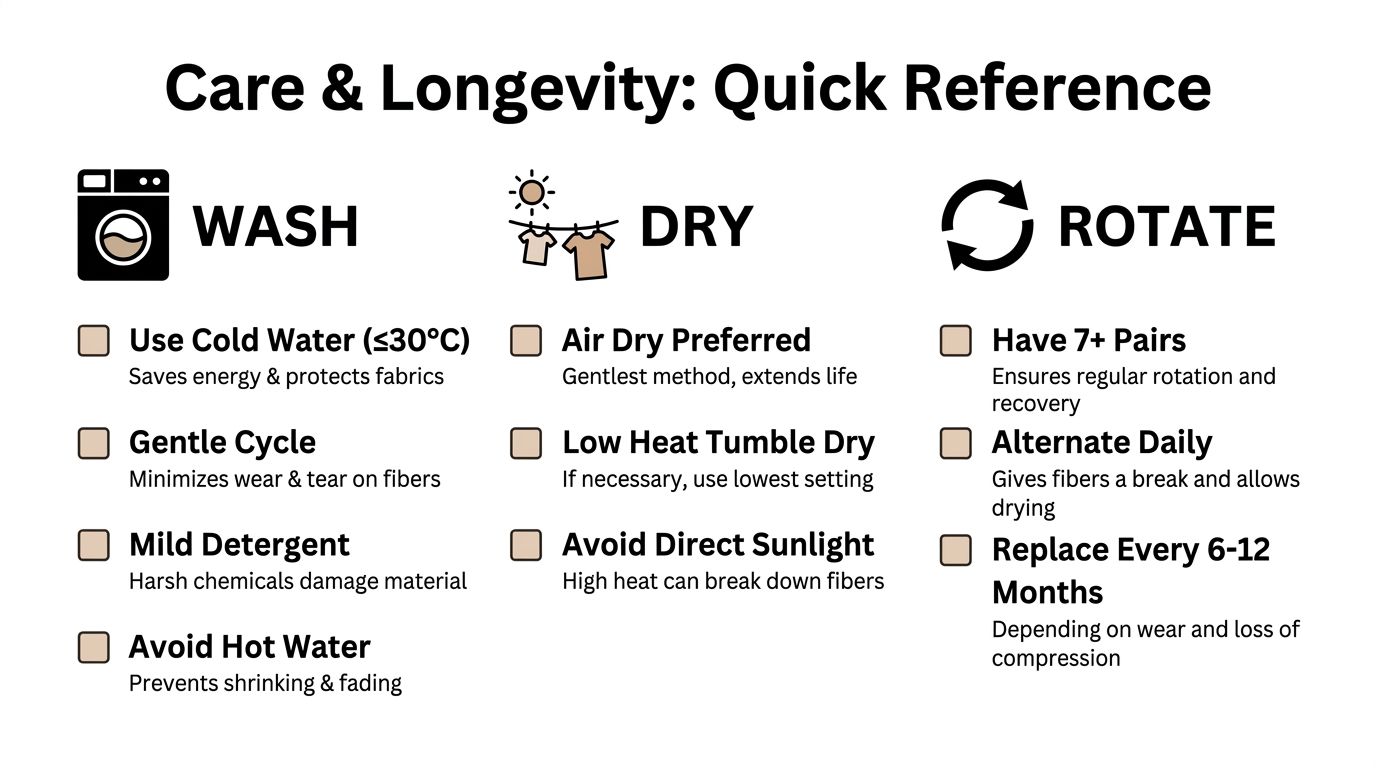
Use this pre-purchase checklist:
- Measurement: Your hip measurement sits comfortably within the chart.
- Stretch: The fabric includes a suitable elastane percentage for the support you want.
- Construction: Seams lie flat and the waistband is stable or encased.
- Coverage: The back panel and leg openings match your movement and comfort needs.
- Returns: The retailer explains size exchanges clearly.
Measure before you buy, order one test pair, and inspect the waistband, leg opening and gusset after a full day. When you're ready to compare Australian fashion offers alongside underwear essentials, visit Special8 to browse current deals across participating retailers and make your next purchase with the fit details in hand.


