
Diamond Bracelets for Women: The Complete Buying Guide

You're probably looking at a bracelet online right now, wondering why one piece looks delicate in the photo, another looks bulky on a wrist, and a third costs far more than it seems to justify. That confusion is normal. Diamond bracelets for women are easy to love and surprisingly easy to get wrong, especially when the fit, setting, and pricing all matter more than the glossy product shot.
The smart way to buy is simple. Start with the style that suits your wrist and your life, then check the stones, then check the size, then decide whether the price is paying for quality or just branding. Do that, and you stop gambling on a piece you'll barely wear.
Table of Contents
- Why Most Diamond Bracelet Purchases Go Wrong
- The Five Main Diamond Bracelet Styles Explained
- Diamond Quality Markers That Matter
- Getting the Size and Fit Right Every Time
- Understanding Price and Finding Real Value
- Care and Maintenance for Long-Lasting Brilliance
- Smart Shopping Strategies for Australian Buyers
Why Most Diamond Bracelet Purchases Go Wrong
A lot of women buy a bracelet online, wait for delivery, then realise it does not sit the way they expected. It twists too much, the clasp lands awkwardly, or the stones look smaller on the wrist than they did in the listing. That disappointment usually comes from three mistakes, not from bad taste.
The first failure is fit, not style
Bracelets fail when shoppers guess the size instead of measuring it. A link bracelet and a bangle are not sized the same way, so use a flexible tape measure on the wrist first, then add 1 to 2 cm for comfort to find the right link-bracelet length. One buying guide puts women's medium link-bracelet length at 18.5 cm and women's medium bangle size at 6.5 cm in diameter, or 20.4 cm circumference source.
That difference matters because the wrong size changes the whole wearing experience. Too short, and the bracelet feels tight and does not move naturally. Too large, and the clasp drifts off-centre while the piece slides around the wrist. Fit decides whether a bracelet looks polished or annoying.
Practical rule: if you cannot explain how the bracelet closes, sits, and moves before you buy it, you are not ready to buy it.
The second failure is reading carat weight as if it were visible size
Carat weight alone does not tell you how bold a bracelet will look. Two bracelets can have the same total weight and still look very different, because stone count, stone diameter, and setting style all change the visual result. A 5.00 ct total weight tennis bracelet can contain roughly 44 to 50 stones of about 0.10 to 0.11 ct each, with an average face-up diameter of about 3.0 mm source.
That is why I tell buyers to stop asking only, “How many carats is it?” and start asking, “How wide are the stones, and how even is the line?” A bracelet that looks balanced on the wrist usually gives better value than one that sounds heavy on paper.
The third failure is paying for prestige without checking substance
Brand markup is real. So is craftsmanship. The problem is that shoppers often pay for the first without confirming the second. That is where a piece can look luxurious on a product page and still feel underwhelming in person.
Judge the construction first, the label second. If you want a practical way to compare older design details with current market expectations, this Special8 editorial guide is a useful reference point. The same principle applies across fine jewellery. Look closely at the setting, the clasp, the symmetry, and how the bracelet will wear day to day, then decide whether the price reflects the actual piece or just the name attached to it.
The Five Main Diamond Bracelet Styles Explained
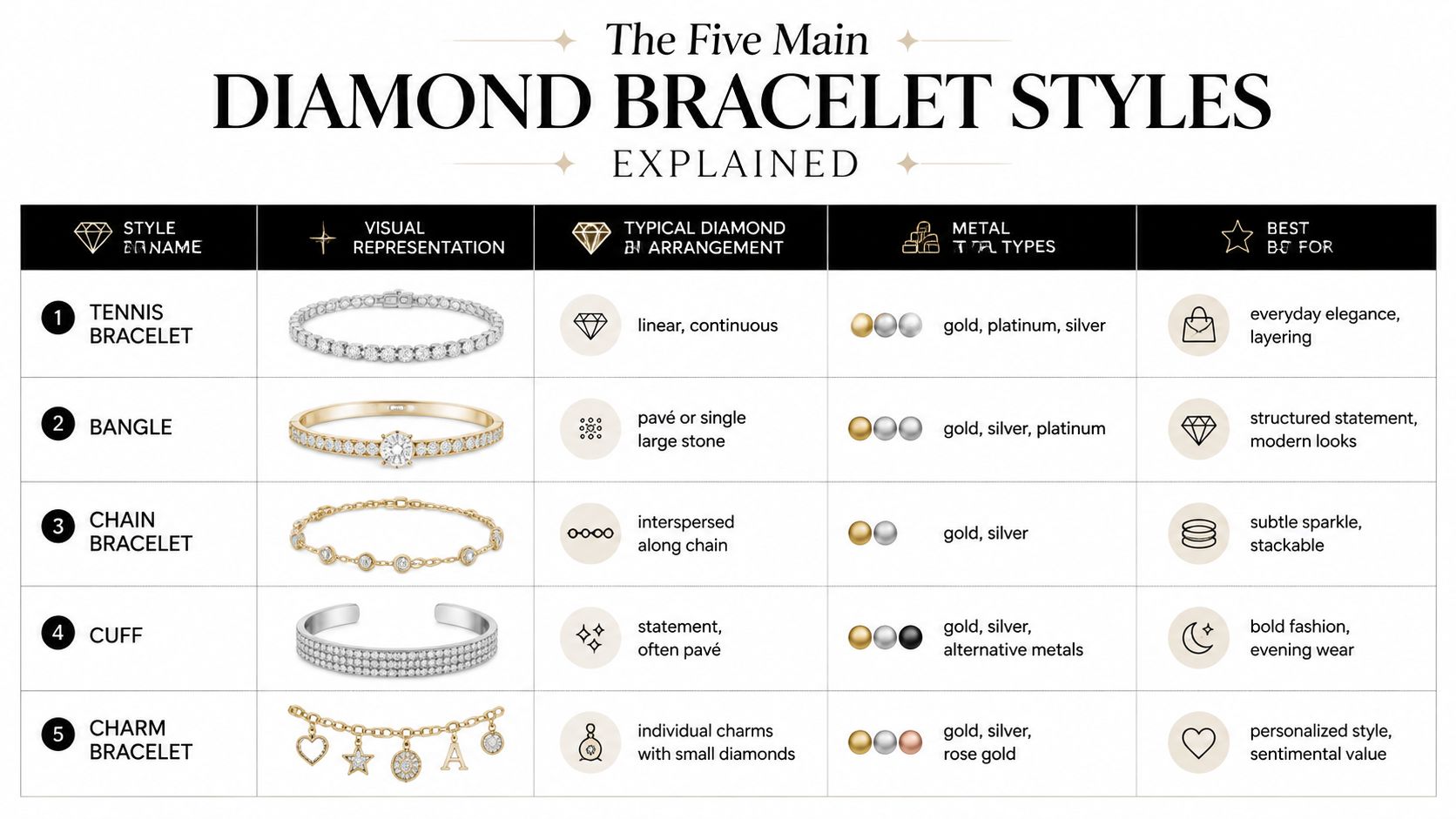
The bracelet type you choose matters more than most shoppers realise. A piece can be beautiful and still be wrong for daily wear, stacking, or an active routine. GIA defines a tennis bracelet as a flexible band made of individually set diamonds or gemstones that forms a continuous line around the wrist source. That flexibility is exactly why it stays the benchmark.
Tennis bracelets are the cleanest everyday choice
Tennis bracelets give you a continuous line of sparkle, which makes them the most versatile option for most women. They layer easily, sit neatly under sleeves, and work with everything from office clothes to evening wear. If you want one bracelet that doesn't fight with the rest of your jewellery, this is usually the right pick.
They're also the style where stone matching matters most. If the diamonds are uneven, the line looks broken. If the workmanship is tight, the bracelet looks far more expensive than the carat weight suggests.
Bangles are for structure and polish
Bangles are rigid, so they make a clearer style statement. They work best when you want a defined silhouette rather than fluid movement. They're less forgiving on fit than chain-based styles, and they're better for occasional wear or polished occasions than for someone who wants a bracelet to disappear into daily life.
Chain bracelets are the easiest to layer
Chain bracelets use smaller diamond accents along a linked chain, so they feel lighter on the wrist. They're ideal if you like subtle sparkle and want to stack with a watch or other bracelets. They don't usually deliver the same full visual impact as a tennis bracelet, but they're more relaxed and often easier to wear every day.
Cuffs are bold, but not subtle
Cuffs give you more presence and less delicacy. They often suit fashion-forward looks and evening outfits because the shape is part of the statement. If you're after something that reads as jewellery first and background accessory second, cuffs do that well.
Charm bracelets are personal, not minimal
Charm bracelets are the most sentimental option in the group. They're usually chosen for meaning, gifting, or a more personalised look. Small diamonds on individual charms add interest, but the design is less about uninterrupted sparkle and more about story.
If you're comparing shopping pages, keep in mind that a ring set such as 2 Channel Ring Set with 0.80ct of Diamonds in 9kt Yellow Gold (Diamond) shows how 9kt yellow gold can be used in fine jewellery for a durable, warm-toned finish. That same metal logic often carries into bracelet choices.
For a style refresh while browsing, I'd also look at this pear cut diamond guide, because shape knowledge helps you judge how much of the value is coming from the stones themselves.
Diamond Quality Markers That Matter
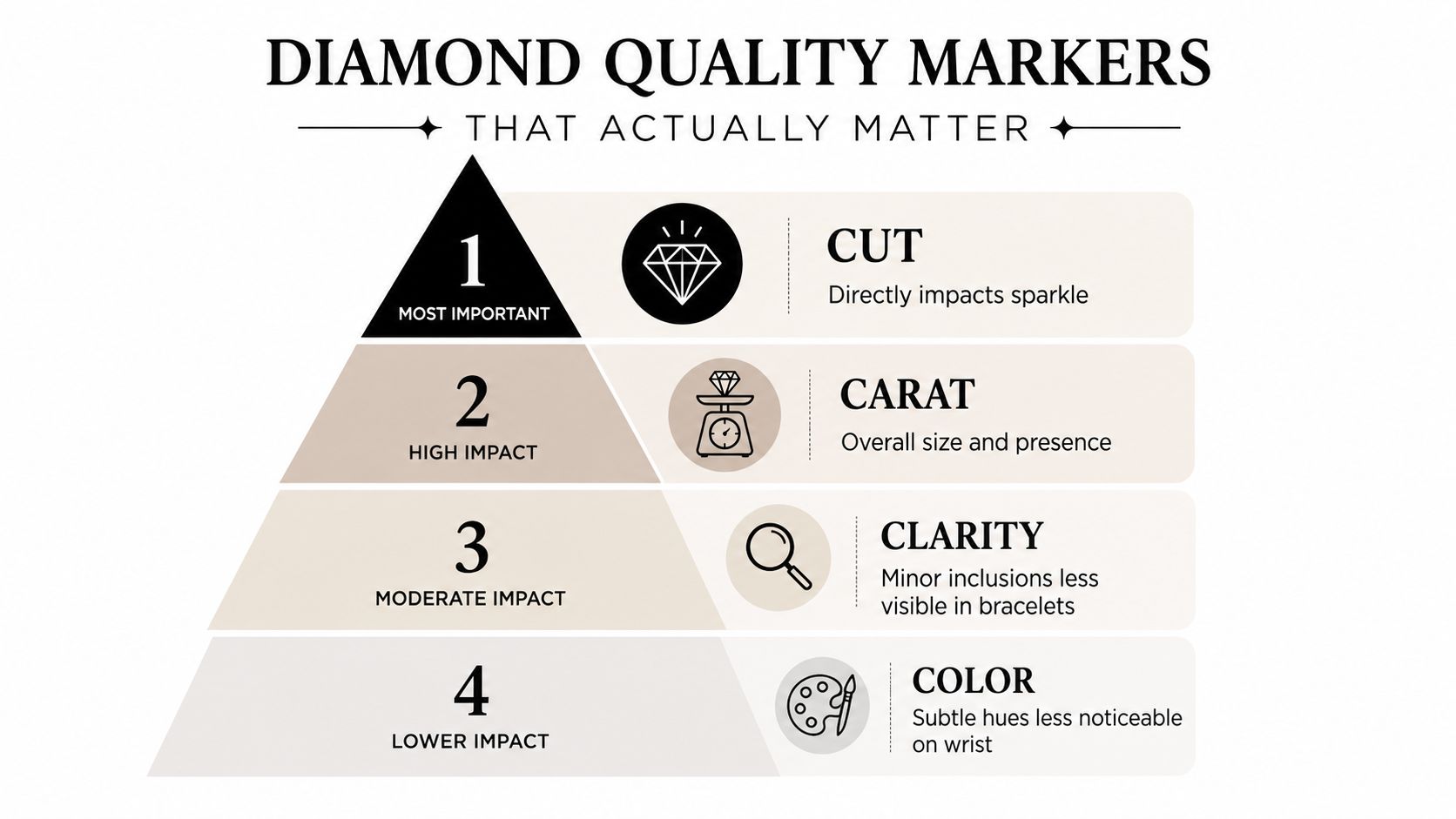
Bracelet diamonds need a different eye than a single statement stone. You are not studying one gem under magnification all day. You are judging a row of small diamonds, so the true test is consistency across the whole bracelet, not fixation on one isolated detail.
Cut and spread drive the first impression
For bracelets, cut still matters most because it controls sparkle. Spread matters almost as much, because a bracelet that looks bright and evenly matched across the wrist reads better than one with a higher carat weight and weaker visual presence. A bracelet can still look underwhelming if the stones are deep and the face-up size is small, even when the weight sounds impressive source.
Carat weight is a benchmark, not the whole story
With Clarity notes that the total average carat weight of a diamond tennis bracelet can range from 2 to 8 carats source. That range helps, but it should never be the only filter. You need the stone count and the per-stone diameter as well, otherwise you are comparing weight without understanding how the bracelet will look on the wrist.
A 5.00 ct total weight bracelet typically contains about 44 to 50 stones at 0.10 to 0.11 ct each, with an average face-up diameter of 3.0 mm source. That is the kind of detail worth asking for before you buy.
Clarity and colour are more forgiving here
Small stones can hide minor imperfections better than larger centre stones. In a bracelet, the overall pattern matters more than microscopic flaws in any single stone. That does not mean quality stops mattering. It means you should not pay extra for grades you will barely notice once the bracelet is moving with your wrist.
Ask for the stone count, the average diameter, and the matching tolerance. If a seller cannot answer those clearly, move on.
For a practical comparison mindset, I'd also keep this cubic zirconia earrings guide in mind when you are weighing sparkle, value, and visible performance across different jewellery buys.
Getting the Size and Fit Right Every Time
The quickest way to waste money on a bracelet is to guess the size. Bracelet sizing looks simple until the piece arrives too tight to wear comfortably or loose enough to spin all day. That is not a minor mistake. It changes how the bracelet sits, how often you wear it, and how long it stays in good condition.
Measure your wrist before you look at listings
Use a soft measuring tape, or wrap a strip of paper or string around the wrist bone and mark where it overlaps. Lay that length flat against a ruler, then decide how much ease you want.
A practical bracelet-sizing guide recommends allowing extra room for a close fit or a looser fit, depending on how you plan to wear the piece source. If you prefer a neat fit, keep the allowance small. If you want more movement and easier stacking, allow more space.
Link bracelets and bangles are not sized the same way
Link bracelets are usually chosen by wrist length because the chain or links give you some flexibility. Bangles are chosen by internal diameter and circumference because the opening has to clear the hand before the bracelet can sit on the wrist. That is why a bangle can feel right once it is on and still be awkward to put on.
Women's medium link-bracelet length is typically 18.5 cm, while women's medium bangle size is 6.5 cm in diameter, or 20.4 cm circumference source. Use those figures as a reference point, not a rule you treat as universal.
Adjustable styles can save you from a bad guess
Bolo bracelets and extension chains are worth considering if your wrist size changes or you plan to wear the bracelet with a watch. They reduce sizing risk and make online buying less stressful. If you are buying a gift, they are usually the safer choice because they allow more wear without needing an exact wrist measurement.
If a bracelet has no adjustment and no clear size chart, treat that as a risk, not a feature.
For a visual refresher, the fit issue is the same one women run into across different jewellery categories, including the practical side of pieces such as this Special8 jewellery deal page, where variety only helps if sizing is clear.
Understanding Price and Finding Real Value
Bracelet pricing looks confusing because two pieces can share the same headline carat weight and still sit at very different price points. That gap exists because you pay for more than diamonds. Metal weight, craftsmanship, setting complexity, stone matching, and branding all shape the final number.
Buy the bracelet for what you'll see and wear
The strongest self-purchase signal in the category is real. Research cited by De Beers found that 33% of female nonbridal diamond jewellery is now self-purchased, up from 23% in 2005, and bracelets accounted for 10% of those purchases source. It also reported average spending on natural diamonds rising 25% from $3,242 in 2023 to $4,063 in 2025 source.
That shift matters because self-buyers usually care more about wearability and day-to-day value than ceremonial gifting language. They want a bracelet they'll reach for often, not a piece that lives in a box. A bracelet should earn its place by how well it sits on the wrist, how often it gets worn, and how confident it makes you feel.
Where the money usually goes
Use the following breakdown as a buying lens, not as a fixed formula.
| Diamond Bracelet Price Ranges by Style and Quality | Entry Level (2-3ct) | Mid-Range (4-5ct) | Premium (6-8ct) |
|---|---|---|---|
| Tennis bracelet | Smaller-stone layouts, lighter metal, simpler finishing | Better matched stones, stronger presence, more refined setting | Larger visual impact, tighter uniformity, heavier workmanship |
| Bangle | Slimmer profiles, minimal diamond coverage | More substantial construction, more polished surface work | Heavier structure, stronger statement finish |
| Chain bracelet | Delicate diamond accents, lighter build | Better balance of sparkle and wearability | More elaborate chain work and stronger visual definition |
Those ranges help you compare offers without getting distracted by a shiny headline. A bracelet with fewer visual compromises can beat a larger-looking one if the stones are better matched and the build sits properly on the wrist. Fit matters here too, because a design that spins, pinches, or sits awkwardly will waste part of what you paid for.
What counts as real value
Value shows up when the bracelet feels coherent. A well-made 14k or 9kt gold setting can be a smarter buy than a heavier-looking piece with weak stone matching. Lower colour grades can also be a rational choice in small stones, because the wrist rarely exposes the same detail you'd inspect in a ring.
Brand markup can distort the price fast, so compare construction before you compare logos. Check how the stones are set, how solid the clasp feels, whether the links or bangle body look finished cleanly, and whether the bracelet wears comfortably rather than just looking impressive in a product shot. If you are comparing sales and want a broader deal-search approach, Special8's jewellery deals collection is one way to scan market options alongside other retailers, then judge the piece by its construction rather than the discount badge.
My blunt view is this. Pay more when the extra money buys better matching, better fit, or better metal work. Don't pay more just because the listing sounds premium. If a bracelet looks good on paper but feels awkward on the wrist, it is overpriced for what you'll wear.
Care and Maintenance for Long-Lasting Brilliance
A diamond bracelet should hold up to real wear, but only if you treat it like a fine mechanical piece, not a decoration that can survive anything. The stones may be hard, but the settings, clasps, and links still need care.
Build simple habits around daily wear
Take the bracelet off before showering, swimming, and exercising. Water, sweat, and impact all add strain, and bracelets snag more easily than rings because they move with the wrist. If you wear it often, make removal part of your routine, not an afterthought.
Store it separately so it doesn't rub against other pieces. A soft pouch or lined compartment is enough. Chains and flexible links can tangle, and rigid pieces can scratch other jewellery if they're tossed together.
Match cleaning to the setting
A quick wipe after wear keeps lotions and skin oils from dulling the stones. For deeper cleaning, use gentle methods and pay attention to the setting type. Prong settings can trap debris, bezel settings need attention around the edges, and channel-set pieces should be checked for loose stones along the line.
Know when it needs a jeweller
If the clasp feels loose, the bracelet spins more than usual, or you notice any movement in a stone, stop wearing it and get it inspected. A small issue becomes an expensive one when a stone loosens or a worn prong breaks. That's maintenance, not paranoia.
A bracelet that needs attention usually gives you warning signs first. Don't wait for a stone to fall out before you act.
Women who buy with longevity in mind often end up happier with the piece, because the bracelet stays wearable instead of becoming a special-occasion item only.
Smart Shopping Strategies for Australian Buyers
Australian buyers have a better reason than most to shop with discipline. Australia is one of the top five rough-diamond producers globally, alongside Russia, Botswana, Canada and Congo, and those five countries account for more than 80% of global rough-diamond supply source. That supply-chain position makes diamond jewellery a structurally important category here, but it doesn't excuse sloppy buying.
Use comparison tools, then verify the seller
Deal aggregators help you compare offers across retailers without opening twenty tabs. That matters because prices can hide behind similar product photos. Once you find a promising bracelet, check the seller's return policy, certification, and business details before you buy.
A solid listing should tell you whether the diamonds are independently graded, what metal is used, and what documentation comes in the box. For diamond bracelets, independent certification from respected labs such as GIA or IGI is the baseline I'd want on a serious purchase.
Watch for sale language that means nothing
A big percentage off can still be a bad deal if the original price was inflated. Real markdowns usually come with clear product details, not just urgency. If the listing hides the stone count, hides the bracelet length, or avoids the setting type, I'd treat that as a warning sign.
Choose the right shopping lane for the budget
Some shoppers want natural diamonds and a heavier precious-metal feel. Others want a cleaner entry point without the markup. If that's you, Special8's affordable Australian jewellery brands page is a sensible place to compare value-driven options alongside branded pieces.
The important thing is to shop with a checklist, not emotion. Confirm the fit, confirm the stone specs, confirm the return policy, then buy. That sequence protects you from most of the regret people feel after an online jewellery order.
If you want to compare diamond bracelets for women without paying blind-brand premiums, visit Special8 and start with pieces that make sizing, materials, and value easy to judge. Special8 pulls together Australian offers across jewellery and accessories, so you can compare options faster and choose a bracelet that fits your wrist, your style, and your budget without the usual guesswork.


