
Diamond Rings Sale: A Smart Australian Shopper's Guide

Most advice about a diamond rings sale starts with the wrong question: “How much is the discount?” In Australia, the sharper question is, “What am I getting for the total basket value, and why is this particular ring discounted?”
The category is volatile, not a steady bargain parade. Australian and New Zealand data from more than 400 independent jewellery stores showed diamond jewellery sales rose 3.5% year on year in June 2026, while unit sales fell 7% and were 14% below the same month in 2024. The average retail sale reached $355, up 23% year on year and 34% above the same period in 2024. Buyers were purchasing fewer items, but spending more per transaction. (Diamond Vault)
That changes how you should shop. A large red sticker can hide an ordinary stone, an inflated reference price or a setting the retailer needs to clear. A smaller saving on a well-cut, properly documented diamond can be the smarter buy.
Table of Contents
- What a Diamond Rings Sale Really Signals in 2026
- Reading the 4Cs and Certifications Without the Jargon
- Spotting Real Markdowns Versus Clever Marketing
- Timing Your Purchase Around the Australian Sales Calendar
- Mined, Lab Grown or Custom and What a Sale Actually Means
- Buying Online Versus In Store for Diamond Rings
- Using Deal Aggregators to Find Limited Time Diamond Deals
- Negotiation, Returns, Insurance and the Smart Buyer's Checklist
What a Diamond Rings Sale Really Signals in 2026
A sale tag usually signals inventory pressure, not retailer generosity. The store may need to move an older setting, make room for newer designs or create urgency around a seasonal campaign. That can produce a genuine bargain, but the percentage printed beside the ring doesn't prove it.
The retail data supports a more disciplined view. In August 2025, jewellery sales in Australia and New Zealand increased 4% year on year, while diamond jewellery sales declined 7%. The average retail sale still rose 14% to $313, based on point-of-sale data from more than 400 independent Australian jewellery stores. (Diamond Imports)
A rising basket value alongside weaker diamond-specific demand suggests that shoppers who do buy are concentrating their spending. You shouldn't treat every promotion as a market-wide price collapse. Treat it as an invitation to inspect the stone, setting, certificate and comparable alternatives.
The sale pattern matters more than the sticker
Australian diamond jewellery sales rose 7% year on year in April 2026, fell 7% in May 2026, then improved 3.5% in June 2026 while remaining 9% below the two-year benchmark. (Jeweller Magazine) That movement is too uneven to support the lazy advice that waiting for “the next big sale” will always produce a lower price.
| Sale Pattern | Headline Discount | Real Price Change | What It Signals |
|---|---|---|---|
| Genuine clearance on an older setting | High or moderate | May be meaningful | The retailer wants the item gone |
| Permanent “was/now” pricing | Large | Unclear | Investigate the reference price |
| Short event on a selected stone | Moderate | Potentially useful | Compare the complete ring, not just the percentage |
| Bundle promotion | Impressive | Often mixed | Separate the stone, setting and extras |
| Custom-order promotion | Any figure | Often limited | Made-to-order work may not use discounted stock |
Mid-tier retailers commonly use EOFY and Boxing Day windows to shift slower-moving inventory. Flagship chains can present a “was” price against a reference price that isn't useful unless you know whether comparable rings sold at it.
Practical rule: Ignore the discount until you've established the ring's total price, stone quality and independent benchmark.
The best opportunity is often not the ring with the biggest markdown. It may be a standard setting with a clearly graded stone, a sale price that compares favourably with similar listings, and a return policy you can use if the ring doesn't meet expectations.
Reading the 4Cs and Certifications Without the Jargon
The 4Cs give you a consistent way to compare diamonds, but they do not tell you whether a setting is well made or flattering on your hand. Read them before you react to a sale banner. A polished product page can make an ordinary stone sound exceptional.
Start with cut, because brilliance is the feature you will notice every day. A well-cut diamond returns light with brightness and pattern. A poorly cut stone can look flat despite its carat weight. A cheap ring with weak cut quality is still poor value.
Colour records the visible yellow or brown tint. Lower tint generally means a higher grade, although the right choice depends on the metal and diamond shape. Yellow gold can make a warmer stone look intentional. White metals tend to reveal colour differences more clearly, so inspect the diamond rather than buying a grade blindly.
Clarity records inclusions inside the diamond and blemishes on its surface. Some marks appear only under magnification, while others affect the stone's face-up appearance. Check the diamond closely before paying for a higher grade. A lower grade that looks clean to your eye can be better value, but an obviously marked stone is a false saving.
Carat measures weight, not the visible diameter. Measurements and cut proportions determine how much of the diamond you see from above. Compare dimensions as well as carat weight when two sale rings look similar.
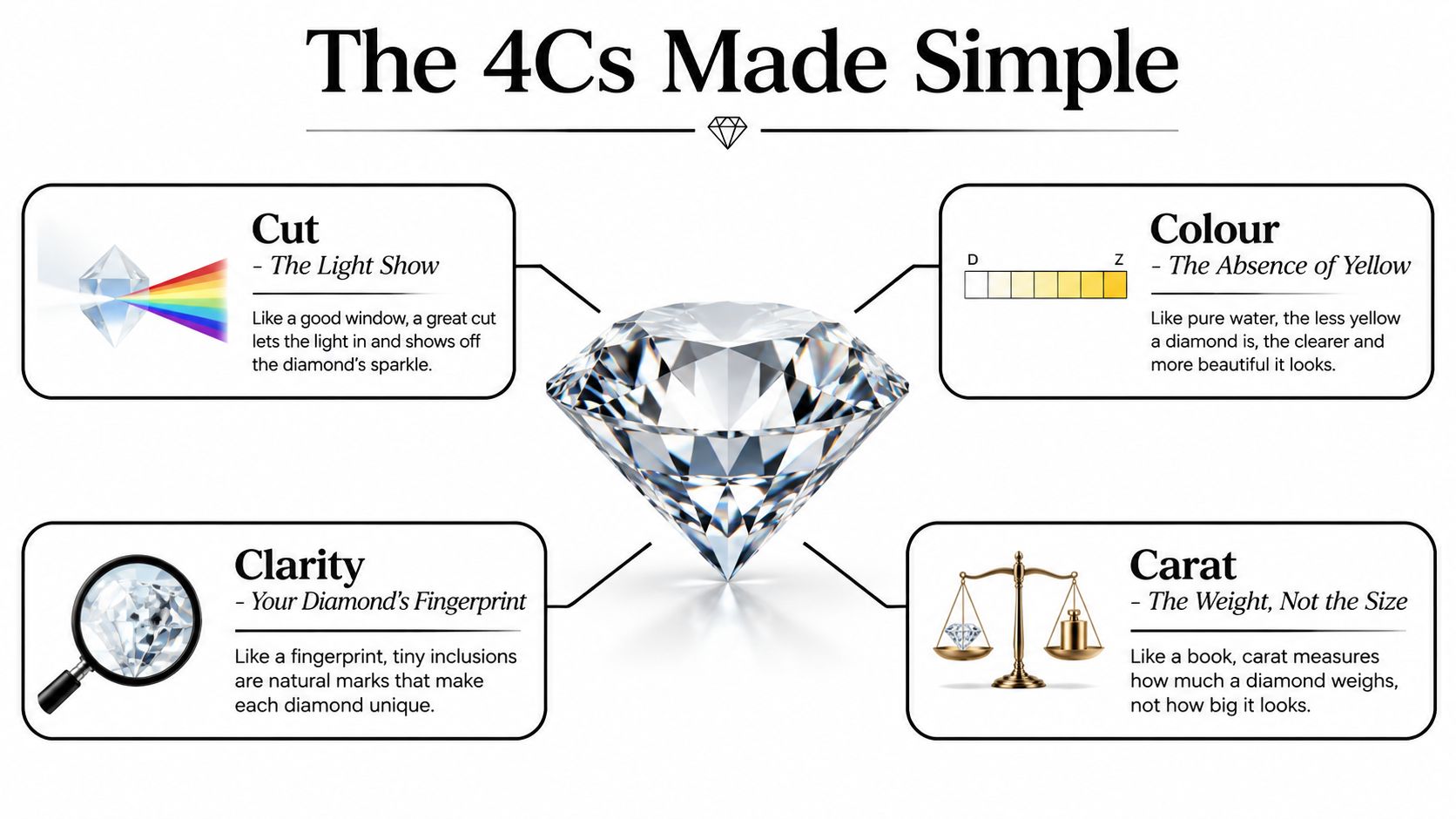
How each C changes a sale decision
Use this priority order:
- Cut first: Choose brightness and liveliness before extra weight.
- Colour in context: Match the grade to the metal and the appearance you want.
- Clarity by visibility: Check whether inclusions can be seen without magnification.
- Carat last: Select size after the diamond performs visually.
A 30% discount on a poorly cut stone can be worse value than a 10% discount on an excellent cut if the latter looks better and has stronger documentation. These percentages illustrate the decision only, not a market benchmark. Judge the quality you receive, not the size of the claimed saving.
Certification gives you an independent description of the diamond. GIA, IGI and HRD are recognised grading laboratories, but the report must match the stone and record its relevant characteristics. Ask the Australian jeweller for the report before you treat the ring as a serious contender.
For higher-value purchases, the JAA Industry Code of Conduct sets a documentation standard for members. It requires a grading report from a reputable laboratory for loose diamonds or new jewellery containing a diamond at or above 1.00ct with H/SI2 colour and clarity, and customers should receive a receipt for every purchase. That paperwork supports your decision, but it does not replace inspecting the actual stone.
Check the girdle for a laser inscription if the report says one exists, then match its number with the certificate. The 2 Channel Ring Set with 0.80ct of Diamonds in 9kt Yellow Gold (Diamond) is described as two rings with a square look, baguette shoulder and 9kt yellow gold. Its available product snapshot does not establish price, certification or sale status, so request those details before calling it a deal. Shape and metal form only part of the value calculation.
For shape-specific shopping, this pear-cut diamond guide helps compare a pear shape with a standard round solitaire. Apply the same certificate, proportion and inspection checks to either choice.
Spotting Real Markdowns Versus Clever Marketing
A diamond rings sale is only real if the complete basket is cheaper than comparable stock. A large crossed-out percentage proves nothing when the centre stone, setting or paperwork differs.
Start with the “was” price. Ask whether the ring was offered and sold at that amount, rather than treating a crossed-out figure as evidence of value. Under the JAA Industry Code of Conduct, members are expected to show genuine savings and avoid misleading reference pricing. Use that standard when a retailer cannot explain its benchmark.
Three warning signs
- The old price has no history: Request the retailer's recent price record in writing. If the shop cannot explain the reference price, discard it as a comparison point.
- The setting carries the promotion: A slow-moving halo, unusual shoulder design or dated metal combination may be reduced while the centre diamond remains ordinary.
- The listing hides useful comparisons: Compare matching shape, carat, colour, clarity, cut, fluorescence, metal and laboratory certificate. A similar-looking ring is not necessarily like-for-like.
Ask for a 90-day price history. If the retailer will not provide one, compare the full specifications with reputable Australian jewellers and recognised diamond pricing references. Rapaport may offer a trade reference for eligible comparisons, but it is not a retail invoice and cannot set the final price by itself.
Split the ring before you judge it
A ring is a bundle of separate costs:
- Centre diamond.
- Side stones.
- Setting and metal.
- Labour or customisation.
- Warranty, resizing and delivery.
A reduced setting paired with a full-price centre stone can still be good value if you can select the diamond independently. The bundle fails when the promotion distracts from weak clarity, poor cut or a certificate that does not match the advertised stone.
Compare the basket total, not the headline percentage. Then ask what changes if you remove the setting, choose another centre stone or pay for resizing. A retailer that explains each component gives you useful evidence. One that keeps repeating the discount figure is selling the tag, not the value.
Timing Your Purchase Around the Australian Sales Calendar
A large diamond rings sale discount proves very little on its own. Australian jewellery promotions follow proposal demand, stocktake decisions and store-specific campaigns. The calendar helps you identify when a retailer may need to clear inventory, but the basket still decides whether the deal is good.
Start with the ring, not the event. Choose the shape and metal, then compare the certificate and full specifications. During an EOFY campaign, ask whether the “was” price reflects a genuine previous selling price. Confirm the return terms, delivery timing and whether the ring is ready to ship or made after payment.
Walk away when the seller cannot explain the benchmark. Keep a competing ring on your shortlist when its setting is clearly described and the stone report is available. A sale should give you a better reason to compare, not a reason to rush.
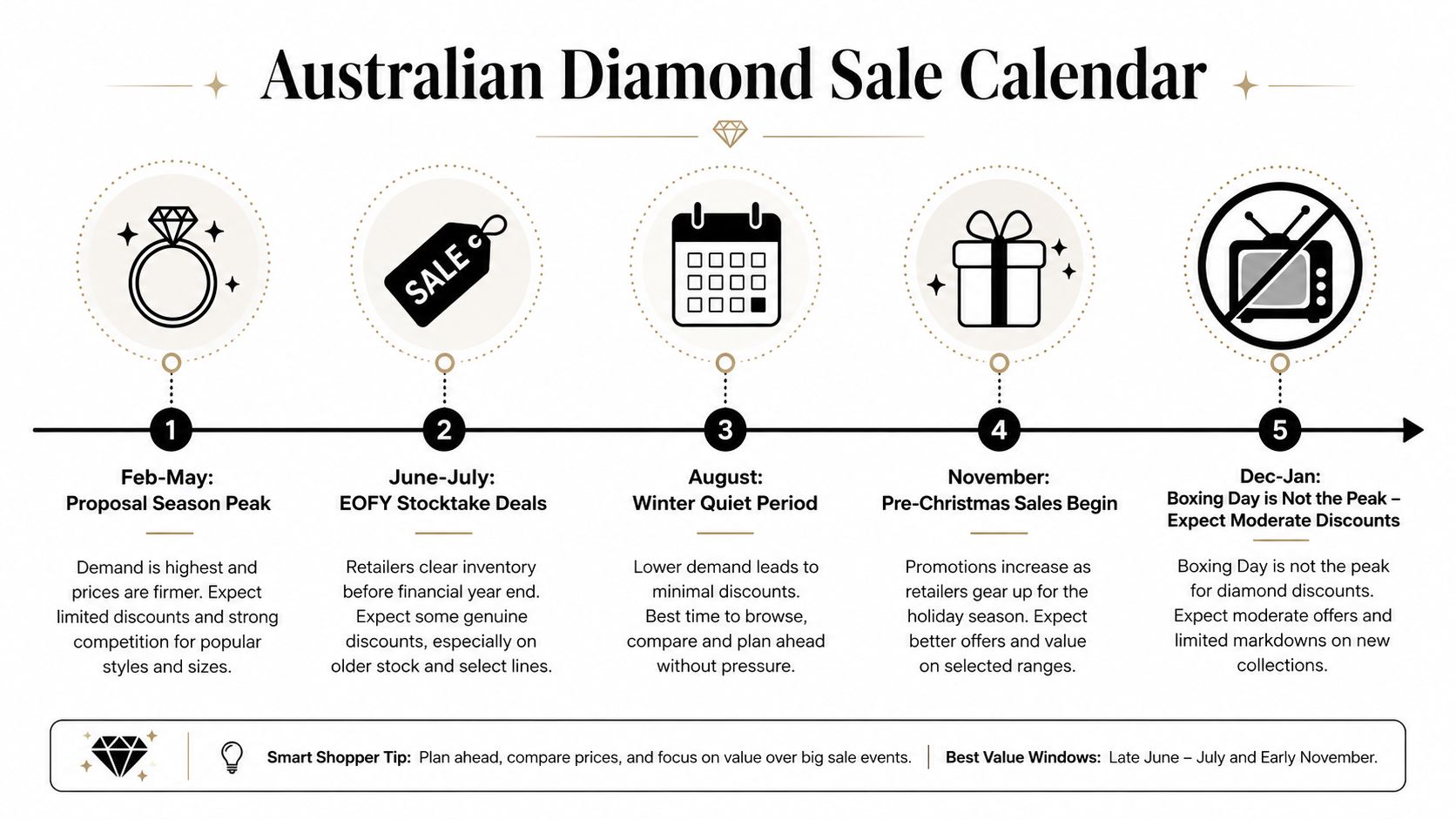
Read the calendar as a stock signal
- February to May: Proposal activity can make popular styles harder to discount. Buy when the exact stone and setting are right, rather than assuming the season brings the lowest price.
- Late June and July: EOFY stocktake can reduce existing inventory. Check that the ring is physically available, not merely listed as made to order.
- August: A quieter retail period can give you more room to ask questions and compare, even if the advertised discount is modest.
- November: Pre-Christmas promotions may suit ready-to-ship pieces. Confirm delivery, resizing and return deadlines before paying.
- December and January: Boxing Day deserves attention, but it does not automatically offer the strongest diamond value. Boxing Day sale guidance helps with event timing. It does not replace checking the stone.
Stack legitimate value sources, including loyalty vouchers, store credit and cashback portals, if the retailer permits them. Calculate the effective price after exclusions, delayed credit and any conditions attached to the benefit. A smaller discount with usable cashback can beat a larger headline reduction that excludes your ring.
Ready-made rings can receive a genuine stocktake reduction. Custom orders usually work differently because the setting is designed for you. A promotional week may improve the discussion without reducing the underlying cost in the same way.
For shoppers considering a two-ring design, the 2 Channel Ring Set with 0.80ct of Diamonds in 9kt Yellow Gold (Diamond) is described as a two-ring set with a square look, baguette shoulder and 9kt yellow gold. Its product snapshot does not confirm a promotion or delivery position, so ask whether the item is stocked, made to order or subject to a separate lead time.
Use the video as a visual aid, then rely on the written certificate and policy details before paying.
Mined, Lab Grown or Custom and What a Sale Actually Means
A sale on a mined diamond isn't automatically cheaper than a non-sale lab-grown diamond. Compare the ring you want, not the percentage attached to one category.
Mined diamonds come from geological deposits and can carry stronger emotional appeal for some buyers. Lab-grown diamonds have the same basic diamond composition but are produced through controlled processes. Custom rings let you choose the setting, stone and proportions, though the work involved can limit the usefulness of standard sale pricing.
Australian trend coverage reports growing interest in lab-grown diamonds, custom engagement rings and larger centre stones, alongside renewed interest in yellow gold and mixed metals. (Australian wedding ring trend coverage) That means a traditional mined solitaire with a large discount may still be the wrong purchase if it doesn't match the design or sourcing choice you want.
Compare the value dimensions
The requested price bands for a typical 1ct G VS2 ring aren't included in the verified data, so I won't invent AUD figures. Use this comparison as a buying framework instead.
| Type | Typical Sale Price (AUD) | Non-Sale Price (AUD) | Resale Risk | Trend Alignment |
|---|---|---|---|---|
| Mined diamond | Verify from like-for-like listings | Verify against current comparable listings | Resale value can be materially below retail | Strong for traditional buyers |
| Lab-grown diamond | Compare the complete ring, not the stone alone | Check current equivalent specifications | Treat resale expectations cautiously | Strong for shoppers prioritising size or design |
| Custom ring | A promotion may apply to selected components | Often quoted as a project price | Setting and labour can be difficult to recover | Strong for personal, non-standard designs |
A 30% discount on a mined solitaire can still cost more than a lab-grown equivalent with comparable stated cut, colour, clarity and carat. That comparison needs actual current listings, because the final difference depends on the stone, setting and retailer.
Custom work deserves a separate test. Ask which element is discounted, whether the centre stone is independently graded and whether changing the design changes the price. A “sale” applied to a consultation or setting doesn't necessarily reduce the cost of the finished ring.
For a category view focused on lab-grown jewellery, this lab-grown diamond jewellery guide is a useful starting point. Don't use trend alignment as a substitute for quality. Use it to avoid buying a heavily discounted style you'll immediately want to replace.
Buying Online Versus In Store for Diamond Rings
A diamond rings sale is easiest to judge online, but the showroom still earns its place when fit, setting or stone appearance is hard to assess from a screen. Online listings let you compare several complete rings, certificates and delivered prices without a salesperson directing you towards a higher-margin option. That wider basket comparison often exposes whether the discount survives once the setting, shipping and resizing are included.
A showroom lets you watch the diamond move under fibre-optic lighting, compare metal colours against your hand and test how the setting feels. You can also ask questions and arrange services such as resizing, although same-day availability depends on the retailer. Use the store for judgement, not pressure.
Online checks that aren't optional
Before pressing buy, confirm:
- Stone video: Look for a loose-diamond video or clear rotating view. If it shows a different stone from the report, stop.
- Certificate access: Match the report number, grading laboratory and listed specifications.
- Return terms: Read exclusions for engraving, resizing and made-to-order work.
- Shipping cover: Ask how the ring is insured during transit, particularly for a higher-value order.
- Arrival inspection: Photograph the parcel and inspect the ring promptly. If it differs from the video, contact the retailer before wearing it.
Keep the receipt, report and order confirmation together. The applicable industry requirements may also depend on the sale and the documentation supplied. For higher-value purchases, check that the diamond has the report the retailer says it has and that the report matches the stone.
A “30-day return” may exclude personalised, engraved or custom pieces. Confirm the resizing window, who pays for repairs and whether return shipping is deducted. Those conditions can erase a headline discount, so include them in the final basket value.
Choose the channel by complexity
Buy online when the certificate, return policy and complete price are clear. Choose in-store when the diamond is above 1.5ct or the setting is non-standard. Proportion, finger fit and mounting quality are harder to judge from photographs alone.
Use a deal-aggregator site to find candidates, then verify the offer on the merchant's own product page. Australian ecommerce guidance supports connecting related collection and product pages, so a path such as /collections/some-collection can make browsing easier than jumping between isolated listings. (Spiffy Stores collection URL guidance) Retailers should also link useful buying content with relevant collection pages, as outlined in TPR Media's Australian ecommerce SEO guide.
Using Deal Aggregators to Find Limited Time Diamond Deals
Deal aggregators are useful when they reduce search time without hiding the retailer. The safe workflow is simple: discover the offer on the aggregator, then complete your checks on the partner's own website.
Start with the stone, not the event label. Filter for GIA or IGI certification where appropriate, sort by your target carat range and confirm whether the displayed price includes the setting. Some listings describe a loose diamond, while others show a finished ring. Comparing them as if they're the same product will produce nonsense.
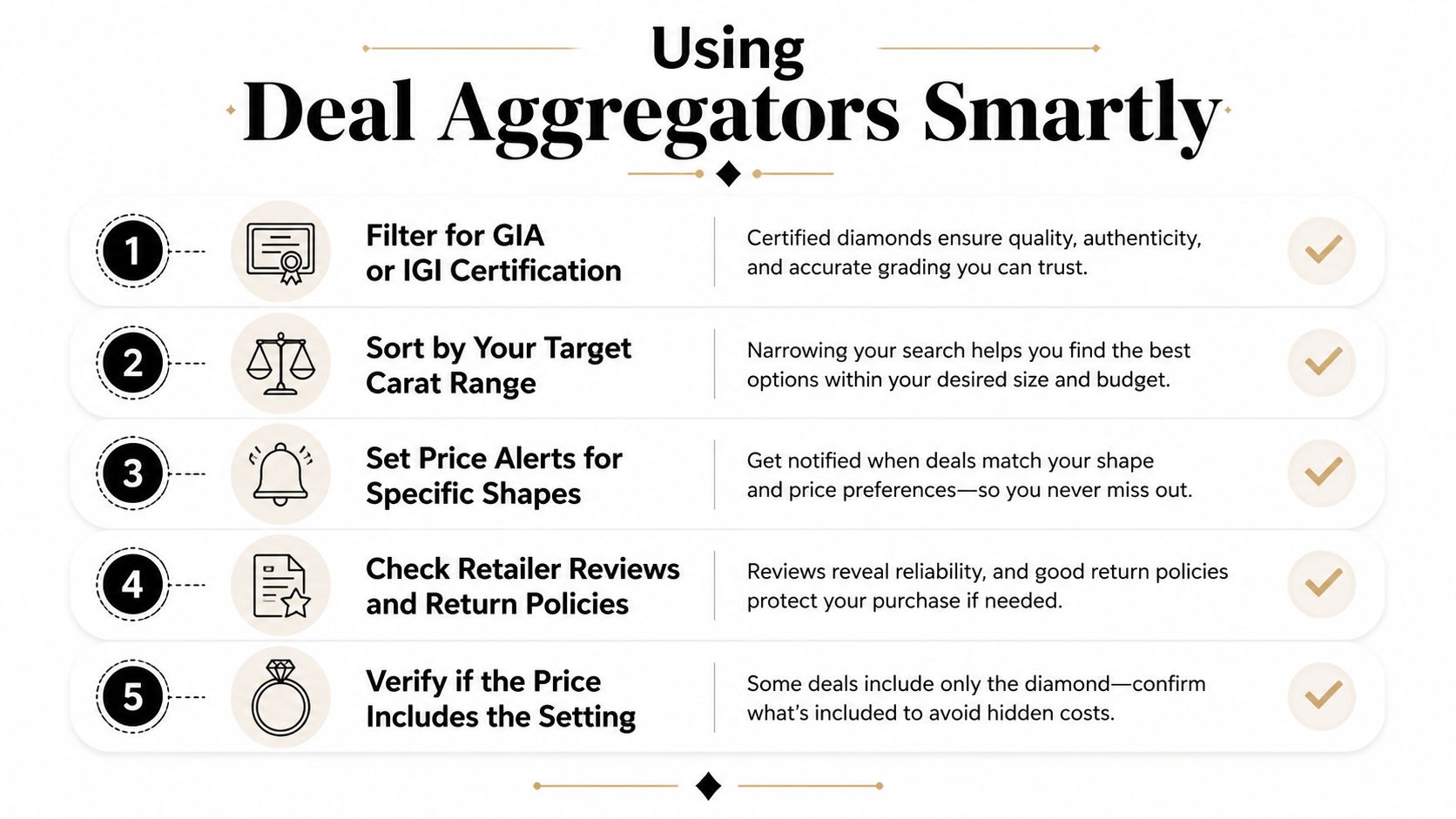
Run this check before you click through
- Confirm the partner: Check the retailer's legal business details, contact options and product page.
- Read the expiry language: A limited offer should have a clear end point. If the same promotion appears indefinitely, treat the urgency as cosmetic.
- Inspect the complete price: Include the setting, shipping, resizing and any required extras.
- Verify the policies: Read returns, insurance during delivery and warranty terms on the merchant's site.
- Pay the merchant: Never enter card details into an aggregator unless the transaction is clearly processed by the named retailer.
Suspicious round-number prices deserve extra attention. A price ending in a memorable figure isn't proof of deception, but it gives you no evidence of value either. Ask for the certificate, compare the specifications and check the retailer's own history.
Use collection pages to browse a category rather than relying only on one product link. Australian Shopify SEO guidance recommends keyword-rich internal links from blog posts to relevant product or collection pages, because those paths help shoppers and search engines understand the relationship between buying advice and merchandise. (Madsun Media's Australian Shopify SEO checklist)
Special8 is one option for surfacing jewellery and other retail offers from multiple stores, with deal pages and sale-event browsing that can help you identify candidates before checking out directly with the merchant. For advice on combining promotion discovery with retailer verification, see this designer discount guide.
Negotiation, Returns, Insurance and the Smart Buyer's Checklist
A sale price is useful only if the ring still works as a purchase after delivery. Ask whether the setting can be separated from the centre stone, whether another clarity or colour grade would look the same to you, and how the total changes with a different stone. Compare the complete basket, including the setting, delivery, resizing and required extras.
Get the return window in writing before paying. Check the allowed timeframe, condition requirements, exclusions for resizing or engraving, and responsibility for return postage. A verbal promise does not override narrower online terms.
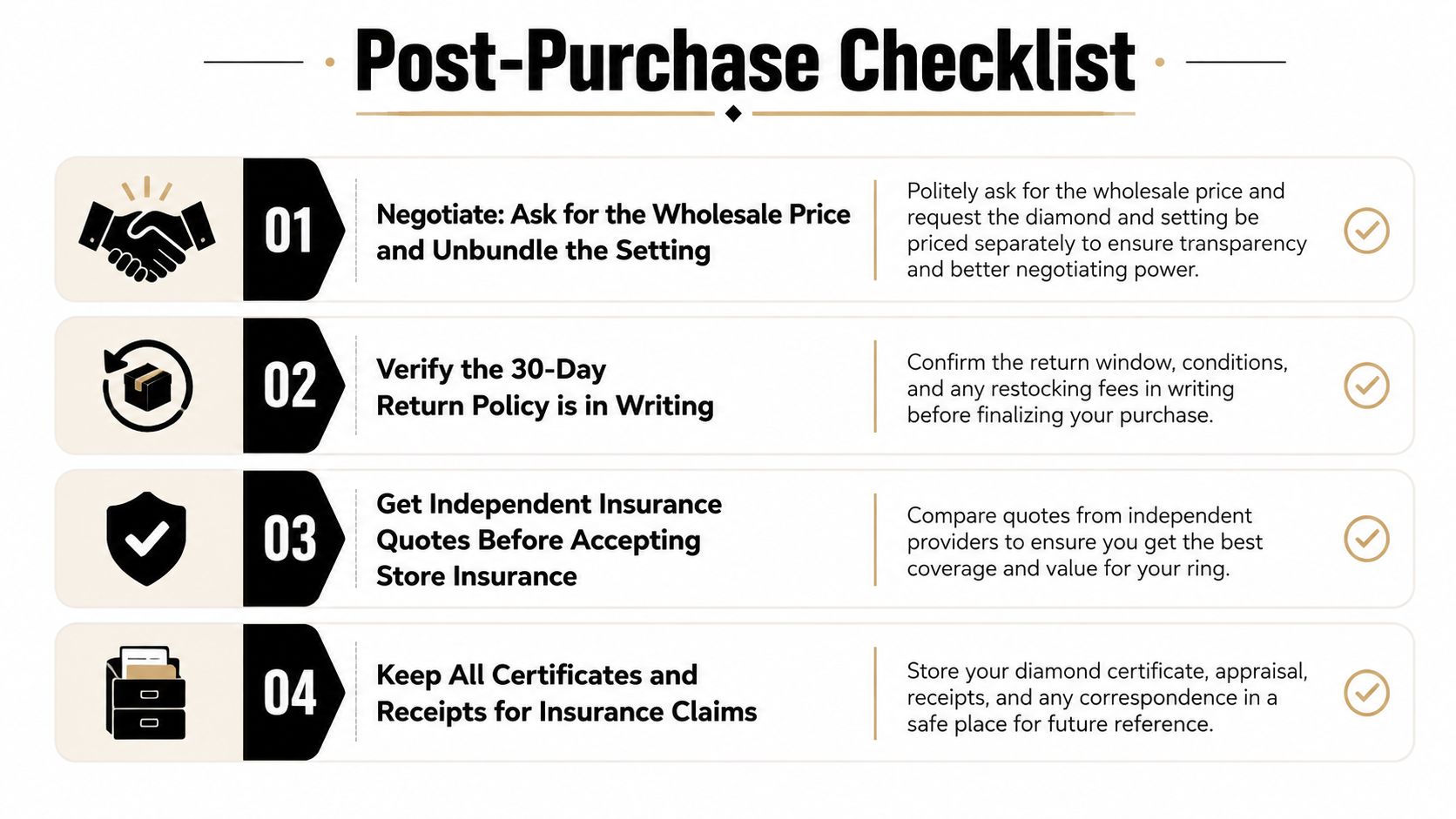
Your payment checklist
- Certificate: Match the report number to the diamond and keep the original documentation.
- Receipt: Store the receipt, order confirmation and product description together.
- Setting: Confirm the metal, ring size, workmanship coverage and resizing terms.
- Return: Read the written policy before approving engraving or customisation.
- Insurance: Arrange specialist jewellery cover promptly and check whether the replacement basis suits your needs.
Keep receipt and grading-report documentation aligned with the requirements under the JAA code. Standard home contents insurance may not cover a diamond ring on the replacement basis you expect, so ask for a specialist assessment before relying on an existing policy.
Use this price-match guarantee guide to prepare comparison evidence before speaking with a retailer. A price match has value only when the products match on the stone report, setting, metal and service terms. A cheaper headline price can disappear once those details differ.
Is now a good time to buy? Buy when the exact ring passes the certificate, basket-price, comparison and return checks. Wait when the retailer cannot explain the reference price, the stone report is missing, or the promotion is steering you towards a style you would not choose without the discount.
What makes a diamond rings sale worthwhile? A defensible total price, suitable cut, clear documentation, a workable return process and a setting you will keep wearing. The headline saving comes second.
Special8 aggregates Australian offers across jewellery, fashion, accessories and lifestyle retailers. Use Special8 to scan current promotions, then check the merchant's own terms, certificate, price history and return policy before buying.


