
Earrings Sale Australia: How to Find the Best Deals Online

You're on your phone with three tabs open, one for a sale page, one for checkout, and one for another store that just popped up cheaper. The cart looks good, the earrings look fine, and then you notice the size you wanted is gone or the “sale” price isn't better than last week's. That's the Australian earring grind, and the people who keep winning it aren't lucky, they're organised.
The smart move is to treat an earrings sale Australia search like a system, not a treasure hunt. The market is big enough to support constant discounting, with Australia's online jewellery and watch sales valued at $576.6 million in 2026 and revenue growing at an annualised 12.9% over the five years through 2025–26 according to IBISWorld. That scale matters because it means sale pages aren't random. They're structured to move stock, steer attention, and push you toward certain price bands.
Table of Contents
- Why Most Australians Miss the Best Earring Deals
- Where to Find Legitimate Earrings Sales in Australia
- Timing Your Purchase Around Australian Sale Cycles
- Materials and Quality Checks for Sale Earrings
- Setting Up Alerts and Comparing Deals Across Retailers
- Common Mistakes Australian Shoppers Make During Earring Sales
- Your Action Plan for Smart Earring Shopping in Australia
Why Most Australians Miss the Best Earring Deals
The usual mistake is simple. You search “earrings sale”, skim a few pages, add something to cart, and assume you've done the hard part. Then a better deal shows up in a collection page you never checked, or the style you liked was always a mid-tier markdown dressed up as urgency. The retailers know this, and they build sale pages to capture impulse, not patience.
The sale page is designed to hurry you
Most shoppers don't notice how often sale pages hide bargains inside collection links instead of broad search results. Australian jewellery sites regularly use URLs like /collections/sale-earrings, /collections/earrings-on-sale, and /collections/earrings-sale, which is exactly how they segment discounts into browsable category pages. That setup rewards people who look inside the category structure, not just the homepage banner.
If you're only scanning one retailer's front-end sale tile, you're probably seeing a curated slice, not the full markdown story. The better shops use scarcity language, countdown windows, and “selected items” phrasing to keep you moving. The smartest shoppers ignore the noise and check whether the pieces they want sit in a true category clearance or in a lightly discounted showcase range.
Practical rule: if a sale page doesn't let you filter by material, style, or category, assume it's built for browsing, not for savings.
Good deal hunters compare structure, not just price
A real bargain isn't just a lower tag. It's a piece that's discounted for the right reason, fits your wear habits, and doesn't force you into regret shipping or return drama later. That's why experienced shoppers compare the whole offer, not just the sticker. They look at the category page, the material, the sale window, and whether the item belongs to a slow-moving line or a useful everyday range.
Special8's online clothing sales Australia piece follows the same logic across fashion categories, and it's the same discipline that works for jewellery. If you're shopping earrings, use the same habit. Don't browse for fun. Browse with a target, then move fast when the right collection page appears.
Where to Find Legitimate Earrings Sales in Australia
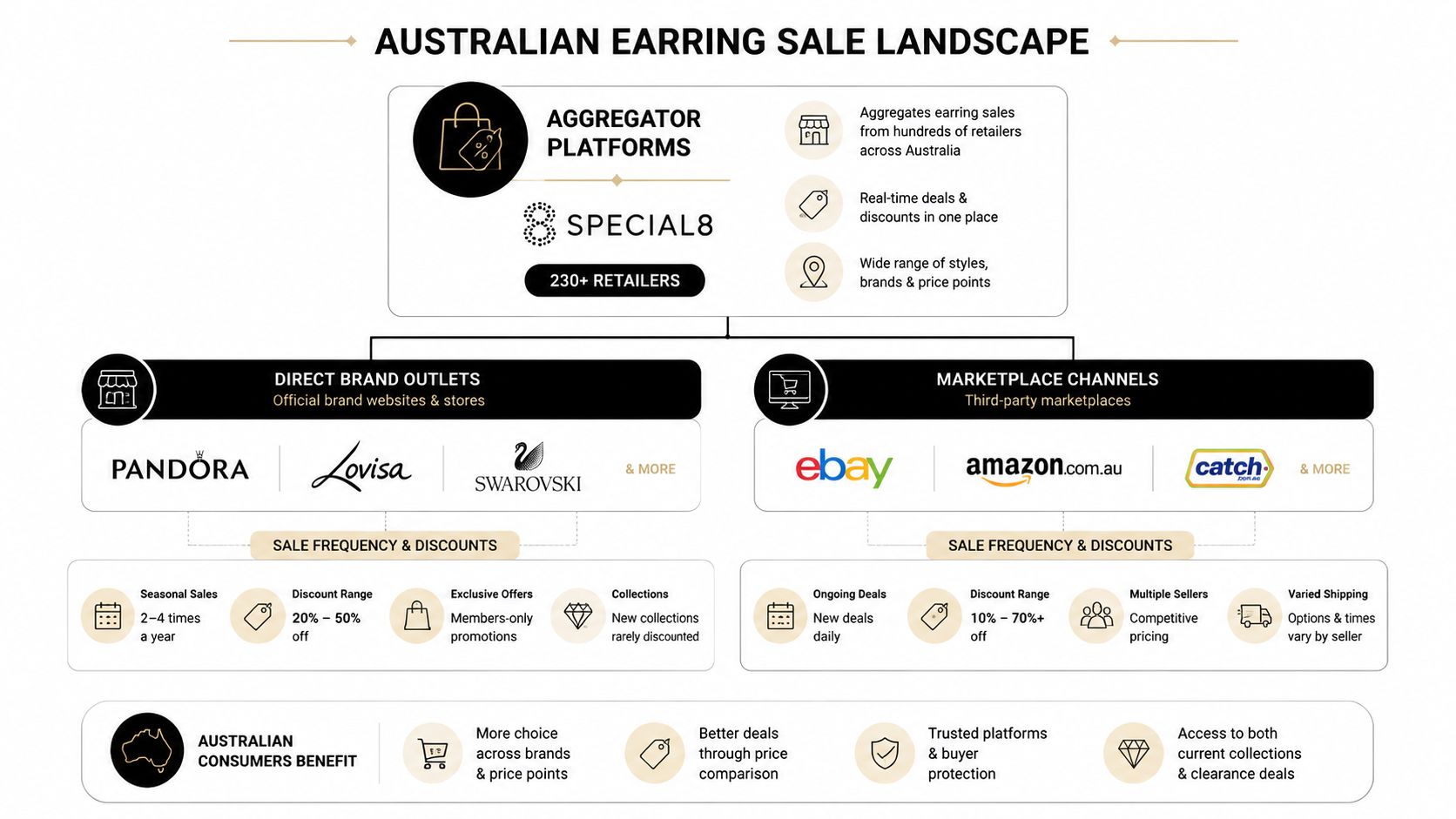
If you want the good stuff, stop relying on a single retailer search bar. The Australian earring sale breaks into three practical channels, aggregator platforms, direct brand outlets, and marketplace channels. Each one serves a different kind of shopper, and each one leaks value in a different way.
Start with an aggregator, then go straight to the source
Aggregator platforms make the first pass easier because they consolidate offers from many stores in one place. Special8, for example, surfaces deals from 230+ retailers, which is useful when you want to compare earring markdowns without opening ten tabs. That matters most for shoppers hunting everyday hoops, fashion earrings, and giftable pieces, where the price gap between stores can be wide.
Then go direct to brand outlets if you already know what you want. That's where collection links earn their keep. Australian jewellery retailers use them heavily, and they're usually the cleanest route to category-specific stock. If a brand has a dedicated earrings sale page, that's where you check first before you trust any homepage promotion.
A useful example is 15mm Diamond-Cut Hoop Earrings in 9kt Bonded Yellow Gold (Gold), which is a compact 2.5mm by 15mm hoop in 9kt bonded yellow gold with diamond-cut detailing and a polished finish. The point isn't that this exact piece is “the one”. The point is that sale earrings often live in the everyday-wear zone, not the one-off statement zone, so that's where you should look if you want repeat use.
If you're shopping for value, shortlist the styles you'd actually wear twice a week. That cuts out most sale clutter instantly.
Use the right channel for the right job
Marketplace channels can work when you're checking breadth or chasing a brand comparison, but they're weaker on clarity. Direct brand outlets are better when you care about material, fit, or post-purchase support. Aggregators are better when you care about speed and discovery. Special8's cheap fashion jewellery Australia coverage sits in the middle, which is useful if you want a fast read on who's discounting what before you commit.
If you want the cleanest path, use this order. Check aggregator, open the relevant collection page, then verify the material and sale mechanics on the retailer's own site. That sequence saves time and cuts down on fake urgency.
Timing Your Purchase Around Australian Sale Cycles
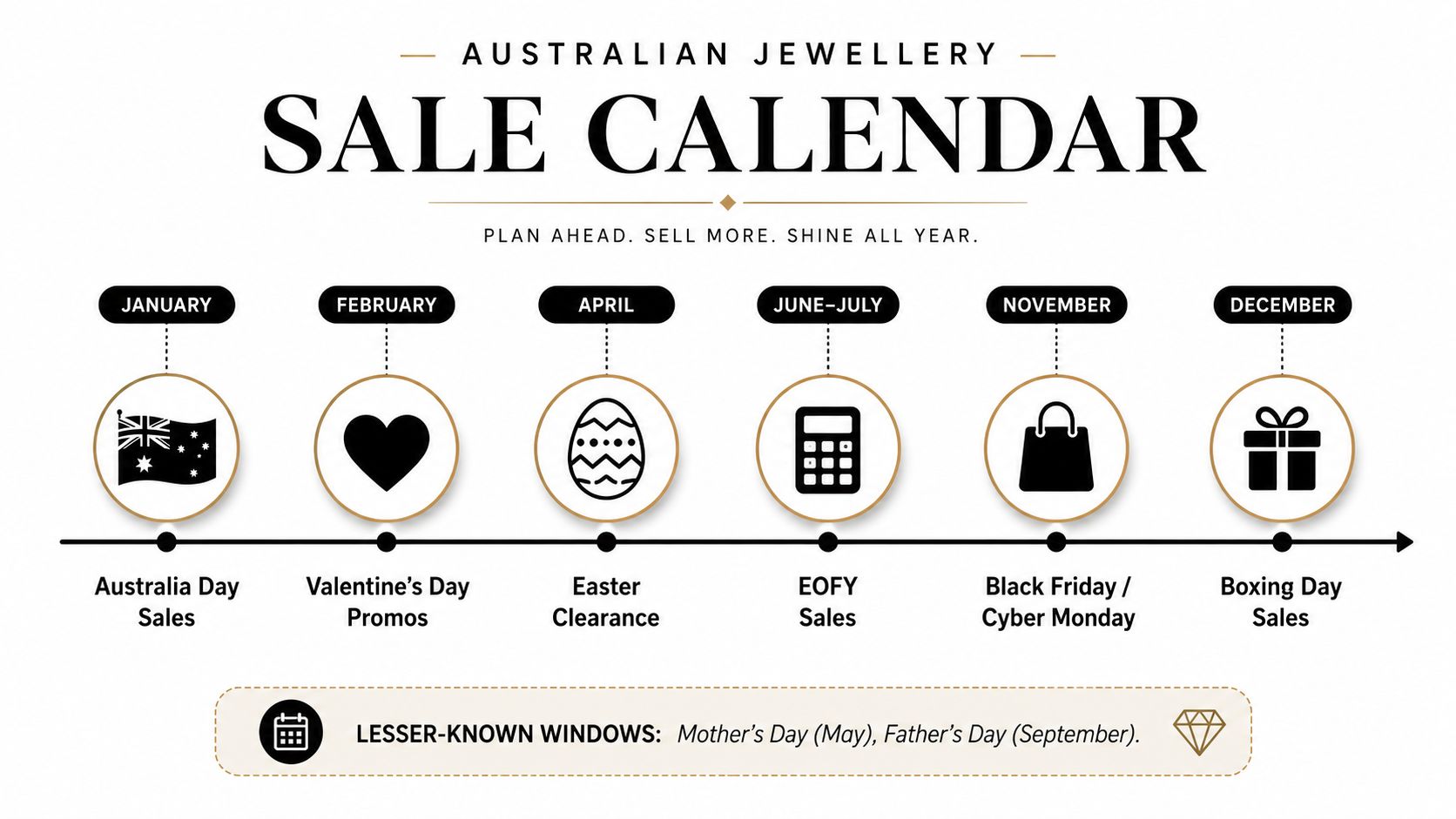
A good earring deal usually shows up when retailers are under pressure to clear space, reset collections, or push traffic through a slow period. EOFY and Boxing Day get the attention, but the sharpest buys often appear just before or just after those headline moments, when the range is still decent and the markdowns start to bite.
Watch for the sale windows that move stock
Australian jewellery retailers lean hard on EOFY, Black Friday, Cyber Monday, and Boxing Day, but the better value often sits in the quieter clearance periods between those events. When new stock arrives, older lines get pushed down through collection pages and sale pages. That is where the useful bargains live, especially in everyday hoops, studs, and fashion earrings.
Timed promotions tell you even more. A retailer running a short sale window is usually trying to clear a specific batch, not slash the whole range forever. The Littl's EOFY jewellery sale was advertised at up to 40% off and ran from 7am on 22 June to 11.59pm on 30 June, with a free pair of earrings on orders over $199. Secrets Shhh also advertises 20% off selected items in an online-and-in-store earrings sale. That is how Australian jewellery deals are commonly framed, clear window, clear stock, clear intent.
Don't wait when the stock is specific
If you want a narrow style, hesitation usually costs you the exact pair you wanted. Sale windows cut range first, then prices. Broad fashion earrings can wait a little longer. A specific metal finish, closure type, or occasion piece usually cannot.
The Perth Mint's free worldwide shipping on orders over AUD 300 excluding bullion is a reminder that sale timing and basket strategy go together. Special8's EOFY sale coverage makes the same point in a practical way. Plan the timing first, then decide whether the deal is worth locking in.
If a sale is for a precise item you want, buy it. If it is only a broad discount on a range you would never wear, wait for the next cycle.
Materials and Quality Checks for Sale Earrings
Discounted earrings are where shoppers get sloppy. They see a lower price, assume the quality must still be fine, and ignore the material details that decide whether the piece lasts or irritates their ears. That's the wrong trade-off. A cheap pair that tarnishes, scratches, or triggers discomfort costs more than a well-made pair bought on sale.
Check the metal first, not the discount
Australian jewellery supply chains often judge earring value by weight in grams, purity or carat, and the live gold spot price at the time of sale. A Sydney-focused gold buyer also notes that broken or single earrings can still have scrap value, and that non-gold stones or charms are usually deducted from the gold weight during valuation. The common purity marks used in Australia are 9ct (375), 14ct (585), and 18ct (750), which are the basic hallmarks worth knowing before you buy or resell. See gold buyers' earring valuation guidance for the valuation logic.
Practical rule: if the product copy hides the metal, assume the retailer wants you focused on the price, not the value.
Compare materials by use case
The difference between solid gold, gold-filled, gold-plated, and lower-cost fashion metals is not academic. It decides whether a piece is everyday-safe, occasional-only, or likely to wear down quickly. For fresh piercings and sensitive ears, material clarity matters more than design flair. Sale pages that don't specify exact material composition are not doing you any favours.
| Australian Earring Material Quality Guide | Hallmark | Durability | Sensitive Ear Safe | Typical Sale Price Range |
|---|---|---|---|---|
| Solid gold | 9ct, 14ct, 18ct | High | Usually yes | Higher sale bracket |
| Gold-filled | Often marked by layer description, not a purity hallmark | Moderate to high | Often better than plating | Mid-sale bracket |
| Gold-plated | Usually no gold purity hallmark | Lower | Sometimes, but not ideal for long wear | Lower sale bracket |
| Sterling silver | 925 | Moderate | Often yes, depending on sensitivity | Mid to lower sale bracket |
| Fashion metal or mixed material | None | Variable | Usually no for sensitive ears | Lowest sale bracket |
If you want a practical filter, use the sale page to shortlist only pieces with explicit metal declarations. Then look at earring shape, back style, and weight. That's the quickest way to avoid buying something that looks elegant online and feels wrong the first time you wear it.
For shoppers drawn to decorative pieces, cubic zirconia earrings are a good reminder that sparkle doesn't have to mean high-risk spending. The key is knowing whether the setting and base metal suit your skin and habits.
Setting Up Alerts and Comparing Deals Across Retailers
Manual checking is a waste of time if you shop earrings more than a few times a year. The better approach is a small alert system that does the scanning for you, then lets you step in only when a deal matches your shortlist. That keeps you from doom-scrolling sale pages every night.
Build a narrow alert list
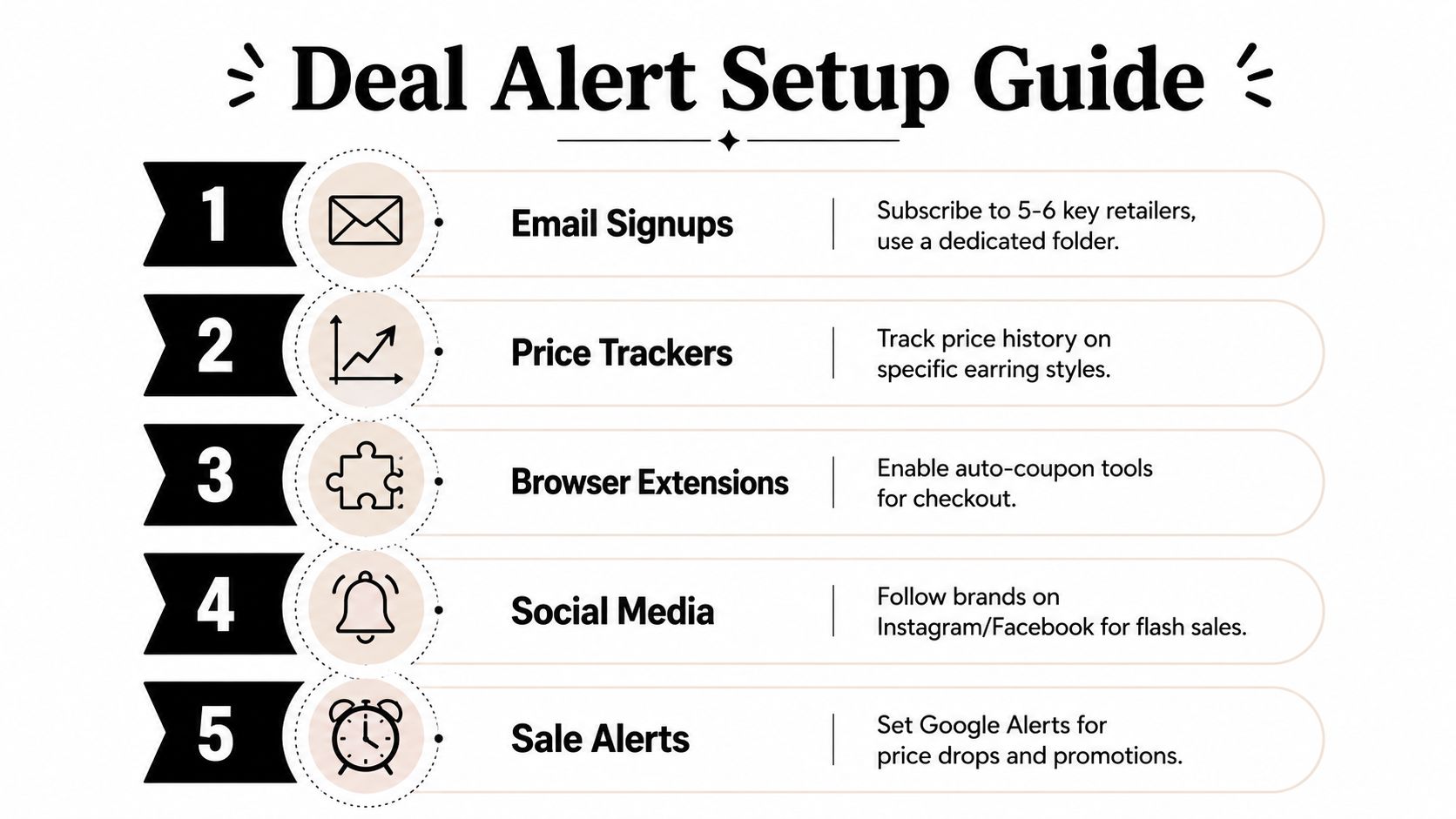
Start with a handful of retailers that send useful alerts, not noisy ones. Sign up for email only where the sale cadence is worth your attention, then keep the messages in a dedicated folder. That's the fastest way to avoid missing a flash sale while still keeping your inbox usable.
Use social follows for brand-led drops and store announcements, then layer in price-tracking tools for the exact styles you care about. If you're watching a specific hoop shape, stud size, or metal finish, price history is more useful than a generic “sale now on” email. Special8's online shopping discount codes guide fits neatly into that system because it's about keeping tabs on offer mechanics without wasting time on dead-end discounts.
Compare the same item before you buy
Once a piece lands on your radar, check whether another retailer carries the same or a near-identical version. That matters especially for evergreen styles like small hoops and plain studs, where the exact same look often appears across multiple brands. Compare total cost, not just ticket price. Shipping can wipe out a small discount fast.
Don't chase every alert. Only chase the pieces you'd buy at full price if the metal and fit were right.
A simple discipline works best. Open the brand site, check the collection page, compare the wording on material and finish, then compare shipping or threshold offers. If the deal only looks good because the original price was inflated, walk away. If it still looks good after shipping, material, and fit, buy it before the size runs out.
Common Mistakes Australian Shoppers Make During Earring Sales
The most expensive mistake is buying a pair of earrings because the discount looks large. That mindset gets people every time. They skip the policy details, ignore the metal, and end up with a piece that never becomes part of their regular rotation.
Shipping and returns can kill a bargain
A sale earring that needs paid return postage is not automatically a good deal. If the fit is wrong, the value drops straight away. Online jewellery is especially unforgiving here because earrings are personal. You can't really judge comfort from a thumbnail image.
The same goes for free-shipping thresholds. They can be useful, but they can also pressure you into adding a second item you didn't plan to buy. That's not saving money. That's padding the order to qualify for delivery savings.
Trend pieces age badly
Statement earrings can be fun, but they're the first thing to look dated if your wardrobe is mostly built around simple basics. Buyers who shop sales well usually prefer pieces that work across outfits, not just for one season. That's why classic hoops, clean studs, and restrained finishes hold their value better in a sale strategy.
Don't let fake “original prices” drive the decision. Some discounts are real, some are just marketing theatre. The only price that matters is the one you'd still pay if the item had no discount banner beside it.
Best habit: ask whether the pair would still make sense if you saw it on the rack at the marked-down price with no hype attached.
Your Action Plan for Smart Earring Shopping in Australia
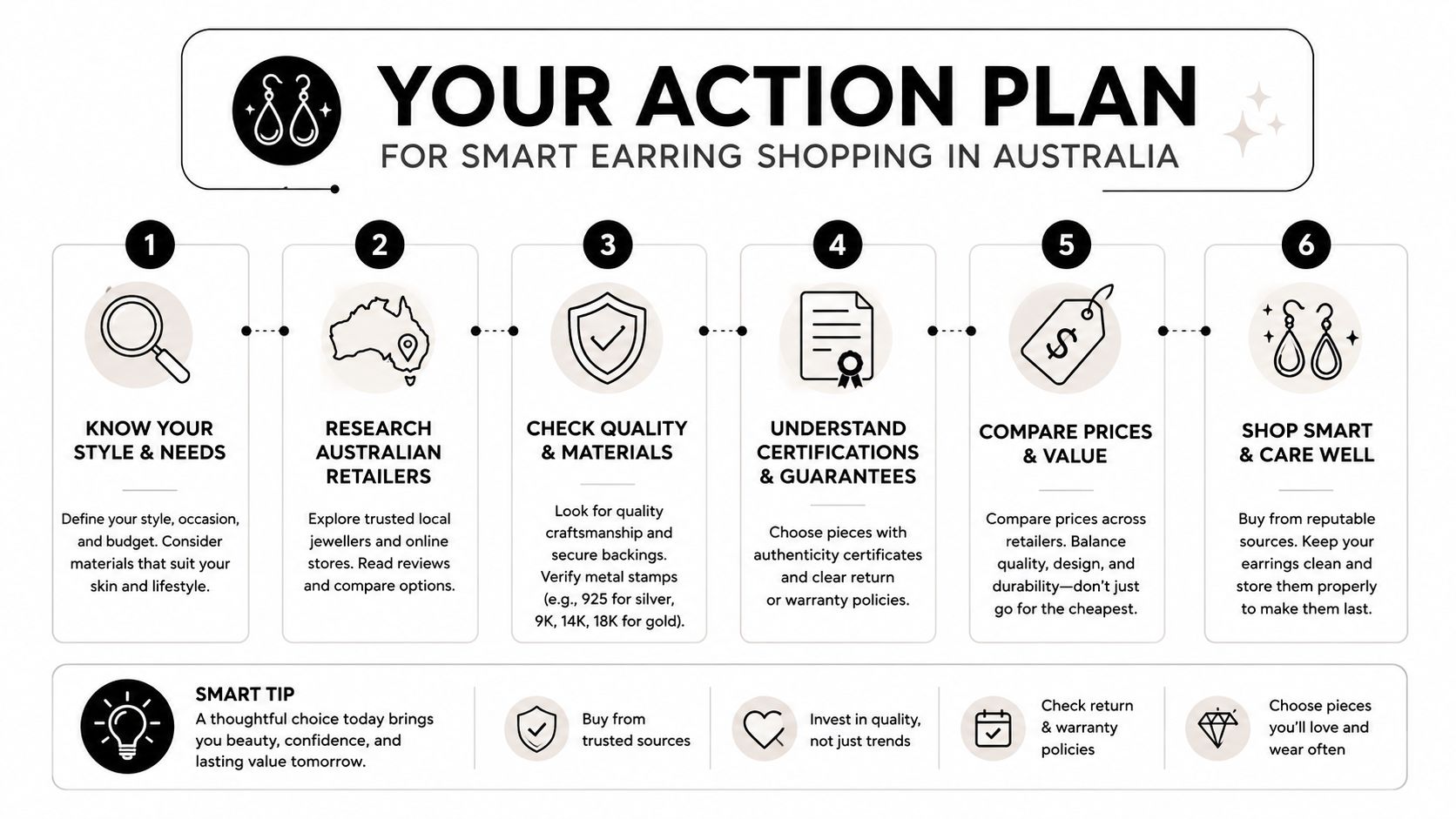
Start with a shortlist, not a mood. Pick the earring types you wear, hoops, studs, huggies, statement pieces, then decide which metal categories you trust. That gives you a buying frame before the sale noise starts.
Use a simple buy or wait rule
Buy now when the item is specific, the material is clear, and the price still makes sense after shipping. Wait when the discount looks broad, the material is vague, or the piece only appeals because it's marked down. That's the whole game.
If you want a clean system, keep three checks in your head. Does it suit your ears, does it suit your wardrobe, and would you buy it at that price if the sale banner disappeared? If the answer is yes three times, move. If not, leave it.
Build a collection, not a cart
The best sale shoppers don't chase volume. They build a small, useful set of pieces that cover daily wear, work wear, and dress-up occasions. That usually means one or two reliable metals, a few shapes you know you'll wear, and no panic purchases.
Use alerts, collection pages, and retailer comparisons to make the process repeatable. The point isn't to shop more. It's to shop better, with fewer mistakes and fewer returns. Keep records of what you bought and what you wore, and you'll quickly see which sale styles are worth your attention next time.
If you want a faster way to track earring deals without bouncing across dozens of sites, visit Special8 and use it to scan current fashion, jewellery, and accessory markdowns in one place. It's built for Australian deal hunting, so you can compare offers, catch limited-time sales, and move when the right pair shows up.


