
Midi Dress Sale: Your Guide to Real Discounts

Sunday night, your inbox fills with sale emails. Dozens of midi dresses flash red prices, countdown timers and urgent subject lines, all promising the wardrobe update you apparently can't afford to miss. You scroll, compare, hesitate, then wonder whether the saving is real or just clever pricing dressed up as a bargain.
The useful question isn't “Where can I find a midi dress sale?” It's “Is this discount worth buying today?” That means comparing the current price with the retailer's usual markdown rhythm, the sale event behind it, the dress's construction and the cost of getting it wrong. Australia's fashion eCommerce benchmark conversion rate is 3.1%, giving retailers a practical baseline for measuring their sales funnel, while Australia Post notes that 1 in 3 shoppers who wait for sales do so specifically before buying women's fashion. You can use that same discipline as a shopper by treating every promotion as evidence, not an instruction to click. (Australian fashion eCommerce benchmark)

Table of Contents
- Why Most Midi Dress Sale Pages Are Not What They Seem
- The Australian Midi Dress Sale Calendar and What to Expect Each Window
- Building a Personal Watchlist So Sales Come to You
- Reading a Sale Listing Like a Sceptical Shopper
- Sizing, Fabric and Fit Checks Before You Commit
- Smart Checkout Tactics, Styling and Care That Protect Your Savings
- Your Midi Dress Sale Cheat Sheet
Why Most Midi Dress Sale Pages Are Not What They Seem
A sale banner tells you that a retailer wants attention. It doesn't prove that the dress is cheap, well made or likely to be discounted further. Start by separating the buying decision into three parts: when to buy, how to judge the listing and how to finish the purchase without regret.
The first decision is timing. A markdown during a major promotional window may be a genuine event price, while a quiet clearance can signal that a retailer is clearing seasonal stock. The second is evidence. Check the original price, the current price, the stated discount and whether the same style appears elsewhere. The third is practical. A bargain loses its appeal if the fit is wrong, the fabric needs impossible care or return postage wipes out the saving.
Practical rule: Treat the sale calendar as a research tool, not a trigger.
The midi silhouette deserves this level of attention because it isn't a disposable micro-trend. Fashion histories commonly trace the length back to the 1920s, with Coco Chanel's October 1926 black dress often cited as an early milestone because it fell below the knee towards the calf. Australian retailers still treat the category as substantial. For example, one Australian sale collection lists 745 women's midi dresses, demonstrating the depth available for promotions, clearance cycles and category-wide discounting.
That longevity gives you a useful advantage. A midi dress sale is usually part of a recurring retail cycle, not a once-only opportunity. Keep a note of the style, retailer and advertised price, then compare it with later sale windows. For broader dress-sale browsing and commentary, this Australian dresses sale review can sit alongside your own price notes.
The Australian Midi Dress Sale Calendar and What to Expect Each Window
Australian fashion sales follow a recognisable rhythm. EOFY, Afterpay Day, Click Frenzy, mid-season clearances, Black Friday and Boxing Day each create different pressures for retailers, so the same midi dress can receive very different treatment depending on its position in the season.
The available Australian deal coverage describes fashion discounts clustering around these event periods, with markdowns varying from about 15% to 70% depending on the retailer and promotion. (Australian fashion sale event coverage) That range is broad enough to make the event name less important than the actual price history.
| Sale Event | Discount Range | Best For |
|---|---|---|
| EOFY | About 15% to 70% | Comparing current-season promotions with early clearance |
| Afterpay Day | About 15% to 70% | Event-led offers and selected brand promotions |
| Click Frenzy | About 15% to 70% | Fast decisions across multiple participating retailers |
| Mid-season clearance | About 15% to 70% | Finding styles retailers need to move before the next range |
| Black Friday | About 15% to 70% | Broad fashion promotions and competitive price checking |
| Boxing Day | About 15% to 70% | End-of-season clearance and deeper stock reduction |
The table shows the available range, not a promise that every retailer will use the same markdown. EOFY deserves particular scrutiny. The Australian Retail Council and Roy Morgan found that 6.1 million Australians, or 26%, planned to shop EOFY sales, with clothing, footwear and accessories the top category at 34%. The same release reported that 37% expected to spend more than the previous year, while 27% planned to spend less, a useful reminder that retailers are competing for both enthusiastic and cautious shoppers. (EOFY shopping intentions)
For a midi dress, early event pricing may reward patience if the size range is strong and the dress is still current. Later clearance can offer a sharper reduction, but popular sizes and colours may disappear first. My recommendation is simple: buy at EOFY or an event-led sale when the price already compares favourably with your notes. Wait for end-of-season clearance when the dress is replaceable and you care more about the lowest possible price than choice.
For Boxing Day timing and broader event planning, use this Boxing Day sales guide as a discovery point, then verify the listing against the retailer's own product page.
Building a Personal Watchlist So Sales Come to You
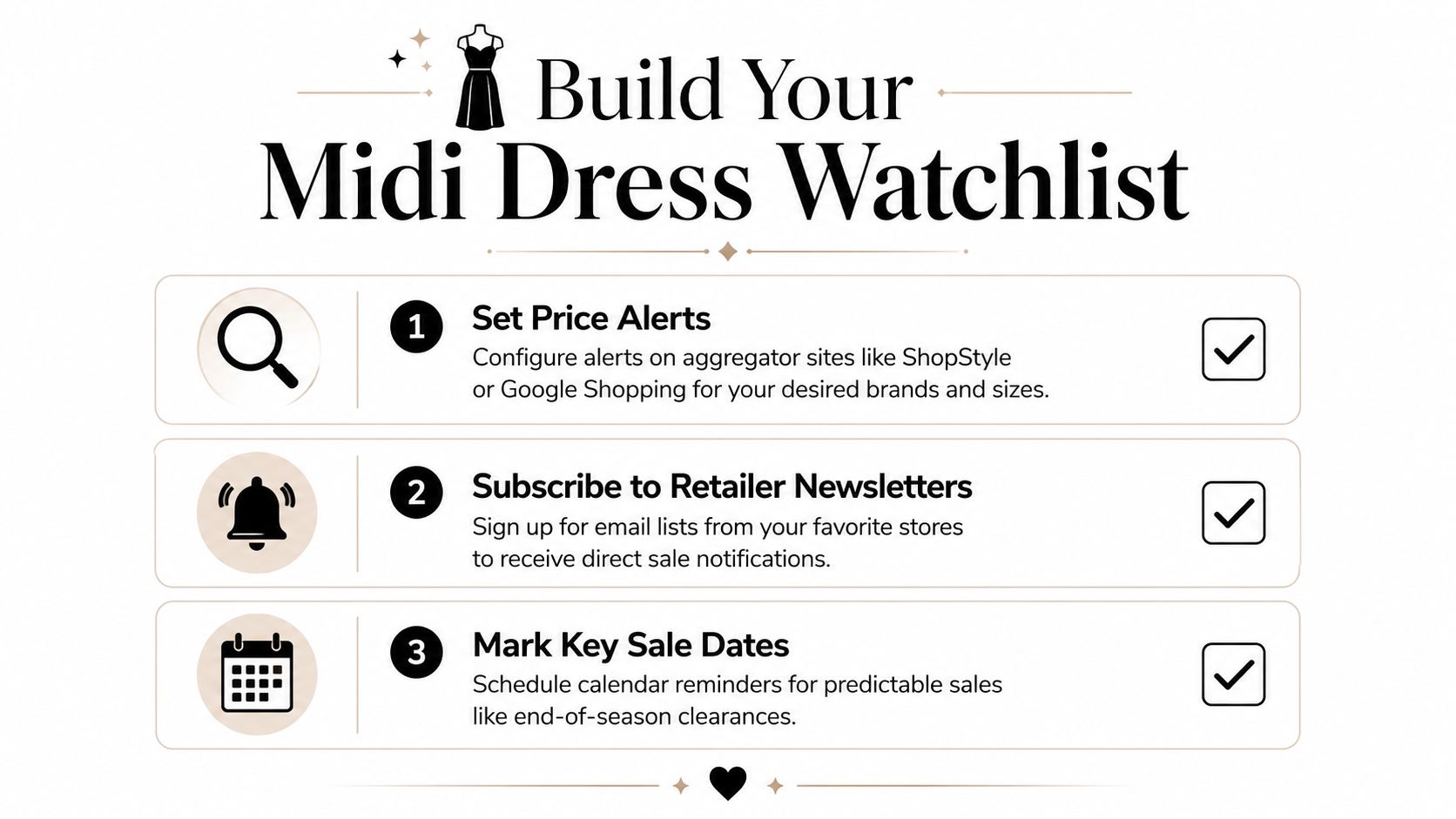
A dress that looks like a bargain today may have been cheaper last month. Build your watchlist before the next sale, then benchmark each markdown against your own price history instead of trusting a red sticker.
Start with a short list of specific silhouettes, fabrics, brands and sizes. Record the retailer, product name, colour, fabric, size and current price. Add the date and the advertised comparison price so you can see whether a discount is new, repeated or just dressed-up marketing. If a listing disappears, those notes give you useful search terms later.
Deal aggregators can help you spot event timing and competing offers. Price tools on platforms such as ShopStyle or Google Shopping can track selected brands and sizes, but use them to find changes, not to make the purchase decision for you.
Set alerts with a purpose
Set the buying rule before an alert arrives. “Any midi dress” creates noise. “Cotton floral midi in my size from this retailer below my recorded target price” gives you a clear decision.
Retailer newsletters serve a separate purpose. They may reveal private codes, early access or clearance announcements, but too many subscriptions recreate the inbox problem you are trying to avoid. Subscribe only to brands you would buy from, and use a separate shopping inbox if promotional mail starts burying useful messages.
A curated deal site can shorten discovery. Special8 aggregates fashion, footwear, accessories, jewellery and lifestyle offers from 230+ stores nationwide, with sale, brand and category browsing, price and saving information, ending-soon alerts and email updates. Use it to identify a possible midi dress sale, then open the retailer's own listing and compare the current price with your notes.
Keep your links clean
Retailers using Shopify commonly place collection pages under /collections/ and product pages under /products/, with those prefixes fixed in the platform's URL structure. (Shopify URL structure guidance) A collection page groups related products, while tagged versions can appear under paths such as /collections/collection-name/tag-name. (Collection URL explanation)
Use the retailer's canonical collection page when you broaden the search. A practical discovery starting point is this guide to online clothing sales in Australia, then record any promising dress and its price in your watchlist.
Reading a Sale Listing Like a Sceptical Shopper
The fastest way to waste money is to read only the red price. Read the whole listing as if you're checking an invoice.
First, identify the comparison price. A clear original price paired with a current price gives you something to assess. “Up to” language doesn't tell you what the midi dress in your size costs. A discount percentage is useful only when it applies to the item you're considering, not to an unrelated product at the edge of the sale collection.
Test the price against the event
Compare the listing with your watchlist notes and the relevant sale window. The Australian deal coverage cited earlier places fashion markdowns across a wide range, from about 15% to 70%, so a dramatic banner isn't automatically unusual or exceptional. A smaller reduction may be sensible for a current style with broad size availability, while a larger reduction may reflect end-of-season stock, limited sizing or a retailer trying to clear a slow colour.
Cross-check the same dress, or a close equivalent, at other retailers. The best deal is often an outlier with a clear original price and a credible seller. It isn't always the listing with the largest percentage printed beside it.
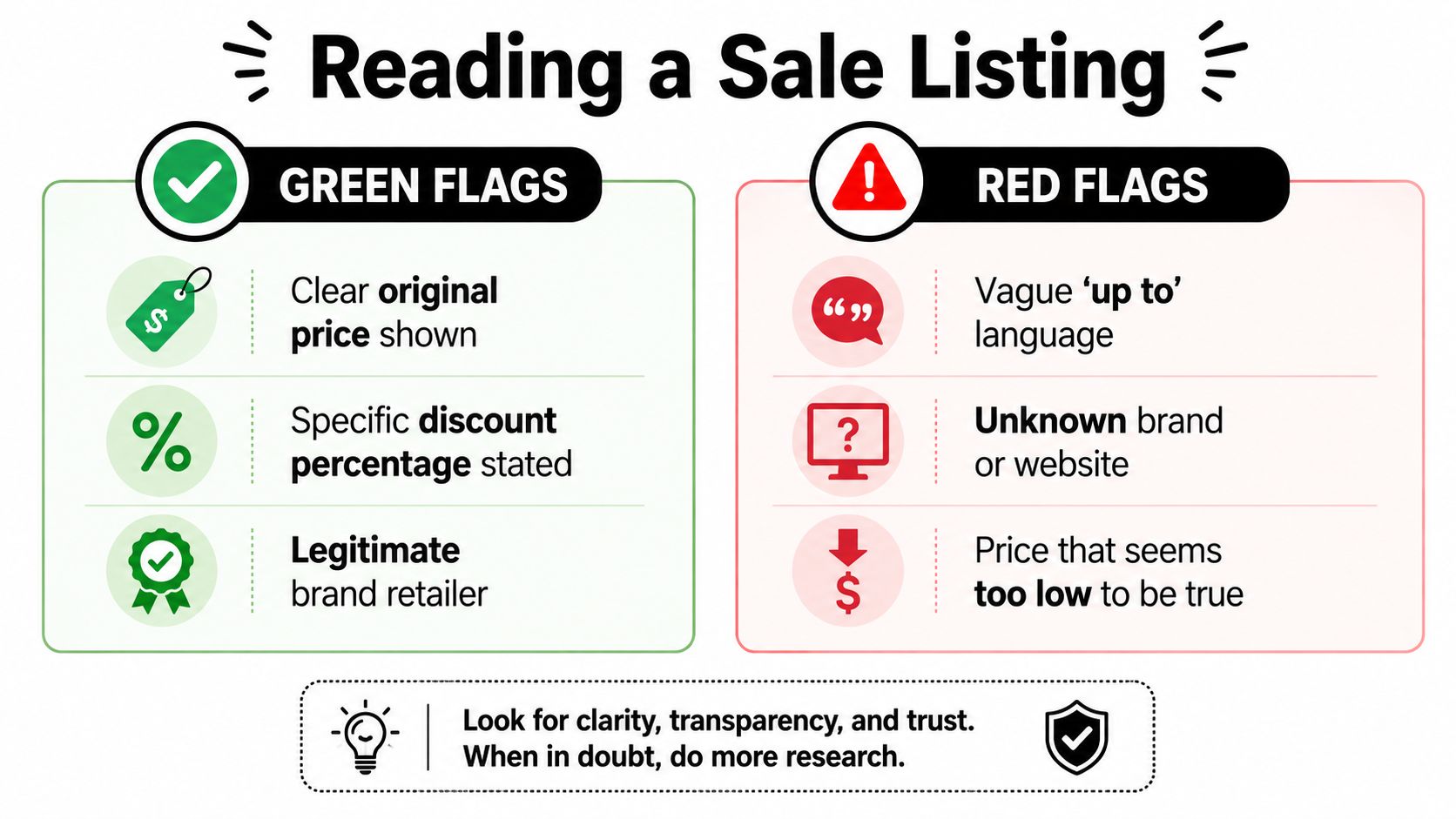
A low price doesn't compensate for uncertain fabric, vague sizing or an impossible return process.
Quality checks belong beside the price check. Look for fibre content, lining, closure details, care instructions and garment measurements. Product photography can make a thin, unlined dress look substantial, so the written specifications matter more than the styling image.
For example, the 132 Fashion St Tropez Dress (Berry Multi) is described as a midi-length, button-through dress with a refined collar, adjustable self-tie waist, soft slip, long sleeves and a berry, blush and neutral floral print. Its listed fabric is 100% breathable cotton, with a gentle cold machine wash recommendation. Those are useful facts to evaluate, but they don't establish a discount or guarantee the fit beyond the stated true-to-size guidance.
Sizing, Fabric and Fit Checks Before You Commit
A discount only counts if you'll wear the dress. Start with the retailer's size chart, not the size you usually buy elsewhere. Measure your bust, waist and hips using the method the retailer specifies, then compare those measurements with the garment or body chart. If the listing gives only generic size labels, treat the fit as less predictable.
Midi length also depends on your proportions and shoes. Check the model's height where it's provided, look for a stated garment length and consider whether you want the hem at the calf, closer to the ankle or somewhere between. A dress that works with sandals may feel awkward with boots if the hem lands at the wrong point.
Inspect the construction details
Button-through styles need room across the bust and should lie flat when you move. Wrap dresses need enough overlap to stay secure when walking and sitting. Tiered or gathered midi dresses need careful attention to where the volume begins, because a seam placed at the wrong point can change the entire shape.
Fabric tells you how much care the bargain may demand. Cotton can be breathable and practical, viscose and rayon can drape beautifully but may need gentler handling, and blends vary according to their composition. Don't assume a natural fibre automatically means better construction. Check the stitching, seam finishing, lining, button attachment and hem before you decide.
Use this clothing measurement guide before ordering, especially when the dress is non-returnable or the remaining size selection is narrow.
Read the policy before the price
Confirm whether sale items can be returned, exchanged or refunded. Check the return window, exclusions, return postage and whether the retailer requires tags attached. Then inspect shipping thresholds and regional delivery terms. A low item price can become an expensive mistake if you need to return it or add unwanted items to qualify for delivery.
Write down three answers before checkout: Will it fit? Will I wear it with what I own? Can I return it if the answer is no? If any answer is unclear, leave the tab open and wait.
Smart Checkout Tactics, Styling and Care That Protect Your Savings
Checkout is where a promising midi dress sale can lose its value. Before paying, place the item in the cart, apply the advertised code exactly as stated and check whether the promotion excludes sale merchandise, selected brands or delivery. Some retailers allow code stacking, others don't. Test only legitimate offers and don't let a coupon hunt push you into buying a dress you wouldn't choose at the full checkout total.
Payment instalments can make a larger purchase feel smaller, but the timing of the payment doesn't improve the value of the dress. Review the total cost, delivery charge and return conditions before selecting any instalment option. If you abandon a cart, a retailer may later send a reminder or an additional offer, but that isn't guaranteed. Use the pause to reconsider the fit and price, not as a tactic you can rely on.
Protect the saving at the final screen
Check these details before pressing pay:
- Coupon rules: Confirm the code applies to your size, colour and sale item.
- Delivery total: Make sure the shipping charge doesn't erase the reduction.
- Return conditions: Read the sale-item exclusions and postage responsibility.
- Order details: Check the selected size, colour, quantity and delivery address.
- Payment security: Use the retailer's normal checkout and keep the confirmation email.
For more practical code-hunting without relying on random pop-ups, use this guide to online shopping discount codes.
A versatile midi earns its place when you can change the styling. Add a blazer and ankle boots for work, swap to sandals and a woven bag for warmer days, or layer a knit over the dress so the skirt reads as a separate piece. A belt can alter the shape of a relaxed silhouette, while a slip can improve coverage and reduce cling.
Care determines whether the saving lasts. Follow the garment label, favour cold washing where permitted, avoid harsh agitation and dry delicate fabrics flat or in the shade when the care instructions call for it. Cotton, viscose and rayon can react differently to heat, so the label should win over a generic routine. Store the dress with enough space to prevent creasing, and repair a loose button or hem before a small problem becomes a reason not to wear it.
Your Midi Dress Sale Cheat Sheet
The best midi dress sale isn't the loudest banner. It's the purchase where timing, markdown depth, fit, quality and return confidence line up.
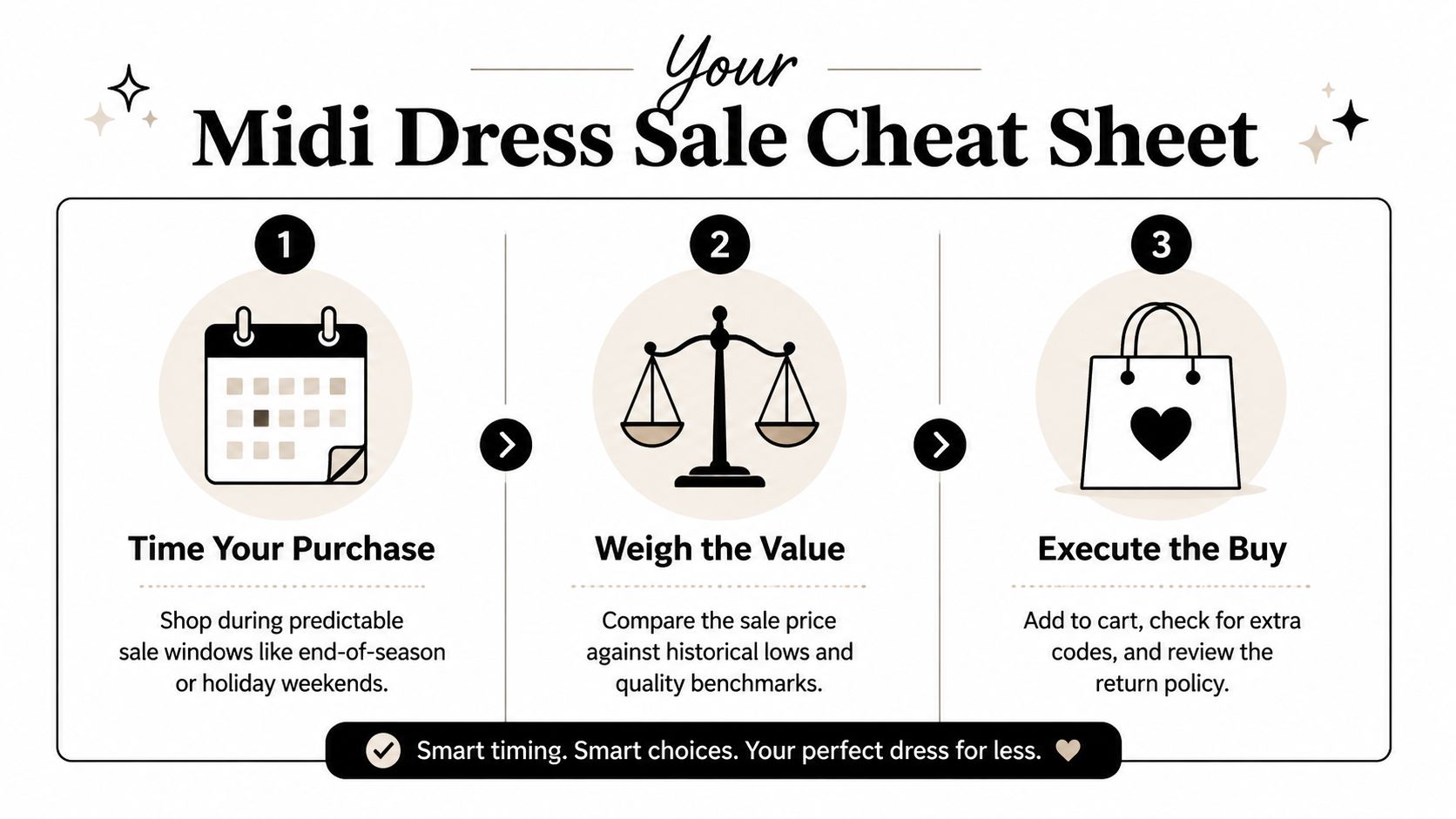
Use this three-part test:
- Time the purchase. Compare EOFY, Afterpay Day, Click Frenzy, mid-season clearance, Black Friday and Boxing Day with the dress's apparent position in the season.
- Weigh the value. Check the original price, actual sale price, fabric, construction, size chart and your own notes. A large percentage means little if the listing is vague or the dress won't earn repeat wears.
- Execute the buy. Apply valid codes, inspect shipping and return terms, verify the order details and save the confirmation.
Save this checklist to your phone:
- Calendar: Which sale window is active, and could the price change later?
- Benchmark: Does the discount make sense against the retailer's usual event range?
- Garment: Are the fabric, measurements, lining and care requirements clear?
- Checkout: Have you checked codes, delivery, returns and the selected size?
- Wear test: Can you style it for more than one setting and season?
A calm buyer beats a rushed buyer. Wait when the evidence is weak, act when the price is credible and choose the dress you'll reach for rather than the one with the most dramatic sticker.
Browse Special8 for daily fashion deals, sale events and markdowns across Australian and international retailers, then use this guide to benchmark any midi dress before you buy. Build your shortlist, compare the actual prices and return to the retailer's listing only when the saving and the dress both stack up.


