
Warehouse Clearance Outlet Guide for Australian Shoppers

Most advice about a warehouse clearance outlet starts with “drive there early and grab the biggest discount”. That's incomplete. A bargain only counts after you subtract fuel, parking, travel time, wasted browsing, stock risk and the cost of returning a poor fit. Sometimes the warehouse wins. Sometimes an online deal search gives you the cheaper, calmer result before you leave the sofa.
Australia's outlet format is established, but it's still a niche part of a much larger retail property market. The Shopping Centre Council of Australia recorded 16 outlet centres among 1,753 shopping centres nationwide in its 2015 industry statistics, within approximately 22.9 million square metres of shopping-centre lettable space and $130.7 billion in aggregated centre turnover for the year ending June 2014. Those figures put outlet shopping in context, as a recognised channel rather than a guaranteed shortcut to the lowest price. The Shopping Centre Council of Australia industry statistics provide the useful national baseline.
The practical rule is simple: compare the net cost of the purchase, not the red sticker. A physical visit gives you touch, fit and immediate possession. Online discovery gives you reach, price comparison and less geographic friction. The smart Australian bargain hunter uses both, but never assumes the warehouse is automatically cheaper.
Table of Contents
- The Hidden Cost of Chasing Warehouse Clearance Deals
- How Warehouse Clearance Outlets Work
- Physical Outlets Versus Online Deal Aggregation
- Timing Your Purchases for Maximum Savings
- Smart Shopping Tactics for Clearance Events
- When to Visit an Outlet and When to Shop Online
- Building a Smarter Clearance Shopping Strategy
The Hidden Cost of Chasing Warehouse Clearance Deals
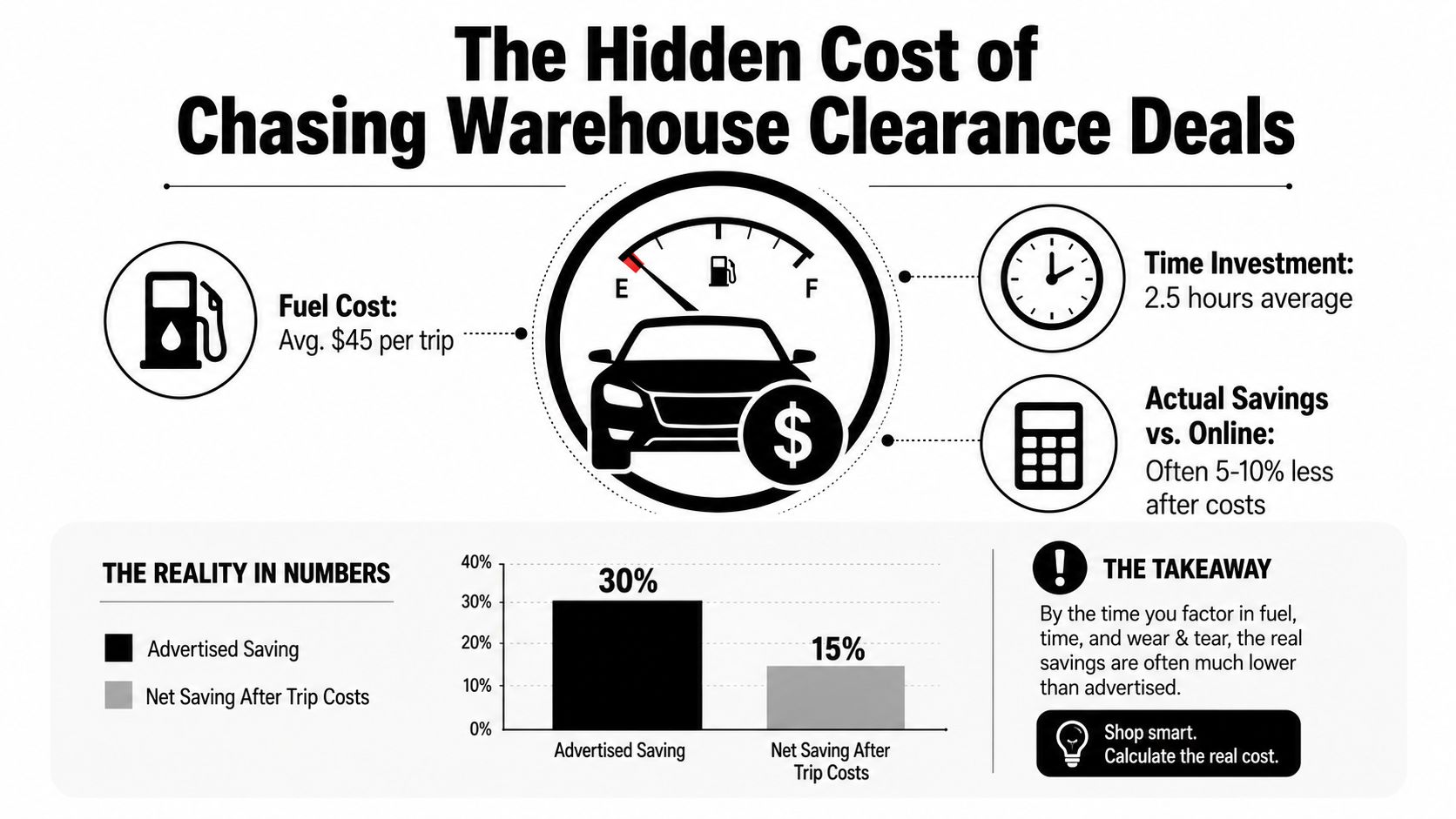
Driving to a warehouse clearance outlet feels like saving money because the discount is visible and the travel cost is easy to ignore. That logic falls apart when you spend heavily to reach a sale, discover your size has gone, then settle for an item you wouldn't have bought at full price.
A Melbourne or Sydney outlet trip can involve fuel, tolls, parking and a substantial block of your day. The exact cost depends on your starting point and vehicle, so there's no honest universal “average trip” figure. What you can calculate before leaving is straightforward:
- Transport: Add fuel, tolls and public transport fares.
- Parking: Include the fee, even if it feels minor beside the advertised markdown.
- Time: Value your travel and browsing time realistically. If the trip consumes half a day, that's part of the purchase decision.
- Stock risk: Popular sizes, colours and high-demand labels may have disappeared before you arrive.
- Return friction: A final-sale item that doesn't fit can turn a discount into dead money.
Calculate the real saving first
Suppose a garment is marked down by $20. If your fuel and parking cost $30, you haven't saved $20 overall. You've paid more to access the discount than the discount removed from the garment. That doesn't make the item a bad buy if you needed it and would have paid more elsewhere, but it does make the trip a poor bargain-hunting exercise.
Return risk deserves equal attention. A jumper that looks fine on a crowded warehouse floor may feel wrong once you wear it at home. If the outlet offers only store credit or treats clearance purchases as final sale, the headline saving doesn't protect you from a bad decision.
Practical rule: Before you start the car, write down the item you're chasing, the price you'd accept, and the full trip cost. If the target purchase can't comfortably cover that gap, search online first.
Physical retail still pulls shoppers into selective destinations. CBRE reported national CBD retail vacancy of 11.1% in H1 2025 and prime retail vacancy of 5.4% in the March quarter of 2025, evidence that in-person shopping remains important even as convenience shapes the decision. CBRE's Australian CBD vacancy update supports the broader point, but it doesn't make every outlet journey economical.
How Warehouse Clearance Outlets Work
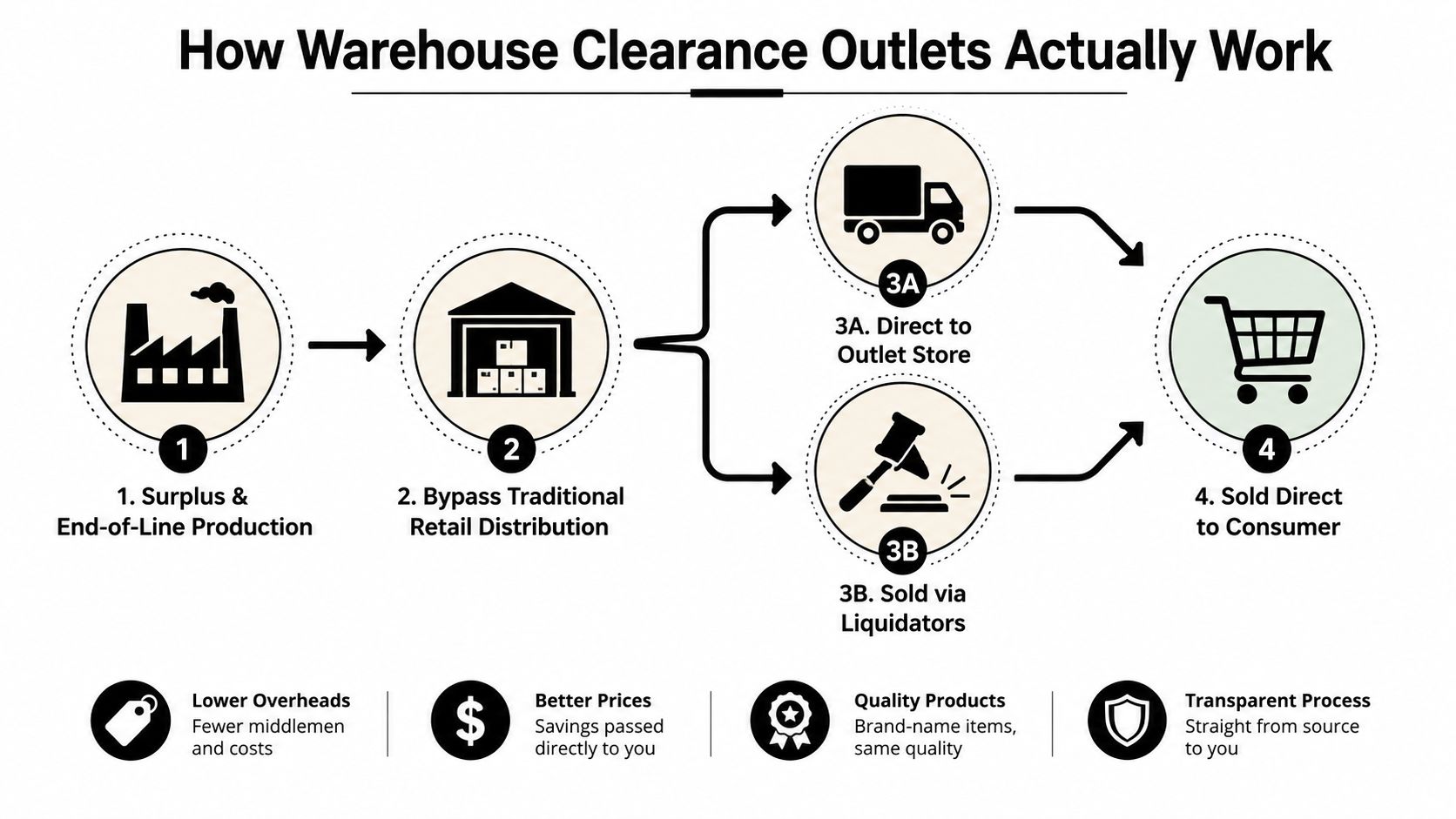
A warehouse clearance outlet runs on changing supply, not a stable department-store range. Operators move stock that needs a new home, so expect incomplete size runs, shifting product mixes and little certainty about the next delivery.
Stock usually enters through four routes:
- End-of-line and surplus stock: Brands clear discontinued colours, seasonal ranges and excess units instead of carrying them into the next assortment.
- Liquidation inventory: Insolvency, business closures and stock liquidation can send mixed products into warehouse channels.
- Direct brand or retailer allocations: Outlet-centre stores may receive stock through a brand's own distribution system.
- Independent resale channels: Warehouse operators can buy mixed lots from liquidators, producing less predictable ranges.
Prime Factory Outlet in Perth provides a clear Australian example. It says it has operated as a discount clearance warehouse since 2008, with inventory sourced from bankrupt, liquidated and clearance items from Australia, Indonesia and China. Prime Factory Outlet's explanation of its sourcing model helps explain why one warehouse can hold a mix unlike a conventional seasonal store.
Why the price isn't the whole story
Clearance pricing reflects urgency, stock age, condition and demand. An item may be cheap because the operator has too much stock, only unusual sizes remain, or the packaging is damaged. A premium label does not guarantee value.
Treat the clearance label as a prompt to inspect, not proof of a bargain. A wool-blend jumper such as the 132 Fashion Tilly Wool Blend Crew Neck Knit (Sage) has specific fit, fabric and care details, including a relaxed fit, 65% acrylic and 35% wool composition, with size guidance covering S/M and M/L. Those details matter more than the word “clearance” when deciding whether it suits your wardrobe.
For a practical comparison of outlet formats and ordinary retail, read this guide to outlet mall shopping. Check the stock's source, condition and specifications before deciding what the price means.
Physical Outlets Versus Online Deal Aggregation
The physical-versus-online decision changes by category. A warehouse clearance outlet has a genuine advantage when you need to feel fabric, test construction, try on shoes or inspect bulky furniture. Online aggregation has the edge when you know the product, need to compare several retailers, or live far from a major outlet precinct.
Australian shopping-centre benchmarks show the scale of the channel shoppers are navigating. Urbis' 2024 benchmark covered 484 shopping centres, 36,445 tenants and 11.1 million square metres of leasable space, representing $86.7 billion in reported moving annual turnover and 20% of retail sales across all Australian shopping locations, types and channels. Urbis' 2024 Shopping Centre Benchmarks demonstrate why physical retail offers variety, but also why one visit can't reveal every relevant deal.
| Factor | Physical Outlet | Online Aggregation |
|---|---|---|
| Price discovery | You compare what's in front of you | You can scan offers across multiple retailers |
| Stock | Limited runs and unpredictable replenishment | Broader visibility, but availability can change quickly |
| Fit and quality | Try on and inspect before paying | You rely on measurements, photos and policies |
| Convenience | Requires travel and browsing time | Removes the trip, but delivery takes time |
| Returns | May be restricted for clearance purchases | Depends on each retailer's return terms |
| Bulky goods | Take home immediately, with no delivery wait | Shipping can reduce the apparent saving |
| Shopping experience | Tactile and spontaneous | Faster for targeted purchases |
Discount intensity also needs context. Independent fashion analysis recorded an EOFY discount rate of 27.6%, its highest level in that index, during a period of aggressive discounting. Ragtrader's EOFY fashion sales analysis indicates that a marked-down price can reflect a competitive sale environment rather than a unique warehouse advantage.
For fashion, inspect in person when fit is uncertain or the fabric is difficult to judge online. For electronics, compare exact model numbers and warranty terms rather than trusting a broad “was” price. For homewares, calculate delivery against the cost of collecting the item. Online outlet shopping guidance for Australia is useful when the product is specific enough to compare directly.
Timing Your Purchases for Maximum Savings
Clearance shopping rewards patience only when the item is replaceable. If you're hunting a basic sneaker, dependable denim cut or popular outerwear size, waiting for the deepest markdown can leave you with nothing. If you're flexible on colour and style, later reductions can produce excellent value.
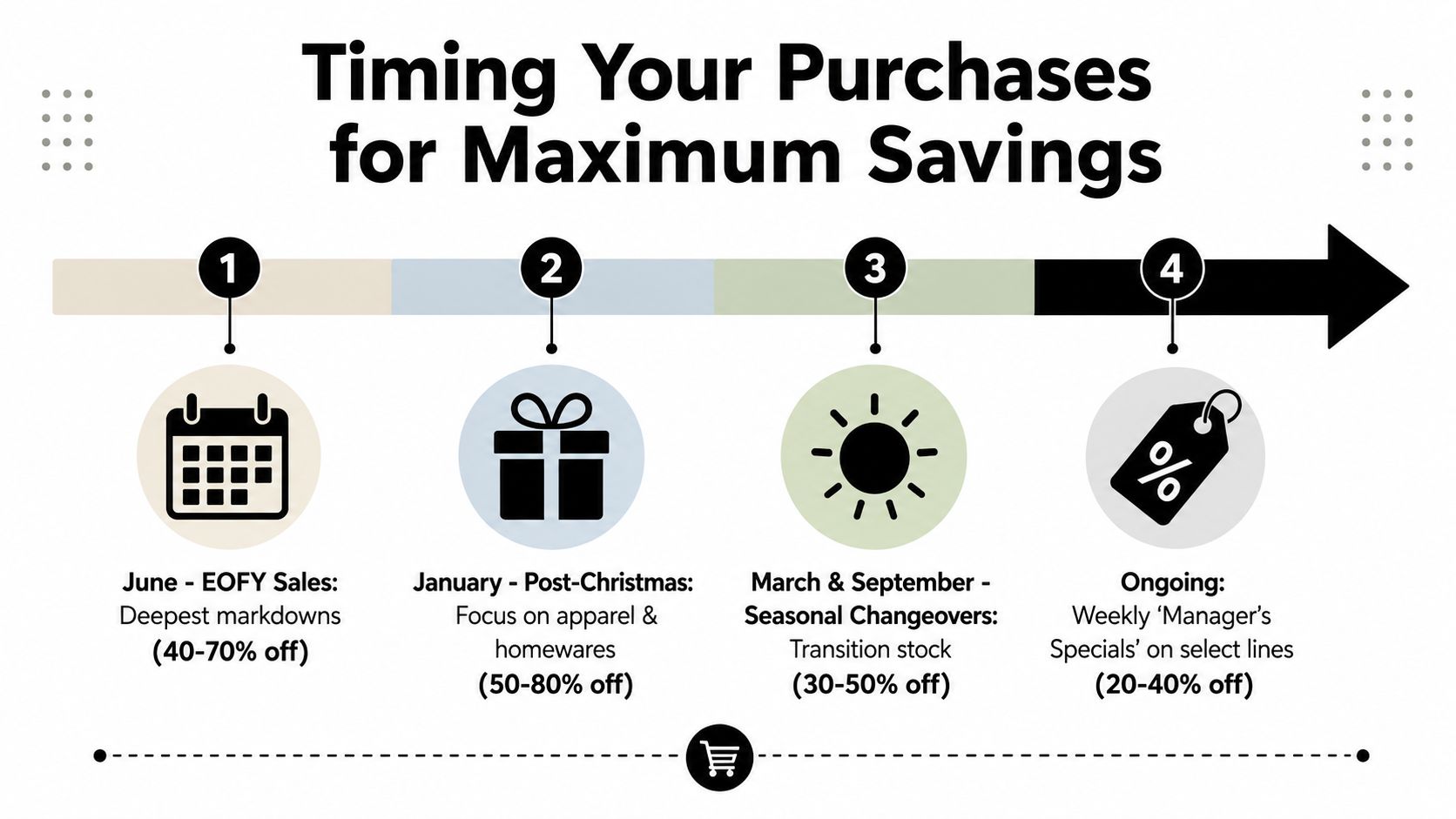
EOFY is the obvious Australian sale window, especially when retailers need to move seasonal inventory before reporting periods close. Post-Christmas clearance can suit apparel and homewares, while seasonal range changeovers create opportunities as stores make space for incoming stock. Electronics often follows product-cycle changes, so compare old and new models before buying.
Use a category calendar
- EOFY: Check fashion, footwear, appliances and lifestyle products, but compare the outlet price with online promotions running at the same time. The Australian EOFY sale guide can help you monitor competing offers.
- After Christmas: Look for seasonal apparel, entertaining pieces and homewares. Buy early if you need a popular size or a specific colour.
- Seasonal changeovers: March and September are useful points to watch for stock rotation. Flexible shoppers can wait, while shoppers chasing a particular item should act when the fit and condition are right.
- Quiet weekdays: Weekday mornings are usually better for inspection and browsing because the floor is less chaotic. Ask staff whether new stock has arrived, but don't assume a promised restock exists.
- Second reductions: A lingering item may be reduced again, but there's no guarantee it will survive until the next markdown. Treat the second cut as a calculated gamble, not a shopping plan.
The ABS measures Australian retail turnover and volume monthly and quarterly. Its June 2025 seasonally adjusted retail volume estimate rose 0.3% in the quarter, a modest movement that reinforces the need to judge clearance decisions at item level rather than assume broad retail conditions will create a better price later. ABS retail and wholesale trade data provides the relevant market measure.
Smart Shopping Tactics for Clearance Events
A clearance floor rewards preparation more than enthusiasm. I've seen shoppers grab a branded jacket because the tag looked dramatic, only to find a pulled seam, a missing button or a return policy that made the purchase irreversible.
Start with a fast physical inspection. Run your hands along seams, check zips repeatedly, look under collars and inspect cuffs, hems and lining. For shoes, examine both soles and compare the left and right pair. Packaging damage may be cosmetic, but it can also signal rough handling or missing accessories.
The five checks I use
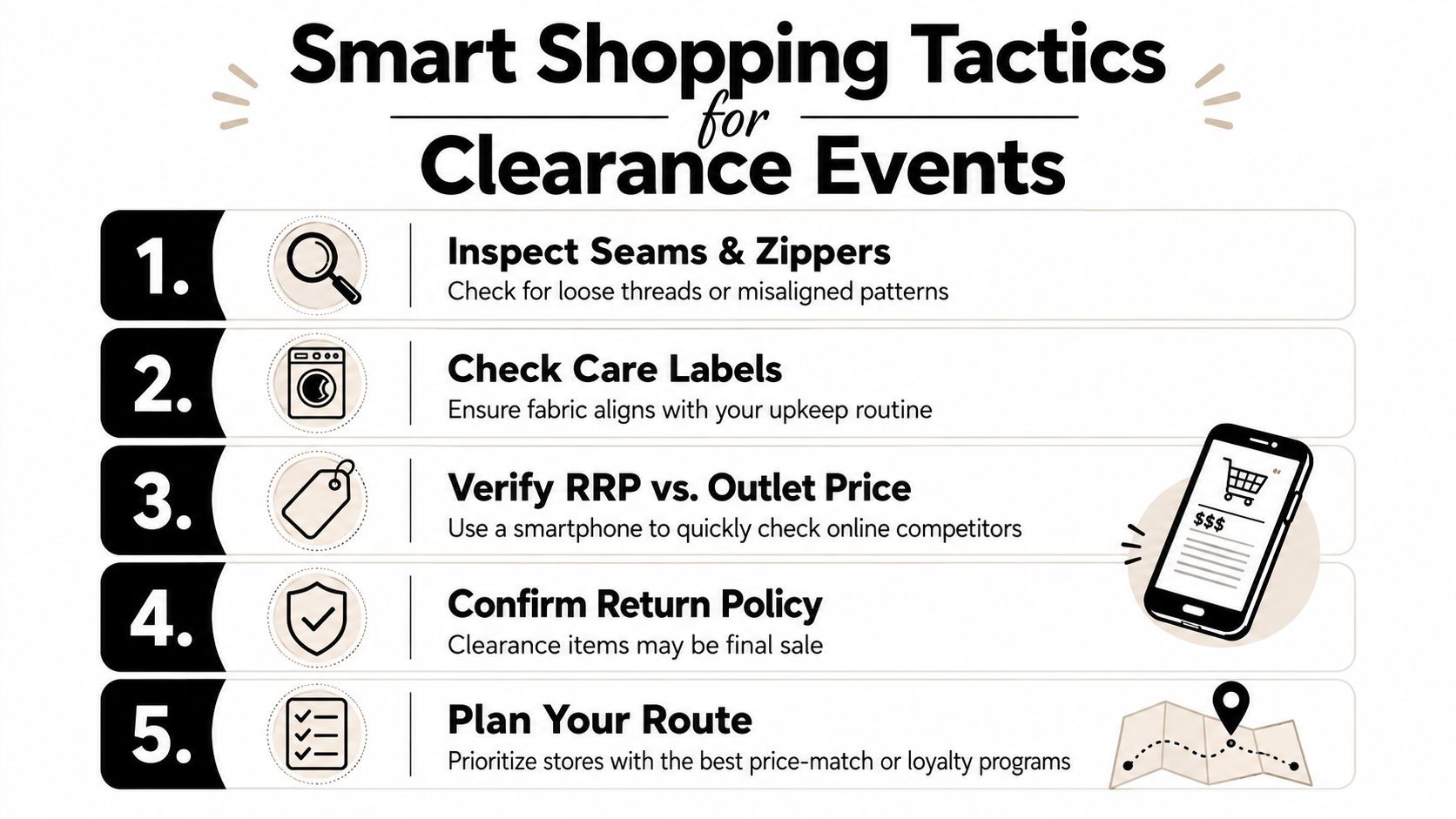
- Check the fabric and construction. Hold garments under clear light and look for fading, pulls, uneven stitching and warped panels.
- Confirm care requirements. A delicate garment isn't a bargain if you won't follow its washing instructions. Read the care label before you reach the register.
- Verify the comparison price. Photograph the tag, then check the same model or a close equivalent online. A crossed-out RRP isn't enough evidence.
- Test the fit properly. Clearance racks often contain irregular size runs. Try the item on, move your arms, sit down and check whether the proportions work.
- Read the return terms. Ask whether the purchase is final sale, exchange-only or eligible for store credit. Keep the receipt and note any defect disclosed at checkout.
A bargain that needs convincing is usually a bargain to leave behind.
Crowded events require a route. Go first to the categories where your need is strongest, then inspect high-value items before browsing accessories. Don't let a low price make you abandon your original criteria.
For online fashion comparisons, this guide to online clothing sales in Australia is a useful reference point. The same discipline applies online and in person, compare the actual product, condition, fit information, delivery and returns rather than the promotional language.
When to Visit an Outlet and When to Shop Online
A warehouse clearance outlet is not automatically the cheaper choice. Select the channel according to what can change your decision: physical inspection favours an outlet, while fast comparison favours online shopping.
| Factor | Physical Outlet | Online Deal Platform |
|---|---|---|
| Best for | Shoes, outerwear, furniture and items needing inspection | Specific brands, known products and fast comparison |
| Fit | Try before buying | Use measurements and retailer sizing guides |
| Availability | Immediate, but often incomplete | Wider search, with stock changing during the sale |
| Travel | Requires a trip | No travel to the store |
| Returns | Clearance restrictions can be strict | Varies by retailer, check before ordering |
| Large purchases | Collection can avoid delivery charges | Delivery may remove the saving |
| Urgency | Take the item home immediately | Wait for dispatch and delivery |
Visit in person for a sofa, coat, sneaker or fabric-heavy garment where photographs cannot reveal condition, texture or fit. The trip earns its place when you are already nearby and can combine the visit with other errands. A separate drive for one uncertain item usually does not.
Shop online for one particular label, limited shopping time or several sale events that need comparing. This matters even more outside major retail corridors, where fuel, parking and wasted time make a failed visit expensive. A focused search through Princess Highway outlet deals shows why starting with a product or brand beats wandering through a warehouse without a target.
Use a strict break-even calculation. Add transport, parking and a realistic value for your time to the outlet price. Compare that figure with the delivered online price, allowing for possible return shipping and the hassle of sending an unsuitable item back. Include collection costs for bulky purchases, because avoiding delivery only helps if the trip is already practical.
The outlet wins when inspection matters, stock is available and the journey is convenient. Online shopping wins when comparison matters more than touch, fit or immediate collection. If the physical option looks cheaper only because you ignored the journey and return friction, leave it out of the bargain calculation.
Building a Smarter Clearance Shopping Strategy
The best clearance strategy starts before the trip. Make a shortlist, establish a maximum price, check online alternatives and decide whether the item needs physical inspection. That process stops a warehouse floor from turning an intended purchase into a trolley full of compromises.
Australia's retail channel has enough scale to support both formats. Urbis' 2025 benchmark expanded to more than 520 shopping centres, 14 million square metres of gross lettable area, over 46,000 tenants and $117 billion in aggregated moving annual turnover, or about 26% of the total Australian retail market. Urbis' benchmark reporting shows why shoppers have plenty of choice, but choice only helps when you compare it efficiently.
Use a three-part routine:
- Scan first: Search online for the exact brand, category and sale event before travelling.
- Visit selectively: Reserve physical trips for footwear, outerwear, furniture and products where touch, fit or condition matters.
- Review the final cost: Include delivery, fuel, parking, time and return friction before deciding which offer is cheaper.
Online clearance events can be unusually time-sensitive. Warehouse Furniture Clearance says its Brisbane warehouse and online store open only 8–10 weekends a year, with the warehouse operating 8am–4pm on Saturday and Sunday during event weekends and the online store live for 48 hours from 6pm Friday to 6pm Sunday. Warehouse Furniture Clearance's event details show why checking timing before travelling matters, particularly for bulky goods.
A service such as Special8 can be used as the online starting point for comparing fashion, footwear, accessories, jewellery and lifestyle offers from multiple Australian retailers. It surfaces sale events and markdowns, helping you decide whether a physical warehouse visit is justified before you spend the day getting there.
My recommendation: Search first, visit second, buy only when the complete cost and the product itself both make sense.
Visit Special8 before your next warehouse clearance trip to compare current Australian fashion, footwear, accessories and lifestyle deals in one place. Use that shortlist to identify genuine opportunities, then make the drive only when seeing, trying or collecting the item adds value.


