
Where to Buy Cheap Shoes in Australia

You're standing in a Westfield corridor, looking at runners marked at $220, and wondering whether you're about to overpay. The sale rack is nearby, but the remaining sizes are useless, the “was” price looks suspicious, and the next promotion might start just after you leave.
That frustration is justified. Cheap shoes in Australia rarely come from wandering into a shopping centre and hoping for a lucky markdown. The smarter approach is to understand which channels discount footwear, when prices tend to move, and how to separate a genuine bargain from a permanent sale label.
Australia's footwear retail market is substantial, with industry estimates putting the sector at about A$5.1 billion to A$5.3 billion in 2026, alongside 1,088 businesses. The market's scale means bargains are distributed across outlets, clearance pages, independent retailers and online platforms, rather than controlled by only a few stores. (IBISWorld footwear retailing data)
Table of Contents
- Why Finding Cheap Shoes in Australia Is Harder Than It Looks
- Understanding How Australian Footwear Discounts Work
- Best Channels for Buying Affordable Shoes
- How to Choose the Right Shopping Channel
- Judging Value and Spotting Genuine Discounts
- Timing Your Purchase Around Retail Cycles
- Smart Strategies for Year-Round Savings
Why Finding Cheap Shoes in Australia Is Harder Than It Looks
The obvious move is to visit a large shopping centre, compare a few familiar brands and wait for a red sale tag. That works occasionally, but it's a poor default strategy. Full-price stores are designed to sell the current range, while the best bargains usually appear where retailers need to clear older colours, broken size runs or excess inventory.
Australia also has a retail structure that makes pricing feel inconsistent. Footwear passes through international supply chains, and retailers must account for importing stock, currency movements, freight and local operating costs before a pair reaches the shelf. A shoe that feels expensive beside an overseas price may still reflect the way Australian retailers source and distribute stock.
The market is competitive, but it isn't concentrated in one discount machine. The footwear retail sector has been estimated at A$5.1 billion to A$5.3 billion in 2026, with a modest value growth rate of 0.4% CAGR from 2021 to 2026, while the number of businesses declined by 2.1% CAGR over the same period. (IBISWorld footwear retailing data) That combination points to a mature, competitive sector where promotions help retailers shift volume.
Why the mall hunt disappoints
A shopping centre gives you speed and the chance to try shoes on, but it also puts you in front of the most visible stock, not necessarily the cheapest stock. New-season products dominate the shop floor, and staff may have limited flexibility once a style is outside its markdown window.
The better question isn't “Where can I find shoes on sale?” Ask instead:
- Is this current-season stock or clearance stock?
- Does the retailer have my size before I get attached to the style?
- Can I return the shoes if the fit is wrong?
- Has the price changed, or has the reference price been inflated?
Official inflation data makes timing more important. The Australian Bureau of Statistics reported that the Clothing and footwear group rose 4.9% over the 12 months to July 2026, with the weighted average across eight capital cities also at 4.9%. The city-level result ranged from 3.4% in Adelaide to 6.0% in Sydney. (ABS Consumer Price Index latest release)
That regional variation doesn't guarantee a cheaper pair in one city, but it does show why local promotions and outlet access matter. Genuine value takes planning. You need to know whether you're buying at the end of a cycle, during a promotion, or just after a retailer has repriced the range.
Understanding How Australian Footwear Discounts Work
Australia's discounted footwear market spreads across brand outlets, outlet centres, online retailers, warehouse clearances, independent specialists and multi-brand platforms. That variety helps shoppers, but only when you compare the final price, exact product and purchase terms instead of trusting the biggest percentage on a sign.
The market is large enough to support frequent clearance activity. Revenue estimates place Australian footwear retail at about AUD 5.95 billion in 2023, helping explain why retailers build substantial clearance pools when they need to move mainstream styles and remaining sizes. (Research and Markets footwear retail data)
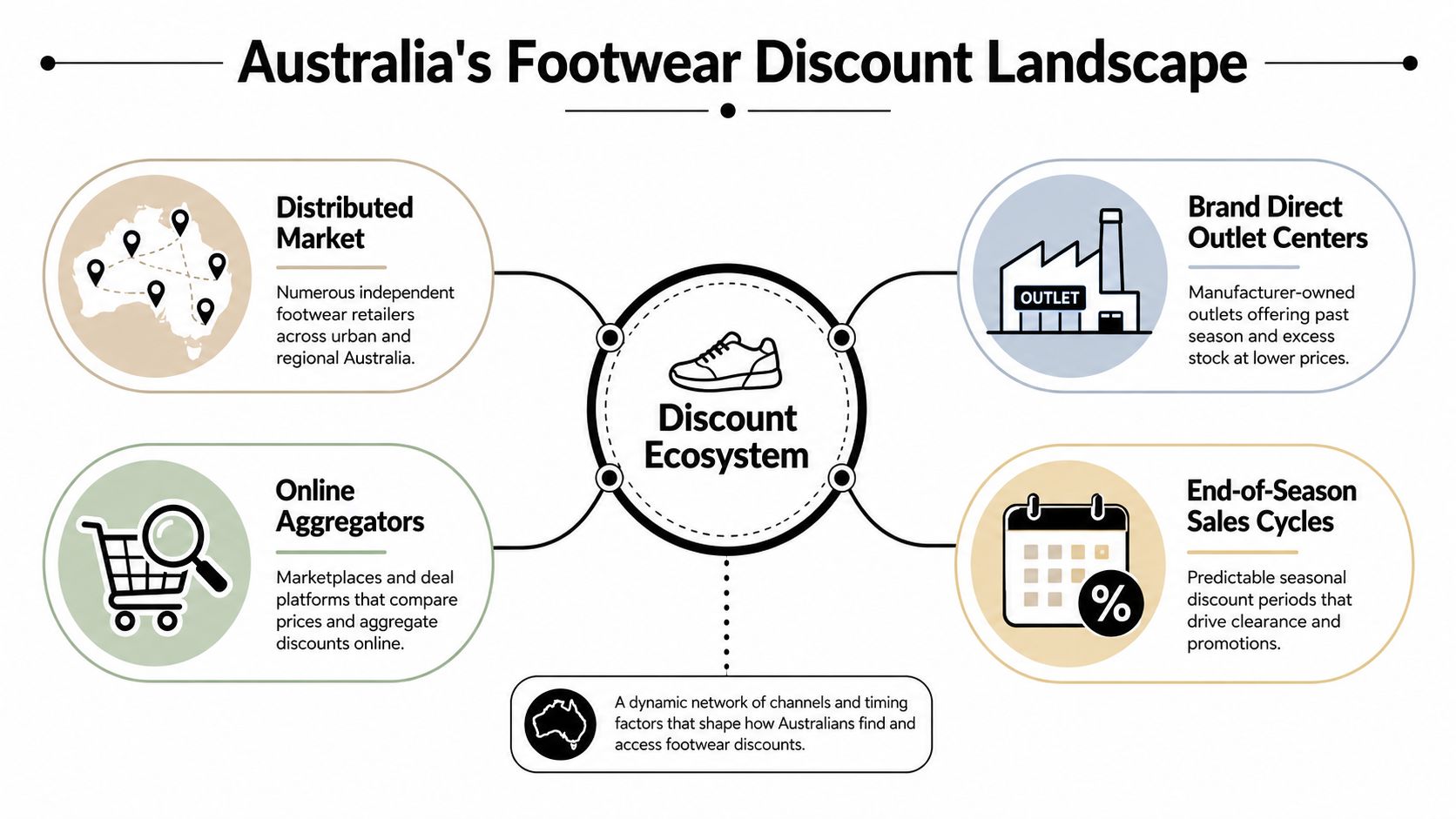
How retailers set discounts
Large groups such as Accent Group and Super Retail Group operate across broad retail networks, yet their markdown patterns differ by brand, product category and inventory position. Smaller online specialists can cut end-of-line stock more aggressively because they do not need to maintain the same shop-floor presentation.
Timing matters more than a sale badge. Retailers commonly clear older ranges before new-season stock arrives, then use promotional events to create volume during quieter trading periods. Inflation adds another reason to avoid buying between campaigns. After a price reset, the next genuine reduction may not arrive until the retailer needs to clear that range.
An outlet store also may not sell the same product found in a mainline shop. Stock can come from surplus regular inventory, older seasons or products made specifically for outlet distribution. Check the model name, materials, construction and product code where available.
Online aggregators and grey-market sellers require closer checks. A low price may reflect parallel imports or a seller outside the brand's usual Australian distribution network. Confirm who sells the item, who handles returns and whether the listing gives you clear Australian Consumer Law protections.
Practical rule: Compare the seller, exact model, timing and return terms before comparing discount percentages.
A 30% reduction on a genuine current product with simple returns can beat a larger markdown on an obscure colour, incomplete size run or marketplace listing with complicated support. For a targeted look at local sneaker promotions and sale timing, browse the guide to the Australian sneaker sale market.
Best Channels for Buying Affordable Shoes
The best channel depends on what you're buying. Runners, work shoes, boots, fashion sneakers and children's footwear don't all discount in the same places. Use the channel that matches the product rather than treating every sale page as interchangeable.
Outlets and physical clearance centres
DFO, Harbour Town and similar outlet centres are useful when fit matters or when you're willing to inspect stock in person. You'll often see sports shoes, casual sneakers, sandals, boots and previous-season branded styles. The trade-off is obvious: sizes and colours are limited, and the outlet may be far enough away that travel costs weaken the saving.
Outlet markdowns can be strong, but don't assume every outlet price beats an online promotion. Photograph the shoe label, model name and product code, then check comparable listings before buying.
Online sale pages and marketplaces
The Iconic's sale section is convenient for fashion sneakers, sandals, boots and lifestyle footwear, particularly when you want broad brand coverage and a familiar returns process. Catch, Kogan and Amazon Australia can be useful for lower-priced everyday footwear and clearance inventory, but marketplace listings require closer checks on seller identity, delivery and returns.
A platform's reputation doesn't remove the need to inspect the individual listing. Read the seller details, confirm whether the product is new, and check whether the displayed “was” price reflects a genuine previous selling price.
Brand warehouse sales
Hype DC, Platypus and other footwear specialists sometimes clear older stock through end-of-season events or warehouse promotions. These events can be excellent for streetwear and sneakers, but popular sizes disappear quickly. Sign up for retailer emails or follow their sale announcements instead of discovering the event after the useful stock has gone.
Student programs through UNiDAYS and Student Beans can also reduce the price on selected brands. They're worth checking before checkout, especially if the student discount can be applied to an already reduced product. Restrictions vary, so read the terms rather than assuming every sale item qualifies.
Secondhand and resale platforms
Depop and Facebook Marketplace are strong options for near-new branded shoes, especially when sellers are clearing wardrobe mistakes or lightly worn pairs. Ask for clear photos of the soles, insoles, heel wear, labels and any damage. Don't buy a heavily worn pair just because the brand name looks impressive.
| Channel | Typical Discount | Best For | Key Trade-Off |
|---|---|---|---|
| Physical outlets | Often below mainline pricing, with deeper reductions on older stock | Branded sneakers, casual shoes and boots | Limited sizing, travel time and outlet-specific stock |
| Online retailer sale pages | Commonly reduced during promotions and clearance events | Fashion footwear and easy comparison shopping | Shipping, returns and fast-selling sizes |
| Marketplaces | Varies widely by seller and condition | Everyday shoes and unusual clearance finds | Seller reliability, authenticity checks and return complexity |
| Warehouse sales | Can be heavily reduced on end-of-line products | Streetwear and previous-season sneakers | Limited stock and rushed decisions |
| Student programmes | Depends on the participating brand and offer | Budget-conscious students | Eligibility and product exclusions |
| Resale platforms | Often substantially below original retail for near-new pairs | Branded footwear and discontinued styles | No standard returns, condition risk and possible scams |
For a practical comparison of outlet formats, see this guide to outlet shopping online in Australia. The strongest bargain usually comes from combining a suitable channel with the right timing, not from chasing the loudest sale banner.
How to Choose the Right Shopping Channel
Choose the channel around your actual priority: speed, selection or the lowest possible price. Timing matters as much as the retailer. Australian outlets and clearance pages often reduce older seasonal stock, while online promotions can create short price drops between broader retail cycles. Buy during the reduction window, not after a price spike has pushed you into an urgent purchase.
Need shoes today and want to check the fit? Use a physical outlet or a regular retailer with stock in store. DFO and Birkenhead Point are practical when you are already nearby and can compare several brands quickly. They make less sense if you must travel a long distance for one uncertain size.
Online retailers suit shoppers who value range and comparison. The Iconic's sale section, Catch and Amazon Australia can make it easier to compare models and colours, but the displayed price is only the starting point. Add delivery, possible return costs and the risk that a popular size sells out before the next promotion.
Compare the costs beyond the ticket price
| Channel Type | Delivery or Collection | Return Policy Clarity | Consumer Protection |
|---|---|---|---|
| Physical outlet centre | Immediate collection | Check the individual retailer | Usually clearer with a direct retailer |
| Brand clearance event | Immediate if bought in person | May be more restrictive | Depends on the brand's terms |
| Multi-brand online retailer | Depends on stock and location | Usually easier to find and compare | Generally clearer than an independent seller |
| Marketplace | Seller-dependent | Seller-dependent and often complex | Verify who is responsible for the sale |
| Resale platform | Seller-dependent | Often limited or unavailable | Condition and seller reliability require closer checks |
Use brand clearance when you know the fit and want a specific label. Choose a multi-brand retailer when you care about a category, such as white sneakers or work boots, and want to compare several brands during a promotion. Marketplaces and resale platforms can produce lower prices, but the saving must cover extra checking and a less predictable return process.
The seller relationship affects what happens if the shoes are faulty or unsuitable. A direct retailer usually gives you a clearer route for returns or remedies than an anonymous marketplace seller. A sale label does not automatically remove your rights, but change-of-mind rules differ from faulty-product remedies. Read the policy before paying.
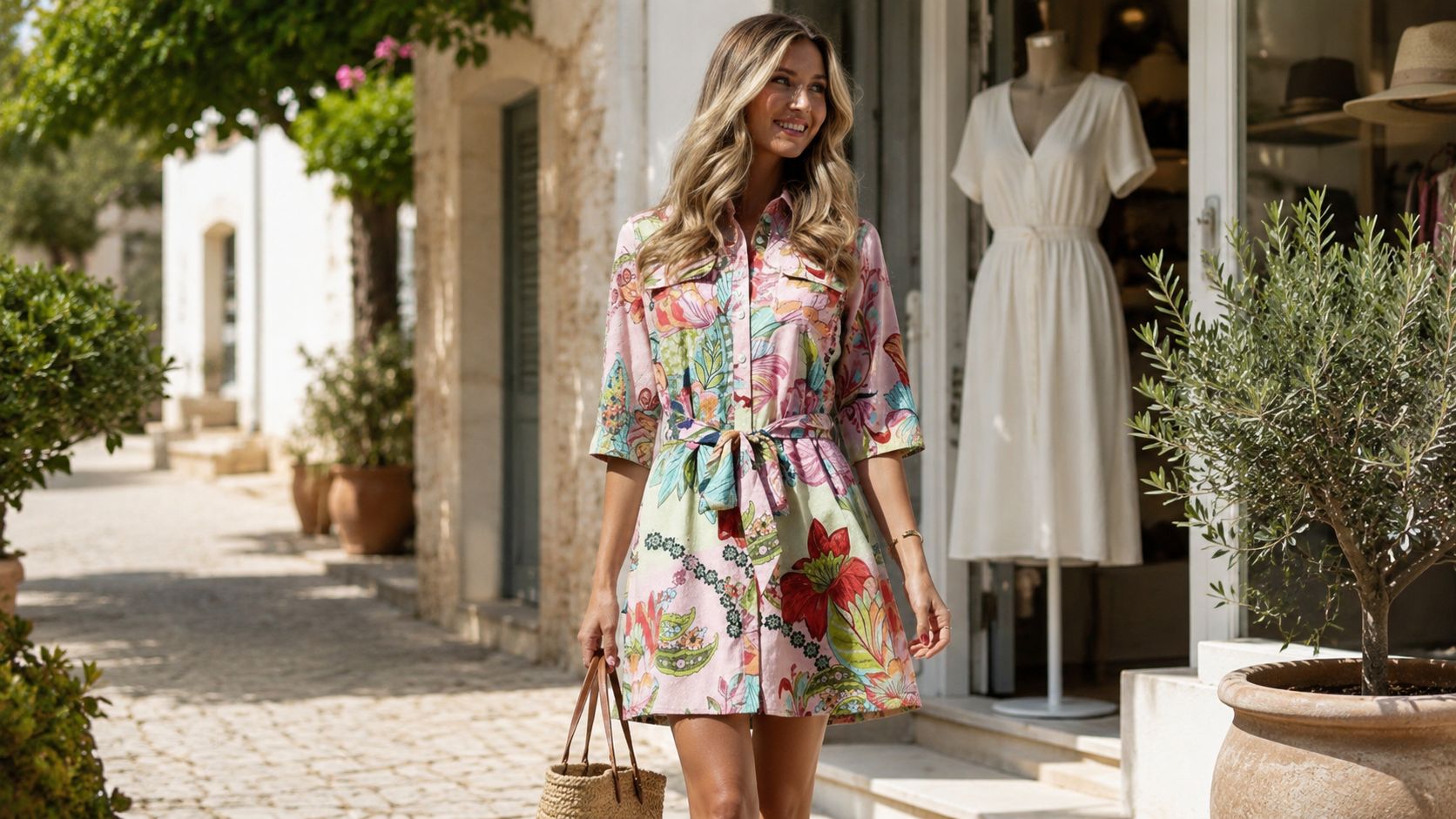
A product page such as 132 Fashion St Tropez Shirt Dress (Pink Green Multi) shows why category browsing can help when you are coordinating footwear with an existing wardrobe. The cotton shirt dress has a button-through front, side seam pockets, a removable self-tie waist and a separate slip, and is described as true to size for a standard fit. Judge shoes by likely outfits and wear, not by the pair alone.
For nearby pickup, check collection options before checkout. This guide to click and collect can help when delivery time or shipping costs would otherwise cancel out the saving.
Judging Value and Spotting Genuine Discounts
A cheap shoe becomes expensive when it causes discomfort, fails quickly or stays unworn because the fit is wrong. Price matters, but construction and intended use decide value. Judge the pair against your walking habits, wardrobe and expected lifespan, not just the markdown.
Start with the upper. Read the material label instead of trusting product photography, then inspect the stitching, seams, eyelets, zip and internal finish. On a physical pair, press the heel counter. It should support the back of your foot without feeling painfully rigid.
Inspect the sole and fit
A stitched sole can offer more repair potential than a fully glued construction, although construction varies by shoe type and price point. For daily walking, a practical rubber sole usually suits wet pavements and urban wear better than a formal leather sole. Leather works well for dressier settings and a slimmer profile. Choose based on where the shoes will be worn.
Check these points before buying:
- Clean stitching: Uneven, loose or unfinished stitching is a warning sign.
- Material clarity: Confirm whether the upper is leather, textile, synthetic material or a combination.
- Sole attachment: Look for lifting edges, excess glue or visible gaps.
- Heel structure: A collapsing heel counter can reduce support and shorten wear life.
- Comfort at once: Reject a painful pair. “Wearing them in” rarely fixes poor fit.
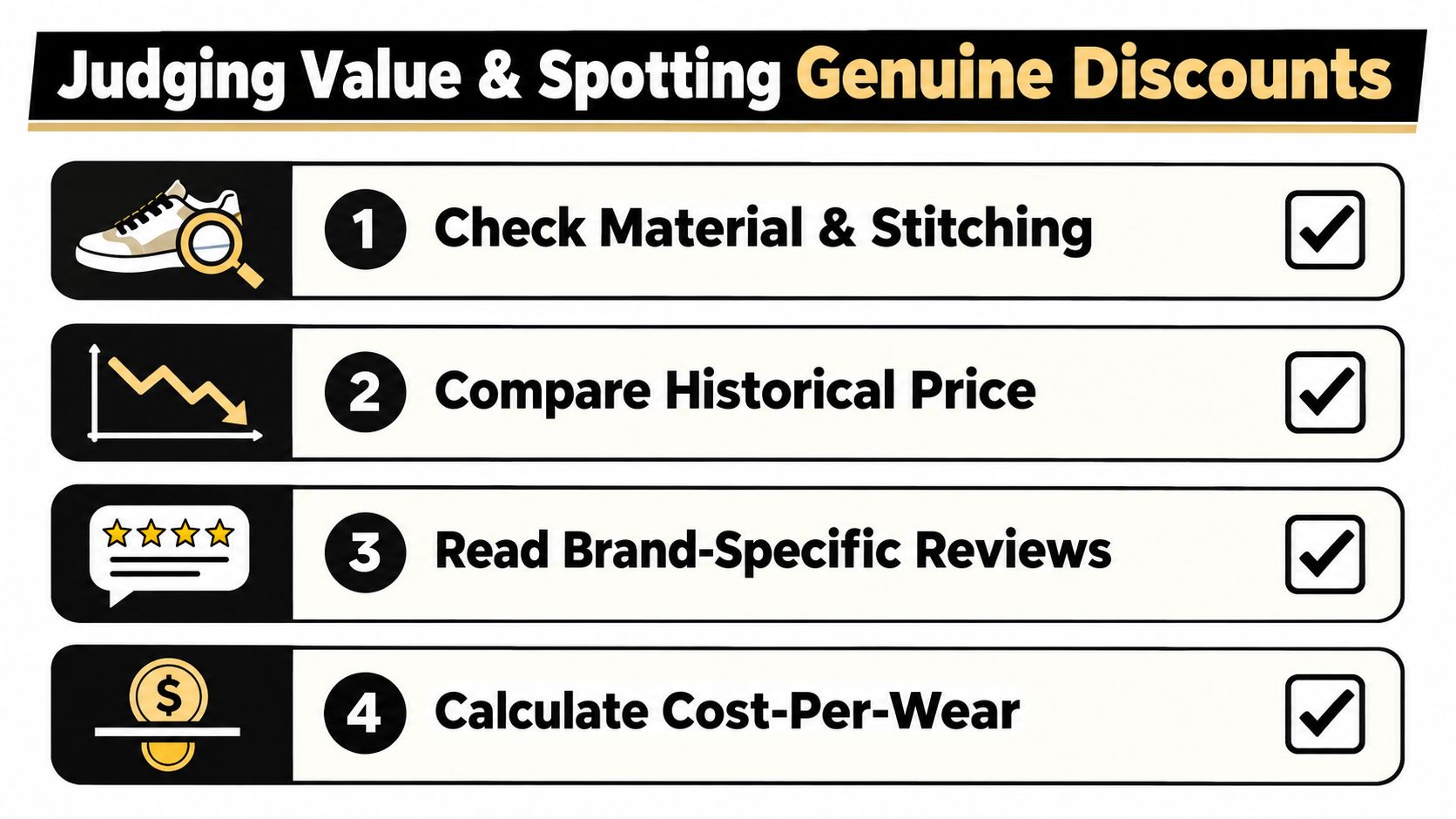
Test whether the markdown is real
Reference prices, constant sale labels and “was/now” displays can make an ordinary price look exceptional. The Australian Competition and Consumer Commission provides guidance on misleading pricing representations, so verify a dramatic crossed-out price before treating it as a genuine saving.
Search the exact model through Google Shopping, check supported listings with CamelCamelCamel, and compare the brand's main website with its outlet page. If several retailers keep showing the same shoe as permanently reduced, treat the displayed saving as sales context rather than proof of outstanding value. Retail pricing can also shift with stock levels and inflation, so buying during a real clearance window is smarter than reacting to an urgent-looking banner.
A sale tag tells you what the retailer wants you to notice. The product history tells you whether you should care.
Read reviews for sizing, sole wear and comfort, not star ratings alone. For dressier or premium footwear, designer shoes on sale can help you compare construction and materials before paying for a luxury label.
Timing Your Purchase Around Retail Cycles
Australia's retail calendar gives footwear shoppers useful buying windows. The strongest approach is to buy prior-season products when retailers need space, and avoid paying top dollar just after a new collection arrives.
ABS data shows why timing matters. Clothing and footwear inflation moved from 0.8% in the 12 months to April 2025 to 1.3% in May, 1.4% in June, 2.3% in July and 3.0% in August. (ABS Monthly Consumer Price Index Indicator) The June quarter CPI also recorded footwear prices rising 5.7%, linked to new-season stock and items returning from sale pricing. (ABS Monthly Consumer Price Index Indicator)
That pattern creates a simple rule: buy before or during clearance, not after the new-season reset.
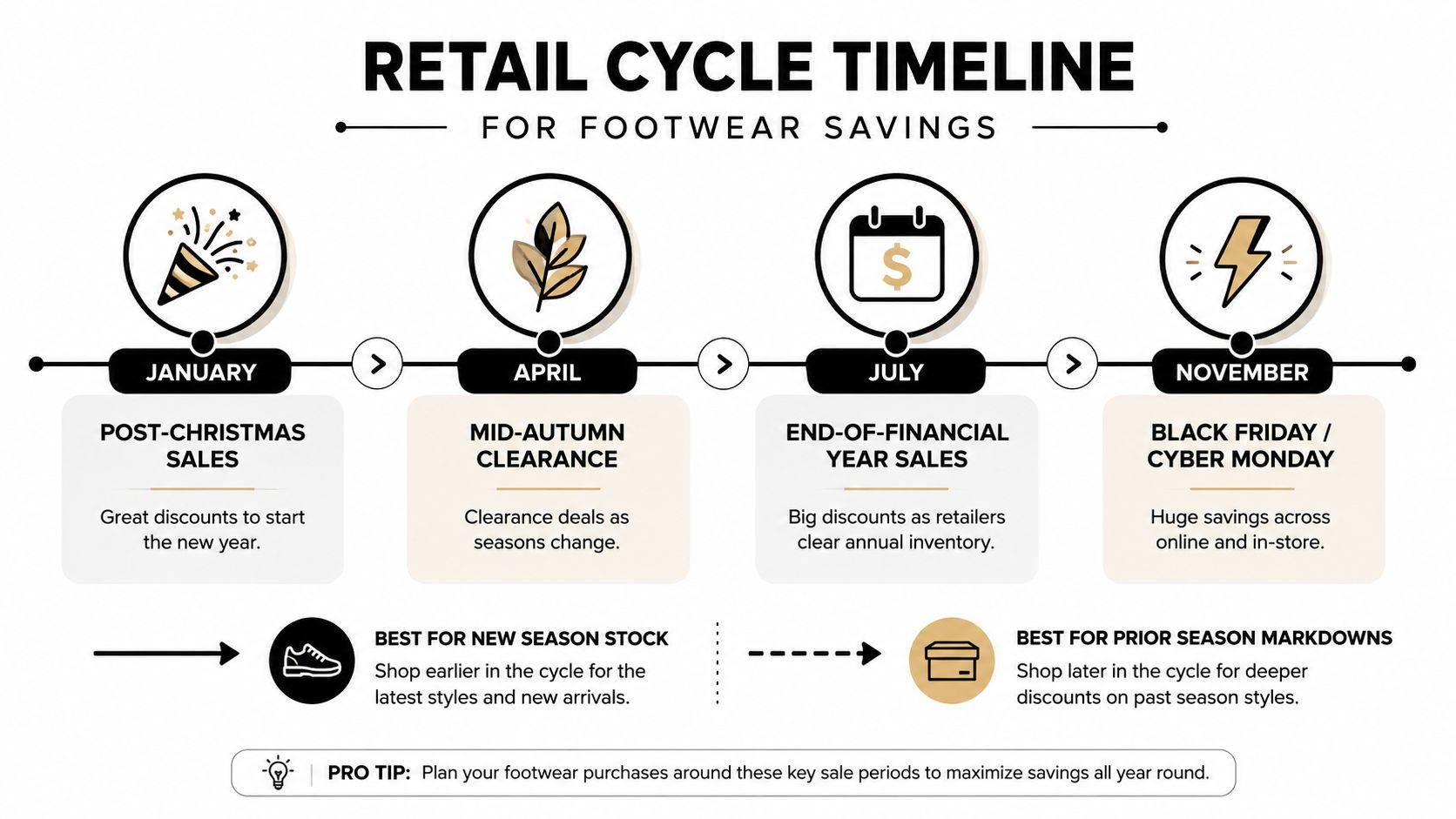
A practical Australian buying calendar
- January: Post-Christmas clearance is useful for sandals, warm-weather sneakers and leftover summer stock. Returns and overstock can increase the amount of inventory moving through sale pages.
- February: New-season arrivals can push older summer lines into clearance. Shop early if you need common sizes.
- April: Mid-season promotions and autumn clearances can suit casual shoes and transitional footwear.
- June: End of Financial Year promotions are a major checkpoint for markdowns across fashion and footwear. Track prices before the event so you know whether the reduction is genuine. For current sale timing, consult this guide to End of Financial Year sales in Australia.
- July: Mid-year clearance often continues as retailers make room for winter and later seasonal stock.
- August: New-season arrivals can lift prices on selected ranges, while remaining winter styles may move into deeper clearance.
- November: Black Friday and Cyber Monday bring broad online promotions, but compare the final price against earlier records.
- December: Boxing Day creates another strong clearance window, particularly for products retailers don't want to carry into the next cycle.
Discounts aren't always deep. Cost-of-living pressure has encouraged some retailers to run more frequent, shallower promotions, which makes price tracking more valuable than reacting to a banner.
Smart Strategies for Year-Round Savings
Use a simple checklist before every purchase:
- Set a price ceiling: Decide what you'll pay for runners, work shoes, boots and casual footwear before you start browsing.
- Track the exact model: Price alerts on retailer platforms and deal sites are more useful than watching a broad category.
- Stack compatible savings: Combine a clearance price with a student, loyalty, coupon or cashback offer when the terms allow it.
- Check deal aggregators: Catch, Kogan, OzBargain and ShopBack can help surface promotions and monitor competing offers.
- Review returns first: Marketplace sellers may apply different exchange rules or fees, so confirm the policy before checkout.
Special8 aggregates fashion, footwear, accessories and lifestyle offers from 230+ stores nationwide, with deals updated daily and organised by category, brand and sale event. It can be used alongside retailer sale pages to spot footwear promotions without checking every store individually.
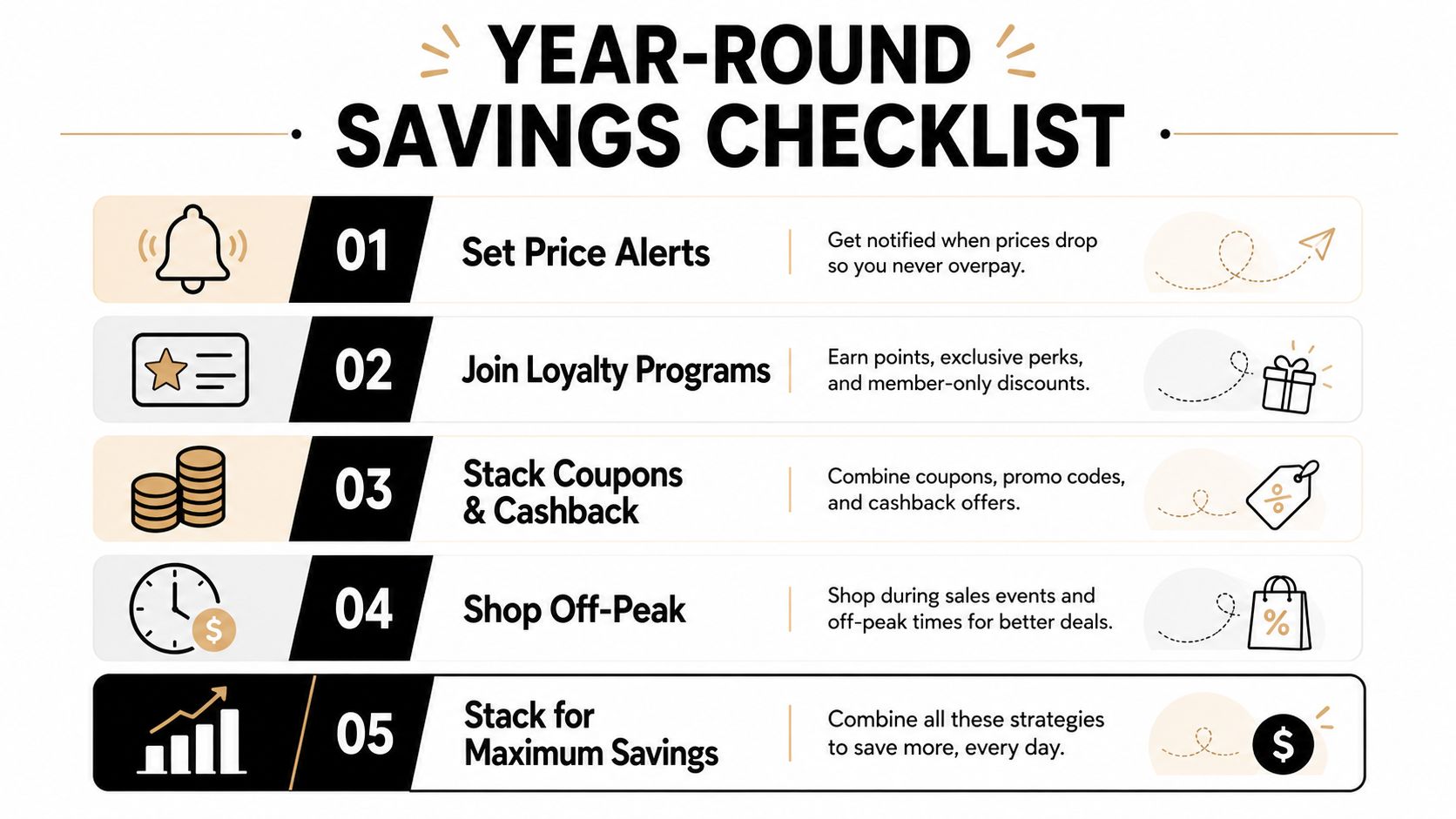
The winning combination is straightforward: choose a realistic price ceiling, wait for the right retail cycle, verify the product's quality and compare the final cost across channels. That's how you avoid paying a “discounted” price that was never good.
Special8 brings together footwear promotions, outlet markdowns and fashion deals from retailers across Australia, so you can compare sale opportunities without searching store by store. Visit Special8 before your next shoe purchase, set your target price, and check whether a better-timed deal is already available.


