
Homeware Clearance Australia: Smart Ways to Save

You're halfway through a kitchen renovation, the budget's already strained, and the finishing pieces still need buying. Or perhaps you're renting and want a fresher living room without paying full price for furniture you may not keep forever. That's where homeware clearance Australia becomes useful, provided you shop by product category, stock age and total cost instead of chasing every loud sale banner.
The Australian market is large enough to create genuine clearance opportunities. The Australian Bureau of Statistics defines household goods retailing as furniture, floor coverings, houseware and textile goods retailing, so homeware clearance sits within a formally tracked retail category, not a tiny niche. In the ABS June 2025 release, household goods retailing rose 2.3% seasonally adjusted, an increase of $138.3 million for the month, while all retail trade rose 1.2% month on month and 4.9% year on year (ABS Retail Trade Australia).
That turnover creates movement. The trick is knowing which stock resets matter, finding the retailer's real clearance pages, and setting alerts before the last units vanish.
Table of Contents
- Why Homeware Clearance in Australia Is Worth the Hunt
- Mapping the Australian Homeware Sale Calendar by Subcategory
- Finding and Using Clearance Collection Pages Like a Pro
- Alerts, Filters and Price Tracking That Catch Ending-Soon Deals
- Stacking Discounts, Returns and Warranties the Smart Way
- Building a Repeatable Homeware Clearance Workflow
Why Homeware Clearance in Australia Is Worth the Hunt
You are replacing a tired sofa, finishing a kitchen renovation, or furnishing a rental on a fixed budget. Full-price shopping makes each decision more expensive. Homeware Clearance Australia gives you better options when you understand why products are marked down and judge the final cost instead of the sale label.
Homeware moves through frequent stock rotations. Retailers replace colours, patterns, furniture ranges, outdoor lines and appliance models. A cushion may fall out of season, a discontinued dining chair may take up costly floor space, and an older appliance may lose attention when its replacement arrives. None of these items needs to be faulty. Age, seasonality, packaging condition or awkward remaining stock can produce a meaningful reduction.
The ABS has tracked retail trade across 75 years, including household goods retailing as an established national category. Its annual turnover tables cover 2019 through 2024 (ABS retail history overview). Household goods retailing also reached about $5.9 billion in April 2025 and $6.19 billion in July 2025, showing the substantial spending base behind Australian homeware sales and clearance activity (ABS Retail Trade Australia).
Read the market before reading the banner
A large market creates opportunities, not automatic bargains. Retailers can shift stock materially from month to month, so flexible shoppers have more chances to find end-of-line reductions. Accept a different colour, finish, model or package only when the substitute still meets your needs.
In June 2025, household goods retailing rose 2.3% seasonally adjusted, an increase of $138.3 million for the month. All retail trade rose 1.2% month on month and 4.9% year on year. The category covers furniture, floor coverings, houseware and textile goods, giving the figures direct relevance to homeware shopping.
Start with a precise need. Record the item, acceptable substitutes, maximum delivered spend and your tolerance for cosmetic packaging damage or a discontinued finish. Then check warehouse clearance outlets and deal listings instead of treating EOFY as the only useful buying period.
Shopping rule: A discount counts only when the item solves a real need and the delivered price beats a realistic substitute.
Use the sale calendar to decide when to wait, collection pages to locate scattered stock, and alerts to catch short-lived reductions. Check returns and warranty coverage before paying, because a low sticker price can become costly when the product does not suit your home or fails after purchase.
Mapping the Australian Homeware Sale Calendar by Subcategory
EOFY deserves less credit than it gets. It works best for appliances, while decorative homewares and residual stock often become more attractive after Christmas. Australian sale coverage separates these buying windows: EOFY suits washing machines, dishwashers and dryers, January favours decorative homewares and accent pieces, and Boxing Day remains useful for department-store homewares, bedding and cookware (Homes to Love furniture sales coverage).
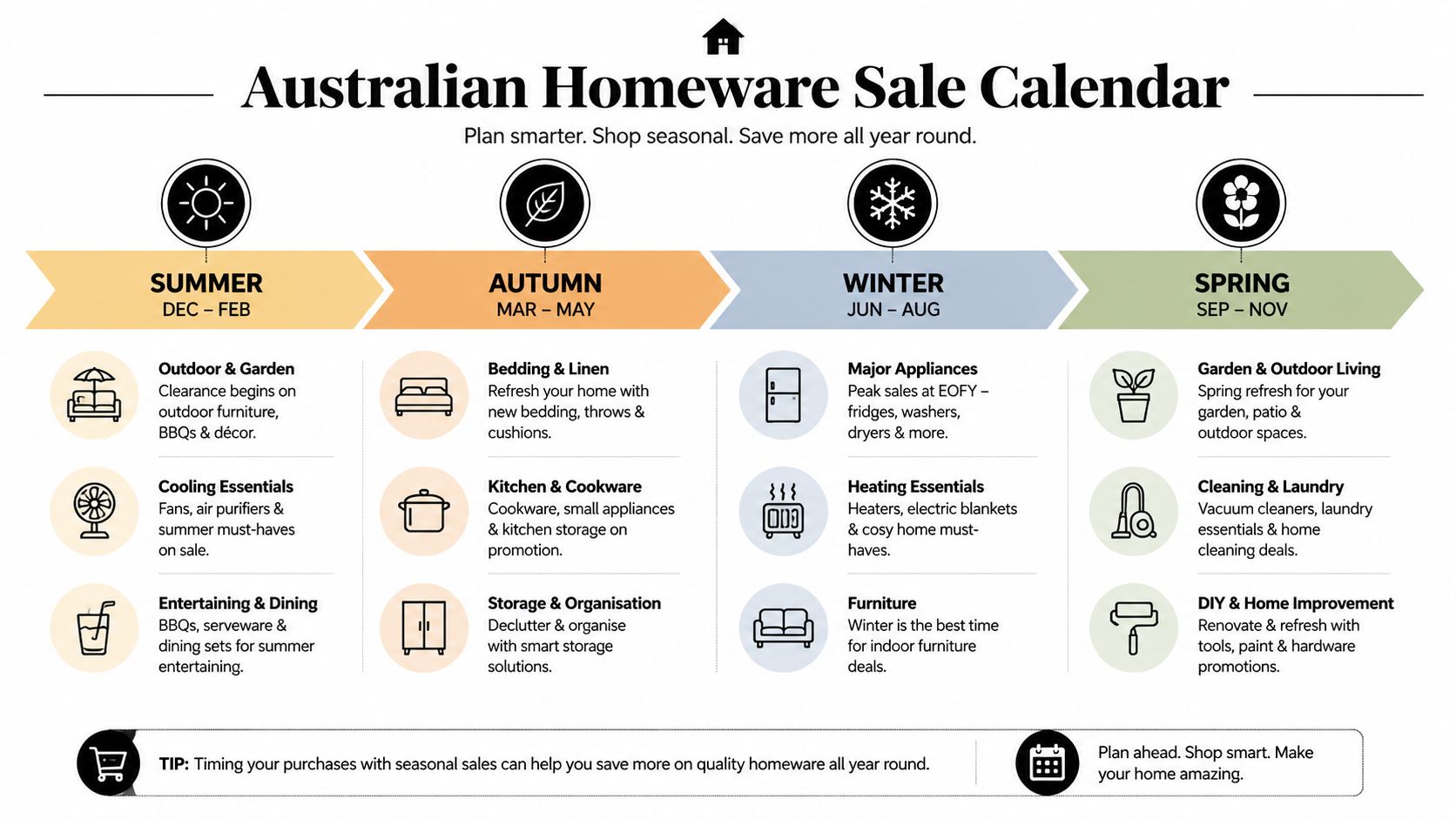
Match patience to the product
Major appliances: Start watching in June and July. EOFY is the clearest window for last year's models, floor stock and discontinued finishes. Compare specifications closely. A lower price is poor value if the older model lacks a feature you need. Use this EOFY sales guide for Australia to track broad retailer activity, then judge each model on its specifications, delivery cost and warranty.
Furniture: Watch spring stocktake from August through October, then check January after Boxing Day. Sofas, dining settings and bedroom furniture occupy valuable floor space, giving retailers a reason to move slow or superseded lines. Buy earlier for an exact size or fabric. Wait when you can accept a replacement finish.
Decorative homewares: Cushions, vases, wall art and accent pieces reward patience. January post-Christmas clearance usually beats EOFY for this category, while late February can bring further reductions as autumn ranges arrive. Colour flexibility gives you more options.
Bedding and manchester: Check May around Mother's Day, then revisit the July stocktake. Boxing Day also deserves attention for department-store bedding. Confirm dimensions, fibre content and care requirements before buying. A reduced ticket does not justify extra sets you will not use.
Outdoor furniture: March and April are the useful months as summer lines exit. Inspect timber, powder coating, cushions and packaging, particularly when considering display or ex-floor stock.
May and November are quieter buying periods. Retailers may clear specific lines without the promotional noise around EOFY, Black Friday or Boxing Day, making them useful for targeted Homeware Clearance Australia searches. Set alerts for the exact category and acceptable substitutes rather than waiting for one headline event.
For jewellery or accessories alongside a lifestyle purchase, the 18cm Diamond Set Black and White Created Sapphire Tennis Bracelet in Sterling Silver (Diamond) is described as a 2mm sterling silver bracelet with alternating black and white created sapphires and diamonds of HI colour and I2 clarity, with a total diamond weight of 0.01ct. Treat it as a separate purchase, not a reason to stretch the homeware budget.
Finding and Using Clearance Collection Pages Like a Pro
Retailers rarely place every reduced item in the same obvious menu. Dedicated collection pages are often the fastest route, especially when the URL includes /collections/. Australian examples include Madras Link's clearance collection, Salt & Pepper's clearance collection, Early Settler's clearance homewares collection and Koala AU's clearance homewares collection. Save the useful pages in a browser folder, then check them by category rather than browsing an entire site from the homepage.
Adairs describes clearance as stock from “last season's” ranges across bedroom, bathroom, furniture, homewares and kids products (Adairs clearance). Freedom's sale and clearance area groups furniture, homeware, kitchen and décor products to make room for new lines. That wording matters. It signals stock-position pressure, not necessarily a product defect.
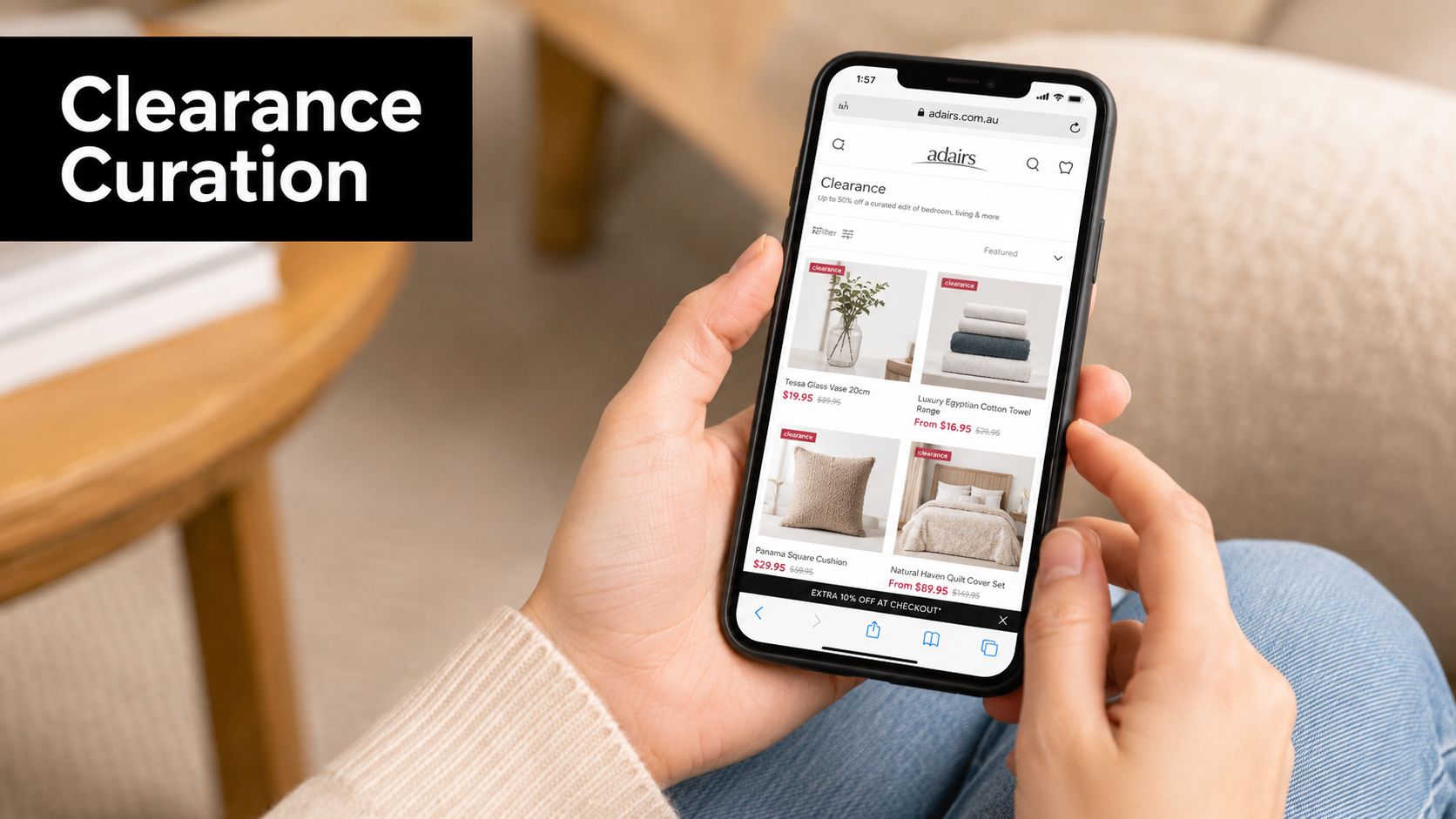
Use the page like a buying tool
Start with the retailer's category filter. Then sort by discount percentage if the site supports it, followed by stock status and delivery location. A “was/now” label tells you the displayed comparison, but it doesn't automatically prove that the reduction is final clearance. Read the wording around clearance, reduced, last chance and online-only. Each tag can imply a different stock and fulfilment position.
Discount depth varies sharply. Freedom advertises 30% off all homewares on its clearance page, while Wicka Homewares describes clearance reductions of up to 75% across overstocked sizes, flash specials and end-of-line products (Freedom clearance, Wicka Homewares clearance). Those are retailer-specific offers, not a benchmark for every store.
Before you compare prices, calculate the delivered total. Check:
- Bulky delivery: Furniture freight can erase a headline saving.
- Regional charges: Metro delivery terms may not apply to your address.
- Collection options: Click and collect can change the economics if the store is nearby.
- Threshold rules: Jardan, for example, lists free shipping on homewares over $150 in Australian metropolitan areas, subject to its terms (Jardan ex-display stock clearance).
- Stock location: A product may be available online but unavailable for local collection.
Once you know your filters, curated feeds become more practical than opening twenty retailer tabs. Online home décor deals can help you think in terms of category, retailer and discount depth, rather than reacting to whichever banner appears first.
Alerts, Filters and Price Tracking That Catch Ending-Soon Deals
The fastest bargain hunter isn't checking every site constantly. They're controlling the feed. Retailer email and SMS lists are useful for event launches, while store-app push notifications can surface short-lived stock changes. They're fast, but broad. If you subscribe to everything, your inbox becomes another shopping trap.
Third-party trackers work better for repeat purchases and known products. CamelCamelCamel can track Amazon AU and Catch listings, while browser tools such as Honey and Keepa can help with price history or checkout comparisons where supported. RSS feeds built from collection-page URLs are useful for technically minded shoppers who want new listings delivered without repeatedly visiting retailer sites.
Compare the tools by job
| Tool | Coverage | Speed of Alert | Cost | Best For |
|---|---|---|---|---|
| Retailer email | One retailer or brand | Event-led | Usually free | Major sale announcements |
| Retailer SMS | One retailer or brand | Fast | Usually free | Short promotional windows |
| Store app push | One retailer or brand | Fast | Usually free | Stock and app-only notifications |
| CamelCamelCamel | Amazon AU and Catch tracking | Product-dependent | Free option | Known products and price history |
| Honey | Supported online checkout environments | At checkout | Free | Testing available coupon codes |
| Keepa | Supported marketplace tracking | Product-dependent | Free and paid features | Price history and alerts |
| RSS from collection pages | A chosen page or feed setup | Feed-dependent | Free | Narrow, self-managed monitoring |
Filter in layers. First choose the subcategory, such as outdoor furniture or bedding. Next set a minimum discount threshold, then select in-stock products and your delivery location. Finally, exclude colours, sizes and materials you won't use. A high discount on an unsuitable item is just expensive clutter.
Retailers including Big W, Target Australia, Adairs, Temple & Webster and Myer use labels such as ending soon or limited stock in different ways. Read those labels as urgency signals, not proof of value. Compare the current price with the product's recent history when a tracker provides it.
Notification discipline: Keep retailer alerts for categories you're ready to buy, and check broader feeds on a planned cadence.
A paid tracker only makes sense if its extra history, filters or alert controls solve a recurring problem. For occasional shoppers, free retailer alerts and a small set of saved collection pages are enough. For a more event-focused approach, the Click Frenzy sales guide can sit alongside your normal clearance monitoring without replacing product-level checks.
Stacking Discounts, Returns and Warranties the Smart Way
A clearance percentage is only the first layer. The actual saving depends on whether a retailer permits an introductory code, whether cashback tracks the order, whether loyalty credit applies and whether shipping pushes the final total above your alternative price.
Start at the product page, not the checkout. Confirm that the item is eligible for the advertised code, then check the retailer's terms for clearance exclusions. After that, open your cashback portal, such as ShopBack or Cashrewards, and activate the offer before entering the store. Loyalty programmes, including Myer One or David Jones Rewards, may add value when the terms allow it, but don't treat future credit as an immediate reduction unless the checkout shows that treatment.
Separate the price layers
A conditional free-shipping threshold can help, but only if the extra item is useful. Buying unwanted filler to obtain free delivery is not saving. For furniture, compare delivery with click and collect, and include regional surcharges before declaring a deal successful.
Returns need equal attention. Clearance lines at retailers such as Freedom, Harvey Norman and Adairs may be sold on a no-change-of-mind basis when marked final sale. That doesn't remove your Australian Consumer Law rights when a product fails to meet the required consumer guarantees, but it does make fit, colour, dimensions and condition checks more important before purchase.
Appliance warranties deserve closer inspection than soft-furnishing warranties. Confirm the warranty provider, coverage period shown by the retailer, installation requirements and exclusions. For furniture and décor, inspect photos, assembly notes, damage disclosures and whether the item is ex-display or end-of-line.
| Element | Unstacked Purchase | Stacked Purchase |
|---|---|---|
| Starting item price | Clearance price only | Same clearance price |
| Extra code | Not applied | Applied only if terms permit |
| Cashback | Not activated | Activated before checkout if eligible |
| Loyalty value | Ignored | Added only according to programme terms |
| Shipping | Standard delivery or collection | Free-shipping threshold assessed against useful items |
| Final comparison | Headline price | Delivered, eligible and return-aware price |
The exact arithmetic changes with every retailer and product, so don't invent a saving before checkout. Use the price-match guarantee guide as a prompt to check eligibility, exclusions and competitor evidence, then save screenshots of the product page, terms and order confirmation.
Defensive rule: A cheap item with no return option and unclear warranty can be worse value than a slightly dearer item with transparent support.
Building a Repeatable Homeware Clearance Workflow
Clearance shopping works better as a routine than a rush. Choose three subcategories you're likely to buy, such as furniture, bedding and decorative homewares, then give each one its own alert and filter settings. Don't monitor the entire home category. That creates noise and encourages purchases that weren't in your plan.
Use a weekly rhythm:
- Sunday: Subscribe to relevant Special8 collections and review your maximum delivered spend.
- Monday: Set price-drop alerts for your three chosen subcategories.
- Tuesday: Check ending-soon labels and remove products that fail your size, colour or delivery requirements.
- Wednesday: Review newly surfaced deals and compare the current offer with retailer terms.
- Friday: Make final purchase decisions, check cashback activation and choose delivery or collection.
- After purchase: Log the headline discount, effective delivered discount, return position and warranty details.
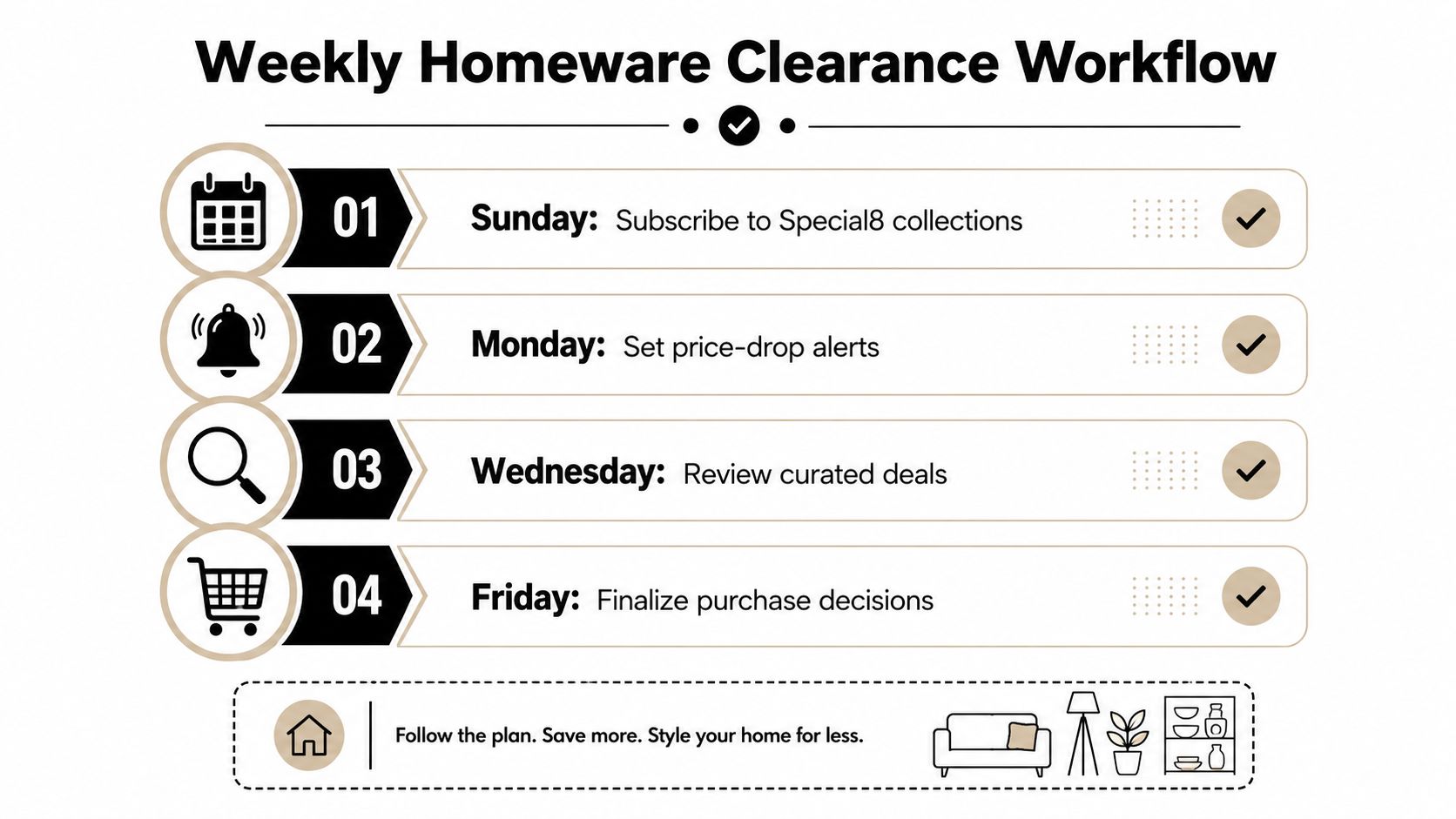
Keep the checklist short
Before ordering, confirm:
- Alert setup: The right retailer, product category and price-drop trigger are active.
- Filter preferences: You've selected in-stock status, location, acceptable materials and maximum spend.
- Cashback login: Your portal is open and the offer is activated where eligible.
- Returns: You understand whether the item is final sale or covered by change-of-mind returns.
- Warranty: Appliance coverage, installation conditions and exclusions are clear.
- Delivery: Freight, regional surcharges and collection costs are included in the comparison.
- Purchase log: You've recorded the effective price, not just the advertised markdown.
The most useful workflow is deliberately boring. It stops you from confusing urgency with value, and it gives you a repeatable way to catch end-of-line stock without waiting for the next giant EOFY banner.
Special8 brings retailer deals and curated sale collections into one place, including home and lifestyle offers alongside fashion, accessories, jewellery and other shopping categories. Visit Special8 to set up a focused clearance routine, monitor relevant collections and act when a suitable Australian deal appears instead of relying on one-off sale hype.


