
Outdoor Apparel Sale: Your Smart Shopping Playbook

You're staring at a technical jacket with a dramatic markdown, one hand on the mouse and the other checking whether your size is still available. The product photos look convincing, the sale banner is loud, and the checkout timer suggests you should decide now. But a cheap outdoor layer that doesn't fit, can't be returned, or fails to suit your actual use isn't a bargain. It's expensive clutter.
Australia's outdoor and performance clothing market is large enough to reward careful shopping. Fitness and athletic clothing stores were valued at A$4.2 billion in 2024, while sports apparel was projected to generate A$2.3 billion, or 55% of activewear retail revenue, in 2025. The same market grew at a 3.0% CAGR from 2019 to 2024, with a further 3.4% revenue increase forecast from 2025 to 2030, according to market figures published by Ken Research. There are plenty of offers, but plenty of noise too.
Table of Contents
- Why Your Next Outdoor Apparel Sale Needs a Real Strategy
- When Outdoor Apparel Sales Actually Drop
- Building an Alert Workflow That Spots Real Deals
- Stacking Coupons, Loyalty Credits and Cashback Offers
- Spotting the Discounts That Are Worth the Price
- Getting the Fit Right Before You Check Out
- Your Repeatable Outdoor Apparel Sale Buying Loop
Why Your Next Outdoor Apparel Sale Needs a Real Strategy
The tempting price is only the first number that matters. A technical shell has a specific cut, a mid-layer allowance, fabric behaviour and care requirements. Footwear has its own fit risks, while sale lines may have stricter return conditions than full-price stock. A rushed purchase can leave you paying for postage, an exchange, or a replacement item when the original doesn't work.
The sharpest deal is the item you'll keep, wear and trust outdoors.
Consider two jackets on a retailer's sale page. One has a large markdown but comes in a discontinued colour, with only irregular sizes left and no clear information about replacement parts or warranty handling. The other has a smaller reduction, a current fit, a useful colour and a return policy you can understand. The second jacket is the better buy if it becomes your dependable layer.
Australian apparel eCommerce carries a 23.1% average return rate and an 14.8% average discount rate, according to Australian apparel benchmarks from ECDB. Those figures don't tell you whether a particular jacket will fit, but they do show why discount chasing and returns are connected. A sale can trade margin for volume, while reverse logistics eats into the value when shoppers order on guesswork.
Judge the whole purchase
Before you click Add to cart, ask four questions:
- Use: Will this piece handle the activity, weather and layering system you need?
- Fit: Have you compared your measurements with the brand's chart?
- Price: Is the current price low against a genuine history, or merely labelled as reduced?
- Exit: Can you return, exchange or receive credit if the fit fails?
The rest of your buying process should answer those questions quickly. A good outdoor apparel sale workflow turns a chaotic browser session into a controlled decision, protecting your budget and keeping your gear cupboard useful rather than crowded.
When Outdoor Apparel Sales Actually Drop
Sale timing changes what you can buy, how much choice remains and whether the reduction reflects a seasonal clear-out or a useful opportunity. Australian retailers usually clear weather-specific stock as demand shifts, so the calendar gives you a starting point, not a guarantee.
End-of-summer clearances in February and March tend to suit lightweight shirts, sun layers and warm-weather trail clothing. EOFY in June can pull mid-season markdowns into view, including shells and insulation. Black Friday and Boxing Day often bring aggressive reductions, but popular sizes disappear quickly and the remaining assortment can become awkward.
The trade-off is simple. Earlier sales usually offer better size and colour choice. Later clearance periods can offer deeper reductions but weaker availability. A shoulder-season window can be particularly useful when new-season products arrive alongside leftover winter lines. That's where a shopper with a precise wishlist can compare function rather than react to the biggest red sticker.

Australian outdoor apparel sale calendar
| Sale Window | Typical Discount | Best Categories |
|---|---|---|
| February and March clearances | Seasonal reductions vary | Lightweight layers, warm-weather clothing and trail runners |
| EOFY in June | Mid-season markdowns vary | Shells, insulation and transitional layers |
| Black Friday | Often stronger reductions, with uneven size runs | Technical clothing, footwear and accessories |
| Boxing Day | Clearance-led reductions vary | End-of-line apparel and seasonal stock |
| Quieter member events | Offer structure varies by retailer | Selected brands, categories and loyalty promotions |
These windows work best when paired with a saved list. The Australian end-of-season sale guide is useful for monitoring event-led reductions, but don't confuse an event name with proof of value. A current-season shell at a moderate markdown may beat an old mid-layer at a dramatic one if the shell has the right fit, fabric and warranty support.
A casual warm-weather option such as the & Co. Ava Beach Shirt (Blue/White Stripe) sits outside the technical shell category, but its relaxed fit, cotton-linen blend and lightweight construction illustrate the same timing principle. Buy seasonal clothing when you can use it, not because the calendar says clearance.
Building an Alert Workflow That Spots Real Deals
An aggregator only saves time if you give it a narrow brief. Start by writing your gear list in plain language: waterproof shell, insulated jacket, merino base layer, hiking trousers or trail footwear. Add preferred brands, your size and acceptable colours. “Outdoor clothing” is too broad. “Women's medium waterproof shell in black or navy” is useful.
Special8 is one option for this workflow. It aggregates offers across fashion, footwear, accessories, jewellery and lifestyle retailers, with categories, brands and sale events that help shoppers narrow discovery. Use the online clothing sales guide as a reference point, then build searches around the items you'd buy at full price.

Create filters that remove noise
Set up separate saved searches for competing retailers rather than one sprawling alert. Keep a premium tier for exact matches, a practical tier for acceptable substitutes and a watch tier for items that need a lower price before they become interesting.
A weekly digest is usually more useful than constant interruptions. Reserve one short review slot, open the listings, check the current size run and reject anything that fails your original brief. The objective isn't to inspect every new offer. It's to make the right items easy to recognise.
Open the retailer's product page before paying. Confirm that the displayed size is available, inspect fabric and activity details, read the sale return terms and compare the price chart if the platform provides one. A listing can look attractive in an aggregator feed while the retailer page reveals a missing size, a changed product variant or an exclusion that blocks the promotion.
For a visual break from the scanning routine, use this short outdoor shopping reference:
Practical rule: Alerts should find candidates. The retailer page should make the final decision possible.
Stacking Coupons, Loyalty Credits and Cashback Offers
Stacking is arithmetic, not a personality trait. Begin with the listed sale price and treat it as your baseline. Then test each benefit separately, because a promotion that sounds compatible may exclude reduced stock, require a minimum spend or cancel cashback tracking.
For a hypothetical $300 jacket, the useful comparison looks like this:
| Method | Layers Used | Final Price | Net Saving |
|---|---|---|---|
| No stack | Sale price only | $300 | $0 |
| Welcome offer | Sale price plus first-order code | Depends on code terms | Depends on code terms |
| Loyalty credit | Sale price plus available account credit | Depends on credit balance | Depends on credit balance |
| Percentage coupon | Sale price plus eligible coupon | Depends on rate and exclusions | Depends on rate and exclusions |
| Cashback | Sale price plus valid portal or card-linked offer | Depends on tracked offer | Depends on tracked offer |
| Combined stack | Eligible coupon, fixed credit and valid cashback | Depends on all conditions | Depends on all conditions |
The table stays deliberately honest. No coupon rate, credit value or cashback amount belongs in the calculation until you've checked the live terms. A discount can be mathematically attractive but practically useless if the code excludes sale lines or pushes you into buying something unnecessary to reach a threshold.
Sequence the stack carefully
Apply the largest eligible percentage reduction first. Add fixed-dollar loyalty credits after that, then confirm cashback or a card-linked offer at payment. Keep screenshots or notes of the offer terms, especially when the retailer uses a separate code field and the cashback service has exclusions.
Watch for three common traps:
- Expired loyalty credits: A balance may lapse before you can use it during the sale.
- Sale exclusions: Reduced jackets, base layers or outlet lines may be excluded from a welcome code.
- Tracking conflicts: Certain coupon codes can void cashback eligibility.
The discount code guide from Special8 can help you identify available offers, but the retailer's terms control the transaction. If a stack makes you buy a poor-fit item, the saving is irrelevant.
Spotting the Discounts That Are Worth the Price
A 70% markdown isn't automatically a 70% win. The percentage only describes the gap between two displayed prices. It doesn't prove that the original price was a useful benchmark, that the product suits your needs or that you can resolve a sizing problem after purchase.
Run three checks before checkout. First, compare the current price with a historical chart covering the available record, whether that's a shorter recent view or a longer annual view. A price that rose before being reduced deserves suspicion. Second, inspect the product lifecycle. Discontinued colourways, prior-season labels and unavailable replacement components can reduce practical value. Third, read the returns policy line by line. Sale items may be non-refundable and limited to exchange or store credit, as shown in a neutral Australian retailer example discussed in coverage of outdoor gear trends and sale-purchase risk.
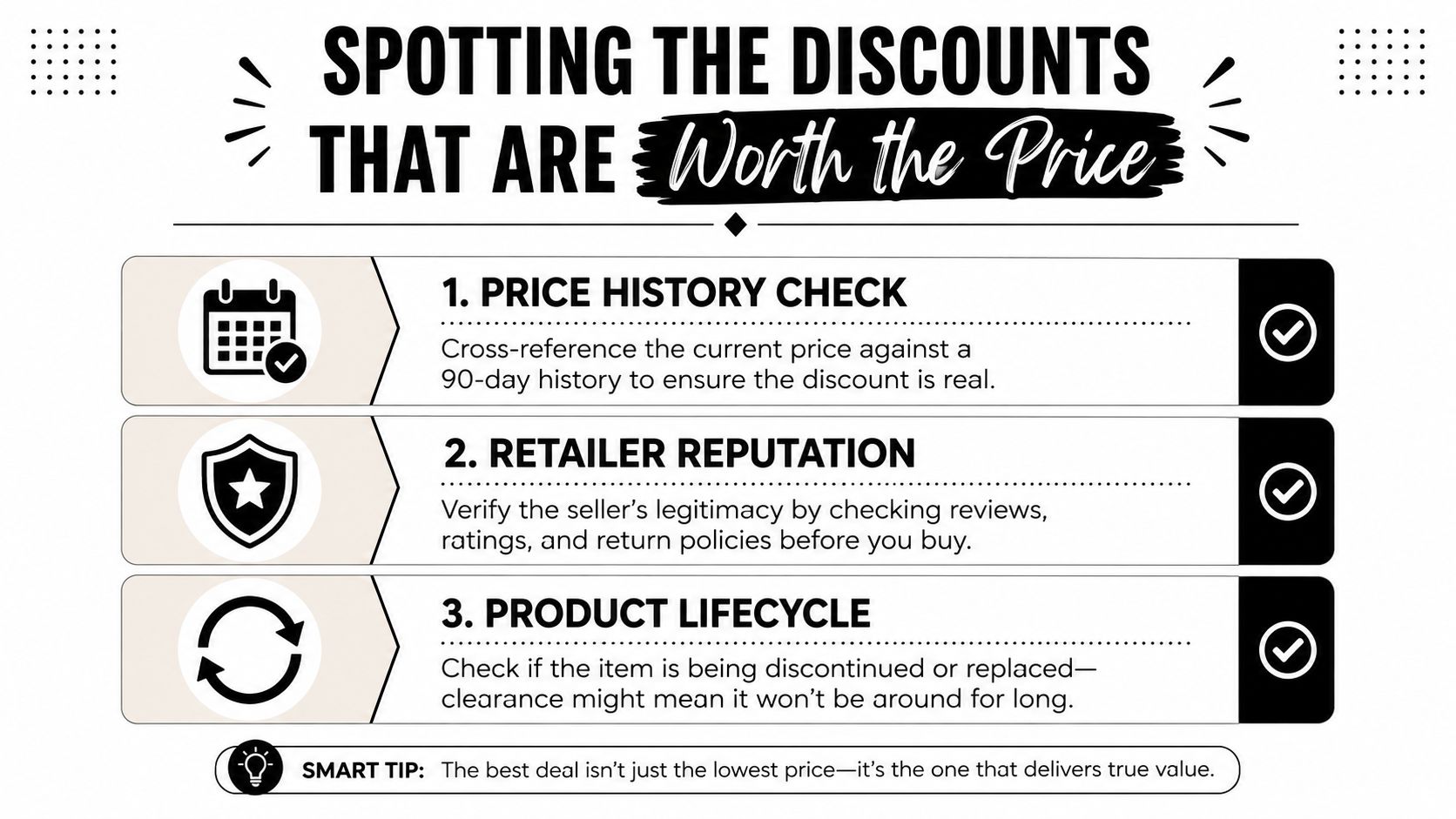
Compare utility, not sticker drama
A current-season shell at a modest reduction may deliver more value than a heavily reduced end-of-line mid-layer. The shell might offer the construction, colour, warranty pathway and availability you need, while the mid-layer's lower price reflects a product you'll struggle to replace or return.
Use the rule of three:
- Price history passes: The current amount is low against the recorded price.
- Condition and lifecycle pass: The item isn't compromised by damage, missing components or an unsuitable end-of-line status.
- Returnability passes: You understand the policy and can manage the fit risk.
Require at least two of the three checks to pass. For technical apparel, I'd require all three unless the item is inexpensive enough that a failed fit won't create financial stress. The activewear sale guide can help surface category offers, but discovery is not verification.
A deep markdown on unusable gear is just a cheaper mistake.
Getting the Fit Right Before You Check Out
Sale shopping punishes lazy sizing. Don't rely on the label you remember from another brand, because outdoor garments vary in cut, intended layering and movement allowance.
Start with a short body scan and write the results in a note on your phone. Record your chest, waist, hip, inseam and sleeve measurements. Keep them beside the brand's size chart while you shop, not in your memory where old figures and optimistic guesses can interfere.
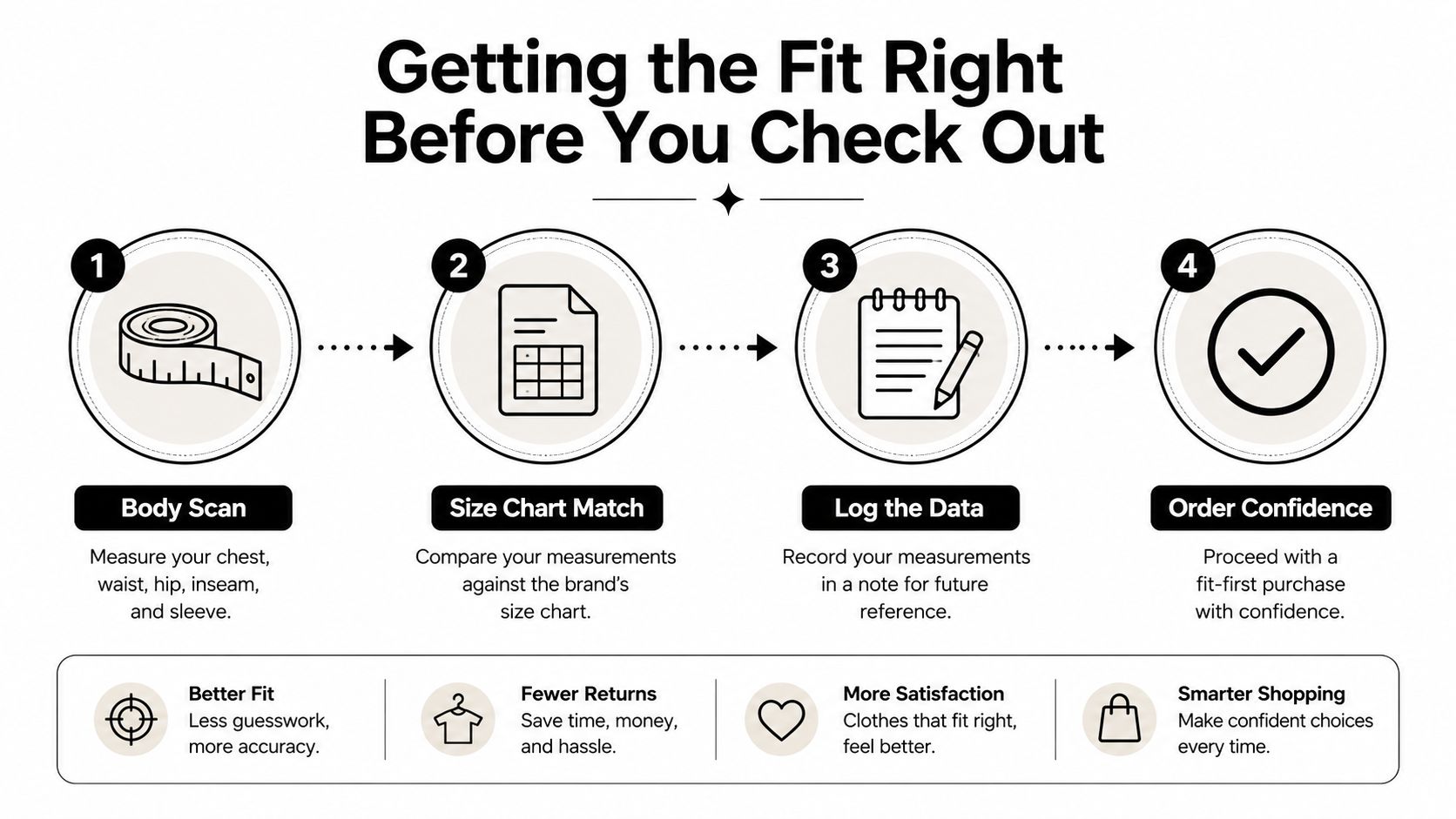
Match the measurement to the garment
A shell jacket needs room for the mid-layer you'll wear beneath it. Chest measurement and shoulder movement matter more than choosing your usual letter size. Lift your arms, rotate your shoulders and check whether the hem rides up if the product page provides useful garment information.
Base layers should sit close enough to manage moisture and movement without restricting shoulder rotation or breathing. For trousers, compare the inseam and waist with a pair you already wear successfully. Lay that favourite garment flat and measure it, then compare those dimensions with the listed garment measurements.
Footwear needs a separate routine. Leave roughly a thumb-width of toe room, then perform a heel-lock test with the laces tightened as they would be for a hike. If you can't test the shoe in person, study user-uploaded photos and detailed fit comments instead of trusting polished studio images alone.
The clothing measurement guide is a practical reference for recording your starting measurements. Before you pay, confirm the numbers, confirm the layering allowance and confirm that the return window is still active if the size fails. Sale rules can make a wrong guess more expensive than a smaller discount on an item with clearer after-sale options.
Your Repeatable Outdoor Apparel Sale Buying Loop
The best buying system is short enough to use every time. Run four checks for each item, and don't let a countdown banner replace them.
Calendar check: Is this the right seasonal window for the product? A warm-weather layer can make sense in a summer clearance, while insulation and shells need a different timing decision. Treat the event as context, not proof that the price is exceptional.
Alert check: Does the listing match your wishlist, preferred brand and size? If it doesn't, dismiss it. A saved search should reduce temptation, not deliver a fresh stream of unrelated products.
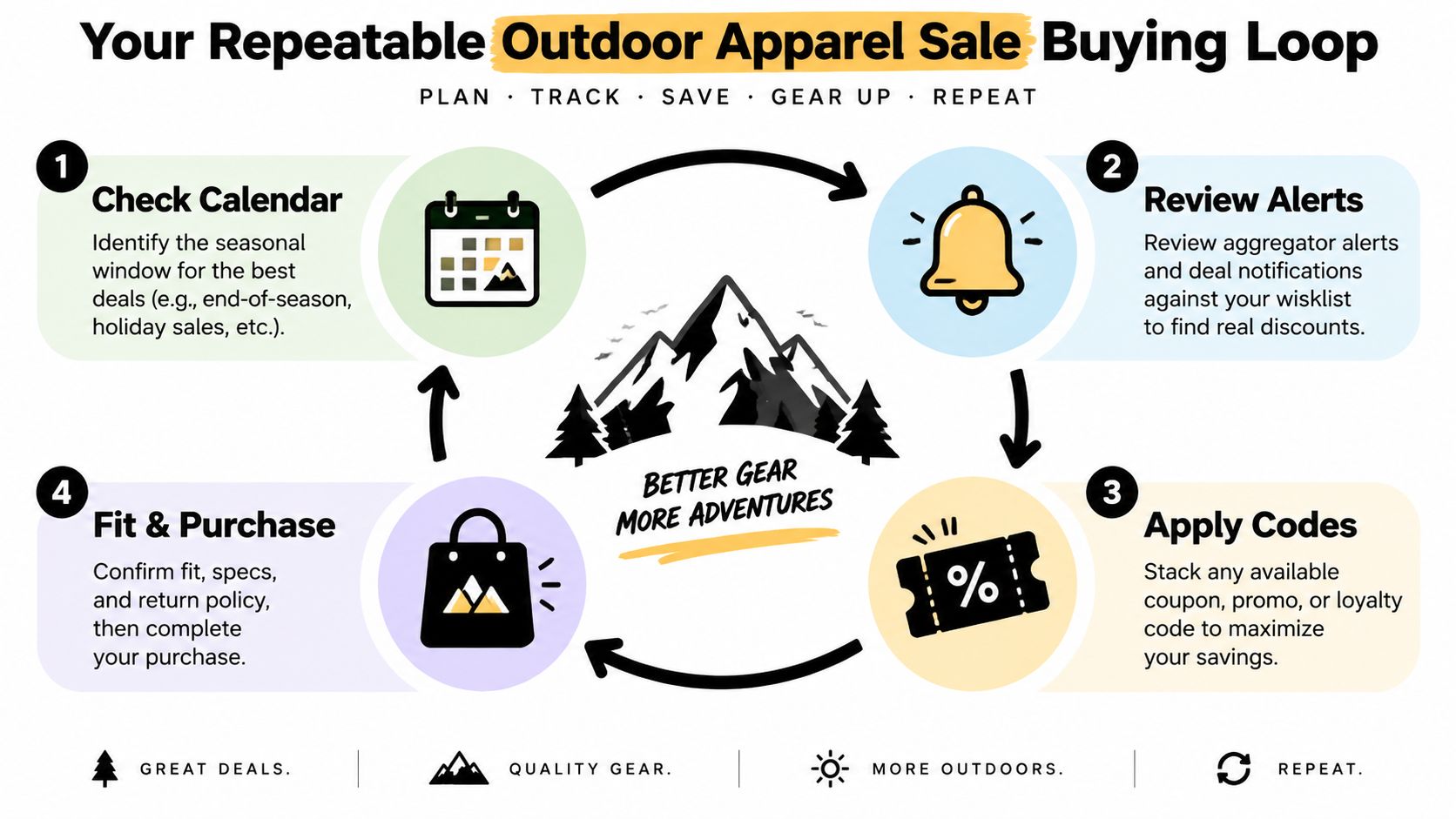
Code check: Test the eligible coupon, loyalty credit and cashback option against the no-stack price. Confirm exclusions and minimum spends before you add anything else to the cart. If the stack requires an unnecessary purchase, abandon the stack.
Fit and price check: Compare your measurements, layering needs and footwear fit routine with the product page. Check the price history, lifecycle and returns policy, then record the final price you paid in your personal gear note.
That final record becomes your own benchmark. You'll recognise whether a future markdown is meaningfully better, merely familiar or too high for an older version. The loop works for end-of-season clearance, mid-season flash sales and member-only drops because the verification stays the same even when the event changes.
Set up your first precise outdoor apparel sale alert today, then let the loop run instead of relying on memory.
Special8 aggregates daily fashion, footwear, accessories, jewellery and lifestyle offers from Australian retailers, including sale events and outlet markdowns. Visit Special8 to monitor outdoor clothing opportunities, compare relevant categories and act on a deal only after it passes your price and fit checks.


